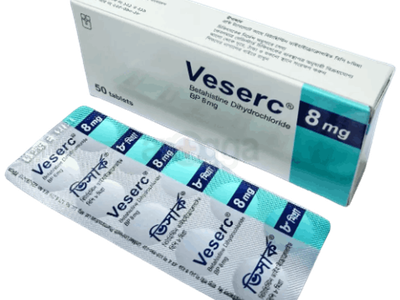
Veserc 8 8 mg
Betahistine Dihydrochloride
Category: Tablet
Manufacturer: Unimed Unihealth Pharmaceuticals Ltd.

Unimed Unihealth Pharmaceuticals Ltd.
Allopathic
MFG. Licence No. Biological
219
MFG. Licence No. Non-Biological
121
Address
Bishaya Kuri Bari, Gazipur
Price: 27.01 ৳
Strip

Medicine Selling service is not available yet.
Related Medicines

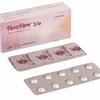
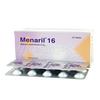
Uses of Veserc 8:
- Meniere's disease
Meniere's disease, tinnitus and/or progressive loss of hearing, vertigo, dizziness.
Phaeochromocytoma. Porphyria.
Drugs used in meniere's diseases
Betahistine acts as both partial histamine H1-receptor agonist and histamine H3-receptor antagonist in neuronal tissue. It improves the microcirculation in the labyrinth, thus reducing endolymphatic pressure.
How to use
Betahistine Dihydrochloride:
Take this medicine in the dose and duration as advised by your doctor. Swallow it as a whole. Do not chew, crush or break it.
Betahistine Dihydrochloride may be taken with or without food, but it is better to take it at a fixed time.
Administration:
Should be taken with food.
Adult Dose:
Adult: Initially, 8-16 mg tid. Maintenance: 24-48 mg daily.
May antagonise antihistamines. May decrease bronchodilator effects of beta-2 agonists.
Phaeochromocytoma. Porphyria.
Common
- Headache
- Nausea
Rash, pruritus, urticaria, dyspepsia, nausea, peptic ulcer disease, headache, dizziness, insomnia.
Pregnancy: There is a very limited amount of data from the use of betahistine in pregnant women. Animal studies, though insufficient do not indicate direct or indirect harmful effects with respect to reproductive toxicity . As a precautionary measure, it is preferable to avoid the use of Betahistine during pregnancy. Lactation: There is insufficient information on the excretion of betahistine in human milk. Betahistine should not be used during breast-feeding.
Precaution:
Active peptic ulcer, bronchial asthma, pregnancy and lactation.
Symptoms: Nausea, somnolence, abdominal pain, convulsion, pulmonary or cardiac complications. Management: Supportive treatment.
Keep below 30°C temperature, away from light & moisture. Keep out of the reach of children.
Drugs used in meniere's diseases
Betahistine improves the microcirculation in the labyrinth which reduces endolymphatic pressure.
In Pregnancy: The safety of Betahistine in human pregnancy has not been completely established, although there is no known teratogenic effect in animals. A careful assessment of potential benefits should be made before prescribing Betahistine in pregnancy.In Lactation: Betahistine is excreted in the breast milk of nursing mothers in concentrations similar to those found in plasma. Toxicity to the neonate at these concentrations is not known.


Samm Care