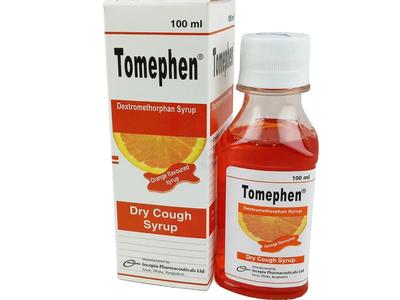
Uses of Tomephen:
- Dry cough
Cough suppression, Flu, Common cold
Hypersensitivity to Dextromethorphan or any other component.
Cough suppressant
Dextromethorphan suppresses the cough reflex by a direct action on the cough center in the medulla of the brain. Dextromethorphan shows high affinity binding to several regions of the brain, including the medullary cough center. This compound is an NMDA receptor antagonist and acts as a non-competitive channel blocker. It is one of the widely used antitussives, and is also used to study the involvement of glutamate receptors in neurotoxicity.
How to use
Dextromethorphan Hydrobromide:
Take this medicine in the dose and duration as advised by your doctor. Check the label for directions before use. Measure it with a measuring cup and take it by mouth. Shake well before use.
Dextromethorphan Hydrobromide may be taken with or without food, but it is better to take it at a fixed time.
Administration:
May be taken with or without food.
Adult Dose:
Oral
Cough suppressant
Adults (>12 years of age): 10-20 mg (1-2 teaspoonful) every 4 hours, or 30 mg (3 teaspoonful) every 6-8 hours.
Do not exceed 120 mg (12 teaspoonful) in 24 hours.
Child Dose:
Oral
Cough suppressant
Children
6 to 12 years of age: 5-10 mg (1/2-1 teaspoonful) every 4 hours, or 15 mg (11/2 teaspoonful) every 6-8 hours. Do not exceed 60 mg (6 teaspoonful) in 24 hours.
2 to 6 years of age: 2.5-5 mg (1/4-1/2 teaspoonful) every 4 hours, or 7.5 mg (3/4 teaspoonful) every 6-8 hours. Do not exceed 30 mg (3 teaspoonful) in 24 hours.
<2 years of age: Use only as directed by the physician.
Pregnancy: Adequate and well-controlled studies in human have not been done. However, Dextromethorphan has not been reported to cause birth defects. Lactation: It is not known whether dextromethorphan passes into breast milk. However, Dextromethorphan has not been reported to cause problems in nursing babies.
Precaution:
Do not use Dextromethorphan to control a cough that is associated with smoking, asthma, or emphysema, or a cough that is productive (produces sputum or phlegm).
Lactation: Not known if excreted in breast milk; use caution
Symptoms: In mild overdose, tachycardia, hypertension, vomiting, mydriasis, diaphoresis, nystagmus, euphoria, loss of motor coordination, and giggling; in moderate intoxication, in addition to those listed above, hallucinations and a plodding ataxic gait; in severely intoxication, agitation or somnolence. Management: treatment is symptomatic and supportive. Naloxone may be useful in reversing toxicity.
Store at 15-30° C
Cough suppressant
Dextromethorphan is a centrally acting cough suppressant which acts on the cough centre in the medulla.
Pregnancy category: C
Lactation: Not known if excreted in breast milk; use caution