
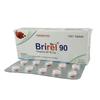
Ticarel 60 mg
Ticagrelor
Category: Tablet
Manufacturer: Incepta Pharmaceuticals Ltd.

Allopathic
MFG. Licence No. Biological
193
MFG. Licence No. Non-Biological
108
Address
Zirabo, Savar, Dhaka Dewan Idris Road, Bara Rangamatia
Price: 1000.0 ৳
20's Pack
10's Strip

Medicine Selling service is not available yet.
Related Medicines

Uses of Ticarel:
- Prevention of heart attack and stroke
- Heart attack
Prevention of thrombotic events, [cardiovascular death (CV), myocardial infarction (MI) and stroke] in patients with acute coronary syndromes (ACS) [unstable angina, non-ST elevation myocardial infarction (NSTEMI) or ST elevation myocardial infarction (STEMI)]; including patients managed with percutaneous coronary intervention (PCI), coronary artery bypass grafting (CABG).
History of Intracranial Hemorrhage: Ticagrelor is not recommended in patients with a history of intracranial hemorrhage (ICH) due to a high risk of recurrent ICH in this population. Active Bleeding: Patients with active pathological bleeding eg, peptic ulcer or intracranial hemorrhage.
Severe Hepatic Impairment: Patients with severe hepatic impairment because of a probable increase in exposure, and it has not been studied in these patients. Severe hepatic impairment increases the risk of bleeding because of reduced synthesis of coagulation proteins.
Hypersensitivity (eg, angioedema) to ticagrelor or to any of the components.
Anti-platelet drugs
Ticagrelor is a selective adenosine diphosphate (ADP) receptor antagonist acting on the P2Y12 ADP-receptor that can prevent ADP-mediated platelet activation and aggregation. Ticagrelor reversibly interacts with the platelet P2Y12 ADP-receptor.Ticagrelor does not interact with the ADP binding site itself, but interacts with platelet P2Y12 ADP-receptor to prevent signal transduction.Thus it prevents platelet activation & aggregation.
How to use
Ticagrelor:
Take this medicine in the dose and duration as advised by your doctor. Swallow it as a whole. Do not chew, crush or break it.
Ticagrelor may be taken with or without food, but it is better to take it at a fixed time.
Administration:
May be taken with or without food.
Adult Dose:
Oral
Acute coronary syndrome
Adult:
Loading dose (following ACS event): 180 mg PO (two 90 mg tablets)
Maintenance dose (for first year following ACS event): 90 mg PO BID
Maintenance dose (after 1 year with history of MI): 60 mg PO BID
Administer with aspirin: Initial aspirin loading dose of 325 mg, then maintenance dose of aspirin of 75-100 mg/day; DO NOT exceed aspirin dose of 100 mg/day.
Hepatic Impairment Moderate to severe: Contraindicated.
Renal Dose:
Renal impairment
No dosage adjustment needed
Aminocaproic acid or tranexamic acid &/or recombinant clotting factor VIIa may augment haemostatis. NSAIDs, oral anticoagulants &/or fibrinolytics, ketoconazole, clarithromycin, nefazodone, ritonavir, atazanavir, rifampin, dexamethasone, phenytoin, carbamazepine, phenobarb, simvastatin >40 mg, digoxin. Increased Cmax & AUC w/ cyclosporine.
History of Intracranial Hemorrhage: Ticagrelor is not recommended in patients with a history of intracranial hemorrhage (ICH) due to a high risk of recurrent ICH in this population. Active Bleeding: Patients with active pathological bleeding eg, peptic ulcer or intracranial hemorrhage.
Severe Hepatic Impairment: Patients with severe hepatic impairment because of a probable increase in exposure, and it has not been studied in these patients. Severe hepatic impairment increases the risk of bleeding because of reduced synthesis of coagulation proteins.
Hypersensitivity (eg, angioedema) to ticagrelor or to any of the components.
Common
- Bleeding
- Breathlessness
>10%
Dyspnea (13.8%),Bleeding
1-10%
Headache (6.5%),Cough (4.9%),Dizziness (4.5%),Nausea (4.3%),Atrial fibrillation (4.2%),Hypertension (3.8%),Noncardiac chest pain (3.7%),Diarrhea (3.7%),Back pain (3.6%),Hypotension (3.2%),Fatigue (3.2%),Chest pain (3.1%),Syncope (1.7%)
<1%
Dyspena (0.9%)
Bleeding
Non-CABG related bleeds
Total bleeds (major + minor) (8.7%)
Major bleeds (4.5%)
Fatal/life-threatening (2.1%)
Fatal (0.2%)
Intracranial (fatal/life-threatening) (0.3%)
CABG related bleeds
Total major bleeds (85.8%)
Major bleeds when antiplatelet therapy stopped 5 days before CABG (75%)
Fatal/life-threatening (48.1%)
Fatal (0.9%)
Pregnancy category C. There are no or limited amount of data from the use of Ticagrelor in pregnant women.Ticagrelor is not recommended during pregnancy.Nursing mothers: Available pharmacodynamic/toxicological data in animals have shown excretion of Ticagrelor and its active metabolites in milk. A risk to newborns/infants cannot be excluded. A decision must be made whether to discontinue breastfeeding or to discontinue/abstain from ticagrelor therapy taking into account the benefit of breastfeeding for the child and the benefit of therapy for the women.
Precaution:
Patients w/ increased risk of bleeding (e.g. patients who are likely to undergo surgery or invasive procedures). Patients at risk of bradycardic events; w/ history of asthma or COPD, hyperuricaemia or gouty arthritis. Pregnancy and lactation.
Lactation: Unknown whether distributed in human breast milk; potential for serious adverse reactions in breastfed infants, a decision should be made whether to discontinue nursing or to discontinue drug, taking into account the importance of the drug to the mother
There is currently no known antidote to reverse the effects ofTicagrelor and it is not expected to be dialysable.Treatment of overdose should follow local standard medical practice.The expected effect of excessive ticagrelor dosing is prolonged duration of bleeding risk associated with platelet inhibition. If bleeding occurs appropriate supportive measures should be taken.
Protect from light & moisture. Store below 25° C. Keep out of reach of children.
Anti-platelet drugs
Ticagrelor and its major metabolite reversibly interact with the platelet P2Y12 ADP-receptor to prevent signal transduction and platelet activation. Ticagrelor and its active metabolite are approximately equipotent.
Pregnancy category C. There are no or limited amount of data from the use of Ticagrelor in pregnant women.Ticagrelor is not recommended during pregnancy.Nursing mothers: Available pharmacodynamic/toxicological data in animals have shown excretion of Ticagrelor and its active metabolites in milk. A risk to newborns/infants cannot be excluded. A decision must be made whether to discontinue breastfeeding or to discontinue/abstain from ticagrelor therapy taking into account the benefit of breastfeeding for the child and the benefit of therapy for the women.

Samm Care