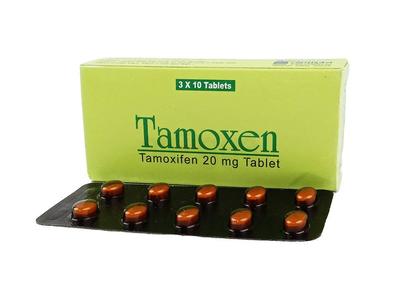
Tamoxen 20 mg
Tamoxifen
Category: Tablet
Manufacturer: General Pharmaceuticals Ltd.

Allopathic
MFG. Licence No. Biological
162
MFG. Licence No. Non-Biological
406
Address
Kaliakair, Gazipur
Price: 144.9 ৳
Strip

Medicine Selling service is not available yet.
Related Medicines

Uses of Tamoxen:
- Breast cancer
Breast cancer
History of DVT or pulmonary embolism. Pregnancy and lactation. Concomitant coumarin-type anticoagulant therapy.
How to use
Tamoxifen:
Take this medicine in the dose and duration as advised by your doctor. Swallow it as a whole. Do not chew, crush or break it.
Tamoxifen may be taken with or without food, but it is better to take it at a fixed time.
Administration:
May be taken with or without food.
Adult Dose:
Oral
Breast Cancer Treatment
20 mg daily as a single or in 2 divided doses. Max: 40 mg daily.
Continue with adjuvant therapy for at least 5 years
For women with ER-positive disease, continuing tamoxifen to 10 years rather than stopping at 5 years produces a further reduction in recurrence and mortality, particularly after year 10
Breast Cancer Prevention
Indicated to reduce the incidence of breast cancer in women at high risk for breast cancer; high risk is defined as women aged >35 years with a 5-year predicted risk of breast cancer >1.67% (calculated by the Gail Model)
Adult: 20 mg daily for 5 yr.
Data are limited for use >5 yr in the risk-reduction setting
Anovulatory infertility
Adult: 20 mg daily on days 2-5 of the menstrual cycle, increase if necessary in subsequent cycles. Max: 80 mg daily. Women w/ irregular menstruation: Initial course may begin on any day and a 2nd course may start 45 days later.
Increases dopaminergic effect of bromocriptine. Increased risk of thromboembolic events w/ cytotoxic drugs. Increased risk of bleeding w/ platelet aggregation inhibitors. May mutually reduce effects w/ hormone preparations particularly oestrogens (e.g. OCs). Reduced plasma levels w/ CYP3A4 inducers (e.g rifampicin) and CYP2D6 inhibitors. Increased plasma levels w/ CYP3A4 inhibitors.
Potentially Fatal: Significant increase in anticoagulant effect w/ coumarin-type anticoagulants (e.g. warfarin).
History of DVT or pulmonary embolism. Pregnancy and lactation. Concomitant coumarin-type anticoagulant therapy.
Common
- Nausea
- Skin rash
- Hot flashes
- Thinning of hair
- Vaginal discharge
- Swelling
>10%
Hot flashes (64%),Vaginal discharge (30%),Amenorrhea (16%),Menstrual changes (13%)
1-10%
Oligomenorrhea (9%),Cataracts (8%),Bone pain (6%),Nausea (5%),Cough (4%),Edema (4%),Fatigue (4%),Musculoskeletal pain (3%),Ovarian cyst (3%),Depression (2%),Abdominal cramps (1%),Anorexia (1%)
<1%
Angioedema,Corneal changes,Loss of libido,Endometrial cancer,Pancreatitis,Retinal vein thrombosis,Stroke,Uterine fibroids
Potentially Fatal: Blood dyscrasias, cholestasis, hepatitis, hypercalcaemia in patients with bone metastasis, thromboembolic events. Increased risk of endometrial cancer and uterine sarcoma.
Precaution:
Patient w/ leucopenia and thrombocytopenia, hyperlipidaemias. Monitoring Parameters Perform periodic CBC (e.g. platelet counts) and LFTs. Routine gynaecological monitoring and any abnormal symptoms (e.g. abnormal vag bleeding or discharge, pelvic pain, menstrual irregularities).
Lactation: not known if excreted in breast milk, do not nurse
Tamoxifen, a triphenylethylene derivative, produces a nuclear complex by competitively binding to oestrogen receptors on tumours and other tissue targets thus, decreasing DNA synthesis and inhibiting oestrogen effect. It is only cytostatic rather than cytotoxic due to accumulation of cell in G0 and G1 phases.


Samm Care