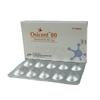
Tagrix 80 mg
Generic: Osimertinib
Category: Tablet
Manufacturer: Beacon Pharmaceuticals Ltd.

Price: 78000.0 ৳
30's pack
piece

Medicine Selling service is not available yet.
Alternative Brands & Related Medicines

Indications
Uses of Tagrix:
- Non-small cell lung cancer
Non-small Cell Lung Cancer,
Indicated for the treatment of patients with metastatic epidermal growth factor receptor (EGFR) T790M mutation-positive non-small cell lung cancer (NSCLC)
None
Therapeutic Class
Cytotoxic Chemotherapy
Pharmacology
Osimertinib is an epidermal growth factor receptor (EGFR) tyrosine kinase inhibitor (TKI) that binds to certain mutant forms of EGFR (T790M, L858R, and exon 19 deletion) that predominate in non-small cell lung cancer (NSCLC) tumours following treatment with first-line EGFR-TKIs. As a third-generation tyrosine kinase inhibitor, osimertinib is specific for the gate-keeper T790M mutation which increases ATP binding activity to EGFR and results in poor prognosis for late-stage disease. Furthermore, osimertinib has been shown to spare wild-type EGFR during therapy, thereby reducing non-specific binding and limiting toxicity.
Dosage and Administration
How to use
Osimertinib:
Take this medicine in the dose and duration as advised by your doctor. Swallow it as a whole. Do not chew, crush or break it.
Osimertinib may be taken with or without food, but it is better to take it at a fixed time.
Administration:
May be taken with or without food: Take at the same time each day. Swallow whole, do not crush/split/chew.
For patients w/ swallowing difficulties, tab may be dispersed in 50 mL non-carbonated water & stir w/o crushing until dispersed. Drink immediately. Rinse glass w/ another ½ glass of water & drink. Dispersed liqd may also be administered via nasogastric tube by using 15 mL for initial dispersion & 15 mL for residue rinses. The tube should be flushed w/ water after administration. Soln should be administered w/in 30 min of the addition of tab to water.
Adult Dose:
Non-small Cell Lung Cancer
80 mg once daily.
Hepatic impairment
Mild (TB Child Dose:
Safety and efficacy not established
Renal Dose:
Renal impairment
Mild-to-moderate (CrCl 30-89 mL/min): No dose adjustment required
Severe or ESRD (CrCl <30 mL/min): There is no recommended dose
Interaction
Decreased exposure w/ strong CYP3A4 inducers (eg, phenytoin, rifampicin, carbamazepine, St. John's wort). May increase AUC & Cmax of rosuvastatin. May increase the exposure of BCRP substrates. Decreased AUC & Cmax of simvastatin.
Contraindications
None
Side Effects
Common
- Diarrhea
- Loss of appetite
- Rash
- Stomatitis (Inflammation of the mouth)
>10%
Lymphopenia (63%),Thrombocytopenia (54%),Anemia (44%),Diarrhea (42%),Rash (41%),Neutropenia (33%),Dry skin (31%),Hyponatremia (26%),Nail toxicity (25%),ypermagnesemia (20%),Eye disorders (18%),Nausea (17%),Decreased appetite (16%),Constipation (15%),Pruritus (14%),Fatigue (14%),Cough (14%),Back pain (13%),Stomatitis (12%)
1-10%
Headache (10%),Venous thromboembolism (7%),Pneumonia (4%),Interstitial lung disease/pneumonitis (3.3%),QTc increased from baseline >60 msec (2.7%),Cardiomyopathy (1.4%)
<1%
Keratitis
Pregnancy And Lactation
Use in Pregnancy: There are no or limited amount of data from the use of Osimertinib in pregnant women. Studies in animals have shown reproductive toxicity. Based on its mechanism of action and preclinical data, Osimertinib may cause foetal harm when administered to a pregnant woman. Administration of osimertinib to pregnant rats was associated with embryolethality, reduced foetal growth and neonatal death at exposures similar to what is expected in humans. Osimertinib is not recommended during pregnancy and in women of childbearing potential not using contraception.Use in Lactation: It is not known whether osimertinib or its metabolites are excreted in human milk. Administration to rats during gestation and early lactation was associated with adverse effects, including reduced growth rates and neonatal death. There is insufficient information on the excretion of osimertinib or its metabolites in animal milk. A risk to the suckling child cannot be excluded. Breast-feeding should discontinue during treatment with Osimertinib.Fertility: There are no data on the effect of Osimertinib on human fertility. Results from animal studies have shown that Osimertinib has effects on male and female reproductive organs and could impair fertility
Precautions And Warnings
Precaution:
Determine EGFR T790M mutation status prior to treatment. Interstitial lung disease (eg, pneumonitis). Avoid use in patients w/ congenital long QT syndrome. Severe & end-stage renal impairment. May affect ability to drive or operate machinery.
Women of childbearing potential not using contraception. Use effective contraception for at least 6 wk for females & 4 mth for males. Not recommended during pregnancy. Lactation.
Based on its mechanism of action and animal data, Osimertinib can cause fetal harm when administered to a pregnant woman. There are no available data on Osimertinib use in pregnant women. Pregnant women should be advised of the potential risk to a fetus.
There are no data on the presence of Osimertinib in human milk, the effects of Osimertinib on the breastfed infant or on milk production. Lactating woman should be advised not to breastfeed during treatment.
Storage Conditions
Store Osimertinib at room temperature between 20°C to 25°C. Safely throw away medicine that is out of date or that you no longer need. Keep Osimertinib and all medicines out of the reach of children.
Drug Classes
Cytotoxic Chemotherapy
Mode of Action
Osimertinib is kinase inhibitor of the epidermal growth factor receptor (EGFR), which binds irreversibly to certain mutant forms of EGFR (T790M, L858R, and exon 19 deletion) at approximately 9-fold lower concentrations than wild-type. In cultured cells and animal tumor implantation models, osimertinib exhibited anti-tumor activity against non-small cell lung cancer (NSCLC) lines harboring EGFR-mutations (T790M/L858R, L858R, T790M/exon 19 deletion, and exon 19 deletion) and, to a lesser extent, wild-type EGFR amplifications.
Pregnancy Category
Use in Pregnancy: There are no or limited amount of data from the use of Osimertinib in pregnant women. Studies in animals have shown reproductive toxicity. Based on its mechanism of action and preclinical data, Osimertinib may cause foetal harm when administered to a pregnant woman. Administration of osimertinib to pregnant rats was associated with embryolethality, reduced foetal growth and neonatal death at exposures similar to what is expected in humans. Osimertinib is not recommended during pregnancy and in women of childbearing potential not using contraception.Use in Lactation: It is not known whether osimertinib or its metabolites are excreted in human milk. Administration to rats during gestation and early lactation was associated with adverse effects, including reduced growth rates and neonatal death. There is insufficient information on the excretion of osimertinib or its metabolites in animal milk. A risk to the suckling child cannot be excluded. Breast-feeding should discontinue during treatment with Osimertinib.Fertility: There are no data on the effect of Osimertinib on human fertility. Results from animal studies have shown that Osimertinib has effects on male and female reproductive organs and could impair fertility

Samm Care