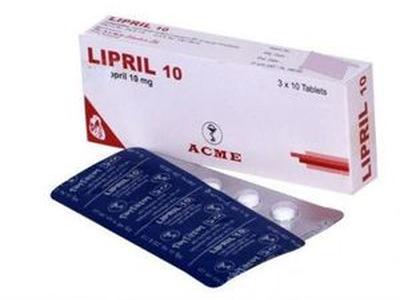
Lipril 10 mg
Lisinopril
Category: Tablet
Manufacturer: The ACME Laboratories Ltd.

Allopathic
MFG. Licence No. Biological
115
MFG. Licence No. Non-Biological
250
Address
Dhamrai
Price: 4.98 ৳
Tablet
30's pack
piece

Medicine Selling service is not available yet.
Related Medicines

Uses of Lipril:
- Hypertension (high blood pressure)
- Prevention of heart attack and stroke
- Heart failure
Heart failure, Myocardial infarction, Diabetic nephropathy, Hypertension
History of angioedema related to previous treatment with ACE inhibitors, hereditary or idiopathic angioedema. Bilateral renal artery stenosis. Pregnancy (2nd or 3rd trimester), lactation.
Angiotensin-converting enzyme (ACE) inhibitors
Lisinopril competitively inhibits ACE from converting angiotensin I to angiotensin II (a potent vasoconstrictor) resulting in increased plasma renin activity and reduced aldosterone (a hormone that causes water and Na retention) secretion. This promotes vasodilation and BP reduction.
How to use
Lisinopril:
Take this medicine in the dose and duration as advised by your doctor. Swallow it as a whole. Do not chew, crush or break it.
Lisinopril may be taken with or without food, but it is better to take it at a fixed time.
Administration:
May be taken with or without food.
Adult Dose:
Oral
Hypertension
Adult: Initially, 10 mg/day, 1st dose given preferably at bedtime to avoid precipitous fall in BP. Patient w/ renovascular HTN, volume depletion, severe HTN: Initially, 2.5-5 mg once daily.
Patient on diuretic: Initially, 5 mg once daily. Maintenance: 20 mg once daily, up to 80 mg/day may be given if needed.
Heart failure
Adult: As adjunct: Initially, 2.5 or 5 mg/day, increased by increments of >10 mg at intervals of at least 2 wk to max maintenance dose of 40 mg/day.
Post myocardial infarction
Adult: Initially, 5 mg once daily for 2 days started w/in 24 hr of the onset of symptoms. Increase to 10 mg once daily.
Patients w/ low systolic BP: Initially, 2.5 mg once daily.
Diabetic nephropathy
Adult: Hypertensive type 2 diabetics w/ microalbuminuria: 10 mg once daily, may increase to 20 mg once daily to achieve a sitting diastolic BP <90 mmHg.
Child Dose:
Oral
Hypertension
Child: >6 yr Initially, 0.07 mg/kg, up to 5 mg once daily.
Renal Dose:
Hypertension
Renal impairment: Adult: CrCl <10 mL/min or on dialysis: Initially, 2.5 mg once daily. CrCl 10-30 mL/min: Initially, 2.5-5 mg once daily. CrCl 31-80 mL/min: Initially, 5-10 mg once daily. Dose can be adjusted up to max 40 mg once daily based on patient's response. Child: Do not give if GFR <30 mL/min/1.73 m2.
CrCl (ml/min)
<10 Initially, 2.5 mg once daily.
10-30 Initially 2.5-5 mg once daily.
31-80 Initially, 5-10 mg once daily.
May enhance hypotensive effect w/ diuretics. May increase risk of renal function deterioration and decrease antihypertensive effect w/ NSAIDs. May increase serum levels and toxicity of lithium. Increased risk of hyperkalaemia w/ K-sparing diuretics and K supplements. May increase nitritoid reactions of gold Na thiomalate.
Potentially Fatal: Increased risk of hypotension, hyperkalaemia and changes in renal function w/ aliskiren in patients w/ diabetes or renal impairment.
History of angioedema related to previous treatment with ACE inhibitors, hereditary or idiopathic angioedema. Bilateral renal artery stenosis. Pregnancy (2nd or 3rd trimester), lactation.
Common
- Decreased blood pressure
- Cough
- Increased potassium level in blood
- Fatigue
- Weakness
- Dizziness
>10%
Dizziness (5-12%)
1-10%
Cough (4-9%),Headache (4-6%),Hyperkalemia (2-5%),Diarrhea (3-4%),Hypotension (1-4%),Chest pain (3%),Fatigue (3%),Nausea/vomiting (2%),Kidney disease, of AMI patients (2%),Rash (1-2%)
<1%
Immune hypersensitivity reaction,Psoriasis,Angioedema of the face, lips, throat; intestinal angioedema,Anuria,Atrial tachycardia,Acute renal failure,Arthralgia,Alopecia,Atrial fibrillation,Bone marrow suppression,Cutaneous pseudolymphoma,Hypersomnia,Leukopenia,Mood changes,Pancreatitis,Skin infections
Potentially Fatal: Severe hypotension, angioedema.
Category D: There is positive evidence of human foetal risk, but the benefits from use in pregnant women may be acceptable despite the risk (e.g., if the drug is needed in a life-threatening situation or for a serious disease for which safer drugs cannot be used or are ineffective).
Precaution:
Hypovolaemia, hyperkalaemia, collagen vascular disease, valvular stenosis; before, during or immediately after anaesthesia, preexisting renal insufficiency, unilateral renal artery stenosis. Children <6 yr. Assess renal function. May impair ability to drive or operate machinery.
Lactation: Not known if excreted into breast milk; not recommended
Symptoms: Hypotension, tachycardia, circulatory shock, palpitations, bradycardia, hyperventilation, renal failure, electrolyte disturbances, anxiety, dizziness and cough. Management: Normal saline IV infusion may be used. Perform haemodialysis, emesis, gastric lavage, admin of absorbents and Na sulfate if recently taken. Consider admin of angiotensin II infusion and/or IV catecholamines if available.
Store at below 25° C.
Angiotensin-converting enzyme (ACE) inhibitors
Lisinopril competitively inhibits ACE from converting angiotensin I to angiotensin II (a potent vasoconstrictor) resulting in increased plasma renin activity and reduced aldosterone (a hormone that causes water and Na retention) secretion. This promotes vasodilation and BP reduction.
Category D: There is positive evidence of human foetal risk, but the benefits from use in pregnant women may be acceptable despite the risk (e.g., if the drug is needed in a life-threatening situation or for a serious disease for which safer drugs cannot be used or are ineffective).


Samm Care