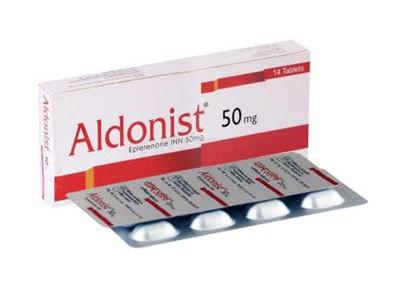
Aldonist 50 mg
Eplerenone
Category: Tablet
Manufacturer: Unimed Unihealth Pharmaceuticals Ltd.

Unimed Unihealth Pharmaceuticals Ltd.
Allopathic
MFG. Licence No. Biological
219
MFG. Licence No. Non-Biological
121
Address
Bishaya Kuri Bari, Gazipur
Price: 76.5 ৳
Tablet
14's pack
7's Strip

Medicine Selling service is not available yet.
Related Medicines

Uses of Aldonist:
- Hypertension (high blood pressure)
- Edema
Hypertension, Heart failure, Congestive heart failure, Left ventricular dysfunction, Acute myocardial infarction
For all patients: Serum potassium >5.5 mEq/L at initiation; CrCl ?30 mL/min; concomitant use of strong CYP3A4 inhibitors (e.g. ketoconazole, itraconazole, nefazodone, troleandomycin, clarithromycin, ritonavir, nelfinavir). For patients treated for hypertension: Patients with type 2 DM with microalbuminuria; serum creatinine >2 mg/dL (male), or >1.8 mg/dL (female); CrCl <50 mL/min; concomitant use of potassium supplements or potassium-sparing diuretics (e.g. amiloride, spironolactone, or triamterene).
Potassium-sparing diuretics, Potassium-sparing diuretics & Aldosterone antagonists
Eplerenone selectively binds to the mineralocorticoid receptor and blocks the binding of aldosterone, a key component in the renin-angiotensin-aldosterone-system, which is involved in the regulation of BP and pathophysiology of CV disease. Aldosterone binds to mineralocorticoid receptors in both epithelial (e.g. kidney, GI tract) and nonepithelial (e.g. heart, blood vessels, brain) tissues; causing increases in BP by inducing Na reabsorption, vascular remodelling, water retention, endothelial dysfunction and possibly other mechanisms.
How to use
Eplerenone:
Take this medicine in the dose and duration as advised by your doctor. Swallow it as a whole. Do not chew, crush or break it.
Eplerenone may be taken with or without food, but it is better to take it at a fixed time.
Administration:
May be taken with or without food.
Adult Dose:
Hypertension (HTN)
Initial 50 mg PO qDay; may increase to 50 mg PO q12hr; may take up to four weeks for full therapeutic response; hyperkelemia may occur with doses >100 mg/day
Heart Failure Post MI
Initial 25 mg PO qDay; may titrate to maximum of 50 mg once daily within 4 weeks as tolerated
Dose adjustments may be required based on potassium levels
Hepatic Impairment
Dose adjustment not necessary
Renal Dose:
Renal Impairment
Contraindicated if CrCl <50 mL/min or serum creatinine >2 mg/dL in males or >1.8 mg/dL in females
Concomitant use with CYP3A4 Inhibitors (e.g. ketoconazole, voriconazole, itraconazole, fluconazole, clarithromycin, diltiazem saquinavir, verpamil, ritonavir) may increase serum concentrations of Eplerenone. CYP3A4 inducers (e.g. rifampicin, carbamazepine, phenytoin, phenobarbital) may decrease Eplerenone efficacy. Eplerenone may enhance hyperkalaemic effect of ACE inhibitors, angiotensin II receptor blockers, potassium-sparing diuretics or potassium salts.
Concomitant use with diazoxide, MAOIs, pentoxifylline, prostacyclin analogues may enhance hypotensive effect of antihypertensives.
NSAIDs may possibly reduce the antihypertensive and/or diuretic effects of potassium-sparing diuretics and may increase risk of hyperkalaemia. Lithium toxicity has been reported when used with ACE inhibitors or diuretics; monitor lithium levels when used with Eplerenone.
For all patients: Serum potassium >5.5 mEq/L at initiation; CrCl ?30 mL/min; concomitant use of strong CYP3A4 inhibitors (e.g. ketoconazole, itraconazole, nefazodone, troleandomycin, clarithromycin, ritonavir, nelfinavir). For patients treated for hypertension: Patients with type 2 DM with microalbuminuria; serum creatinine >2 mg/dL (male), or >1.8 mg/dL (female); CrCl <50 mL/min; concomitant use of potassium supplements or potassium-sparing diuretics (e.g. amiloride, spironolactone, or triamterene).
Common
- Dizziness
- Diarrhea
- Nausea
- Cough
- Flu-like symptoms
- Fatigue
- Increased potassium level in blood
- Increased creatinine level in blood
1-10%
Hyperkalemia (2-10%),Increased risk of hyperkalemia with presence of renal dysfunction
1-3%
Dizziness,Fatigue/malaise,Abdominal pain,Diarrhea,Albuminuria,Hypercholesterolemia,Hypertriglyceridemia,Cough
<1%
Abnormal vaginal bleeding,Gynecomastia,Mastodynia
Pregnancy: There are no adequate and well-controlled studies in pregnant women. Eplerenone should be used during pregnancy only if the potential benefit justifies the potential risk to the fetus.Lactation: The concentration of Eplerenone in human breast milk after oral administration is unknown. Because many drugs are excreted in human milk and because of the unknown potential for adverse effects on the nursing infant, a decision should be made whether to discontinue nursing or discontinue the drug, taking into account the importance of the drug to the mother.
Precaution:
Measure serum potassium levels before starting therapy, within the first wk, and periodically thereafter. Increased risk of hyperkalaemia in patients with impaired renal functions; diabetic patients with CHF post-MI (especially those with proteinuria); or concurrent use of agents affecting the rennin-angiotensin-aldosterone system. Safety and efficacy not established in patients with severe hepatic impairment; or paediatric patients <18 yr. Elderly. Pregnancy and lactation.
Lactation: unknown if excreted into breast milk, discontinue drug or nursing
Symptoms: Hyperkalaemia, hypotension. Management: Symptomatic and supportive treatment. Admin activated charcoal. Initiate standard therapy for hyperkalaemia.
Store below 30°C in a cool and dry place, protected from light and moisture. Keep out of children’s reach.
Potassium-sparing diuretics, Potassium-sparing diuretics & Aldosterone antagonists
Aldosterone binds to mineralocorticoid receptors in both epithelial (e.g. kidney, GI tract) and nonepithelial (e.g. heart, blood vessels, brain) tissues; causing increases in blood pressure by inducing sodium reabsorption, vascular remodeling, water retention and possibly other mechanisms. Eplerenone is a relatively selective mineralocorticoid receptor antagonist, blocking binding of aldosterone and reducing blood pressure. Eplerenone also appears to have cardioprotective effect in patients with congestive heart failure (CHF) after myocardial infarction (MI).
Pregnancy
Available data from published case reports on eplerenone use during pregnancy are insufficient to establish a drug-associated risk of major birth defects, miscarriage, adverse maternal or fetal outcomes; in animal studies, no adverse developmental effects were observed when eplerenone was administered to pregnant rats and rabbits during organogenesis at exposures 32 and 31 times, respectively the human exposure at the 100 mg/day therapeutic dose
Hypertension in pregnancy increases maternal risk for pre-eclampsia, gestational diabetes, premature delivery, and delivery complications (e.g., need for cesarean section, and post-partum hemorrhage); hypertension increases fetal risk for intrauterine growth restriction and intrauterine death; pregnant women with hypertension should be carefully monitored and managed accordingly
Infertility
Based on animal data, therapy may compromise male fertility; in mature rates, male fertility was decreased with eplerenone exposure at 17 times the 100 mg/day human therapeutic dose; reversibility of effect, not evaluated
Lactation
There are no human data available on whether eplerenone is present in human milk, or has effects on breastfed infants or on milk production; eplerenone was present in milk of lactating rats; when a drug is present in animal milk, it is likely that the drug will be present in human milk


Samm Care