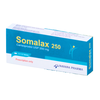
Somalax 350 350 mg
Carisoprodol
Category: Tablet
Manufacturer: Navana Pharmaceuticals Ltd.

Allopathic
MFG. Licence No. Biological
194
MFG. Licence No. Non-Biological
431
Address
Rupshi, Rupganj, Narayanganj.
Price: 10.0 ৳
10 in Blister Pack

Medicine Selling service is not available yet.
Related Medicines

Uses of Somalax 350:
- Muscle relaxation
Painful muscle spasm associated with musculoskeletal conditions
Acute intermittent porphyria, hypersensitivity. Lactation.
Locally acting Skeletal Muscle Relaxants
Carisoprodol is a GABA-A receptor indirect agonist with CNS chloride channel conductance effect. GABA receptor agonists typically produce sedative effect and may also cause other effects such as anxiolytic, anticonvulsant and muscle relaxant. Metabolite of Carisoprodol, Meprobamate, has anxiolytic and sedative properties. Carisoprodol decreases the impulses from brain and spinal cord to the muscle. This causes the muscle to relax and hence decrease the spasm. It has no direct action on muscle itself.
How to use
Carisoprodol:
Take this medicine in the dose and duration as advised by your doctor. Swallow it as a whole. Do not chew, crush or break it.
Carisoprodol may be taken with or without food, but it is better to take it at a fixed time.
Administration:
May be taken with or without food.
Adult Dose:
Oral
Painful muscle spasm associated with musculoskeletal conditions
Adult: 350 mg 3-4 times daily for up to 2-3 wk.
Elderly: Half of the usual dose.
Child Dose:
Musculoskeletal Conditions
<16 years: Not recommended
>16 years: 250-350 mg q8hr and HS
Potentially Fatal: Potentiates alcohol and other CNS depressants.
Acute intermittent porphyria, hypersensitivity. Lactation.
Common
- Sleepiness
>10%
Drowsiness (13-17%)
1-10%
Dizziness (7-8%),Headache (3-5%)
Frequency Not Defined
Orthostatic hypotension,Syncope,Tachycardia,Agitation,Irritability,Depression,Allergic/idiosyncratic reactions (pruritus, rash, dizziness, etc),Epigastric distress,N/V,Facial flushing,Weakness
Pregnancy category C. Maternal use of Carisoprodol may lead to reduced or less effective infant feeding (due to sedation) and/or decresed milk production. Caution should be exercised when Carisoprodol is administered to a nursing woman.
Precaution:
Renal and hepatic failure. Pregnancy. Should be used with caution in addiction prone individuals.
Lactation: Enters breast milk; use with caution
Overdosage of Carisoprodol commonly produces CNS depression. Death, coma, respiratory depression, hypotension, seizures have been reported with Carisoprodol overdosage. Basic life support measures should be instituted in Carisoprodol overdose. Induced emesis is not recommended due to the risk of CNS and respiratory depression. Gastric lavage should be considered soon after ingestion (within one hour). Circulatory support should be administered with volume infusion and vasopressor agents if needed. Seizures should be treated with intravenous benzodiazepines and the reoccurrence of seizures may be treated with phenobarbital. In cases of severe CNS depression, airway protective reflexes may be compromised and tracheal intubation should be considered for airway protection and respiratory support.
Store in cool and dry place at room temperature 20°-25°C, away from direct light. Keep out reach of children.
Locally acting Skeletal Muscle Relaxants
Carisoprodol blocks interneuronal synaptic activity in the descending reticular formation and spinal cord resulting in skeletal muscle relaxation.
Pregnancy
Data over many decades of use of drug in pregnancy have not identified drug-associated risk of major birth defects, miscarriage, or other adverse maternal or fetal outcomes; data on meprobamate, the primary metabolite of carisoprodol, do not show consistent association between maternal use and increased risk of major birth defects
Lactation
Data from published literature report that carisoprodol and its metabolite, meprobamate, are present in breastmilk; there are no data on effect on milk production; there is one report of sedation in an infant who was breastfed by a mother taking carisoprodol; because there have been no consistent reports of adverse events in breastfed infants over decades of use, the developmental and health benefits of breastfeeding should be considered along with mother’s clinical need for therapy and any potential adverse effects on breastfed infant or from underlying maternal condition; infants exposed to drug through breast milk should be monitored for sedation

Samm Care