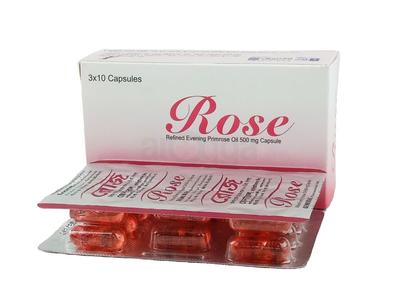
Rose 500 500 mg
Primrose Oil
Category: Capsule
Manufacturer: General Pharmaceuticals Ltd.

Allopathic
MFG. Licence No. Biological
162
MFG. Licence No. Non-Biological
406
Address
Kaliakair, Gazipur
Price: 108.0 ৳
Strip

Medicine Selling service is not available yet.
Related Medicines

Uses of Rose 500 :
Dietary supplement ,Atopic dermatitis
• Atopic dermatitis, allergic & neurodermatitis
• Psoriasis
• Mastalgia , cyclical
• Diabetic neuropathy
• Lactation
• Dry eyes associated with Sjogren’s syndrome
• Infant formula fortification
• Nutritional deficiencies (EFAs)
• Premenstrual syndrome symptoms( PMS)
• Raynaud’s disease
• Rheumatoid arthritis
• Seborrhoeic dermatitis (milk crust)
• Uremic skin symptoms
• Benign breast disease
Individuals with schizophrenia or taking epileptogenic drugs like phenothiazines should consult with their doctor before using it. according to some reports .A recent analysis of clinical trials on polyunsaturated fatty acids in schizophrenia treatment found no significant advantage or disadvantage to it supplementation.
How to use Primrose Oil :
Primrose Oil should be take in the dose and for the duration prescribed by your doctor.Primrose Oil tablets can be taken with or without food. However, taking them with food may help to reduce the risk of side effects, such as nausea and stomach upset.
Administration:
It may be swallowed directly or may be taken
with milk, another liquid, or with food .EPO taken with food may reduce potential gastrointestinal side effects .Concurrent ingestion of the antioxidant vitamin E
Adult Dose:
•Atopic & Allergic Dermatitis:1 capsule 2 times daily.
•Benign Breast disease & Mastalgia : 1 capsule 2/3 times daily with or after meal.
•Premenstrual Syndrome (PMS): 1 Capsule 2 times daily at morning & night with or after meal.
•Rheumatoid arthritis: 1 Capsule daily Or as directed by the registered physician .Cyclical Mastalia : 6 capsules (500 mg) daily for 4 –6 months
•Diabetic Neuropathy: 8–12 capsules (500 mg) daily.
•Lactation Aid: 500 mg capsules, twice daily, morning and evening
External:
Atopic Dermatitis: Water-in-oil emulsion containing 20% evening primrose oil, twice daily is applied topically to affected area for at least 4 weeks
Child Dose:
1 capsule 1/2 times daily
Renal Dose:
Primrose oil should be avoided if you have kidney disease or are taking kidney disease medications .Consult with doctor .
There are currently no known drug interactions. Steroids and nonsteroidal anti-inflammatory drugs may interfere with essential fatty acid metabolism.
Individuals with schizophrenia or taking epileptogenic drugs like phenothiazines should consult with their doctor before using it. according to some reports .A recent analysis of clinical trials on polyunsaturated fatty acids in schizophrenia treatment found no significant advantage or disadvantage to it supplementation.
- Nausea
- Vomiting
- Diarrhea
- Headaches
- Skin rashes
- Loose stool
- Abdominal pain
Adverse effects of primrose oil are unusual at recommended dosages, affecting less than 2% of those who use primrose oil for extended periods. Side effects may include headaches, mild nausea, and abdominal bloating. Symptoms of overdose may include loose stools and abdominal pain.
Pregnancy & Lactation Category Note:
Pregnancy:
There are no known restrictions during pregnancy or lactation, and GLA .The World Health Organization recommends that pregnant women consume 5% of their total calories from essential fatty acids.
Lactation:
The essential fatty acid found in EPO, is considered an important substance in human breast milk .Therefore, it is responsible to ensure that evening primrose oil can be taken while lactation.
Precautions:
Do not take primrose oil if you are allergic to it..
Do not take more than the recommended dosage of primrose oil .If you experience any side effects from primrose oil, stop taking the product and talk to your doctor .Do not apply primrose oil to broken or irritated skin .If you experience any skin irritation from primrose oil, stop using the product and talk to your doctor."
Keep below 25°C in a dry place .light-protected place. Keep children out of reach.
Primrose oil is a natural source of gamma-linolenic acid (GLA), an omega-6 fatty acid required for prostaglandin production. Prostaglandins are hormone-like substances that regulate a variety of bodily functions, including inflammation, pain, and blood clotting.
The body converts GLA to dihomo-gamma-linolenic acid (DGLA), which is then converted to prostaglandin E1 (PGE1). PGE1 has anti-inflammatory and analgesic properties.
Other fatty acids found in primrose oil include linoleic and oleic acid, both of which have antioxidant and anti-inflammatory properties.
Reduced inflammation: GLA and other fatty acids in primrose oil can help reduce inflammation by inhibiting the production of inflammatory prostaglandins while increasing the production of anti-inflammatory prostaglandins.
Improved skin health: Primrose oil can help to reduce inflammation and promote collagen production. Collagen is a protein required for healthy skin..
Reduced menstrual cramps :Primrose oil may help to reduce menstrual cramps by reducing inflammation and prostaglandin production .Relief from menopause symptoms: Primrose oil may help to relieve menopause symptoms such as hot flashes, night sweats, and mood swings.


Samm Care