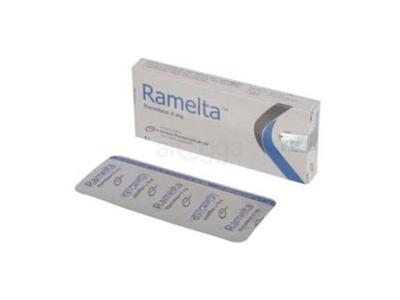
Ramelta 8 mg
Ramelteon
Category: Tablet
Manufacturer: Incepta Pharmaceuticals Ltd.

Allopathic
MFG. Licence No. Biological
193
MFG. Licence No. Non-Biological
108
Address
Zirabo, Savar, Dhaka Dewan Idris Road, Bara Rangamatia
Price: 31.5 ৳
Tablet
10's pack
piece

Medicine Selling service is not available yet.
Related Medicines

Uses of Ramelta:
- Insomnia
Ramelta is indicated for the, treatment of insomnia, characterized by difficulty with sleep onset.
Hypersensitivity
Ramelta is not recommended in patients with severe hepatic impairment.
Patients who develop angioedema after treatment with Ramelteon should not be re-challenged with the drug.
Miscellaneous sedatives & hypnotics
Ramelteon is a melatonin receptor agonist with both high affinity for melatonin MT1 and MT2receptors, and lower selectivity for the MT3 receptor. Melatonin production is concurrent with nocturnal sleep, meaning that an increase in melatonin levels is related to the onset of self-reported sleepiness and an increase in sleep propensity. MT1 receptors are believed to be responsible for regulation of sleepiness and facilitation of sleep onset, and MT2 receptors are believed to mediate phase-shifting effects of melatonin on the circadian rhythm. While MT1 and MT2 receptors are associated with the sleep-wake cycle, MT3 has a completely different profile, and therefore is not likely to be involved in the sleep-wake cycle. Remelteon has no appreciable affinity for the gamma-aminobutyric acid (GABA) receptor complex or receptors that bind neuropeptides, cytokines, serotonin, dopamine, norepinephrine, acetylcholine, or opiates.
How to use
Ramelteon:
Take this medicine in the dose and duration as advised by your doctor. Swallow it as a whole. Do not chew, crush or break it.
Ramelteon may be taken with or without food, but it is better to take it at a fixed time.
Administration:
Take within 30 min of going to bed.
Should not be taken with or immediately after a high-fat meal.
Adult Dose:
Adult:
Tablet
8 mg taken within 30 minutes of going to bed.
Total daily dose should not exceed 8 mg.
Child Dose:
Safety and efficacy not established
Rifampin (strong CYP enzyme inducer): Decreases exposure to and effects of ramelteon.
Ketoconazole (strong CYP3A4 inhibitor): Increases AUC for ramelteon; administer with caution.
Fluconazole (strong CYP2C9 inhibitor): Increases systemic exposure of ramelteon; administer with caution.
Donepezil increases systemic exposure of ramelteon; patients should be closely monitored when ramelteon is coadministered with donepezil.
Doxepin increases systemic exposure of ramelteon; patients should be closely monitored when ramelteon is coadministered with doxepin.
Alcohol: Causes additive psychomotor impairment; should not be used in combination.
Hypersensitivity
Ramelteon is not recommended in patients with severe hepatic impairment.
Patients who develop angioedema after treatment with Ramelteon should not be re-challenged with the drug.
Common
- Dizziness
- Sleepiness
- Fatigue
- Insomnia (difficulty in sleeping)
- Nausea
Most common adverse reactions (≥3% and more common than with placebo) are: somnolence, dizziness, fatigue, nausea, and exacerbated insomnia.
Pregnancy: Based on animal data may cause fetal harm. Do not use unless the potential benefit justifies the potential risk.Nursing mothers: Use with caution.
Precaution:
In rare cases, severe anaphylactic and anaphylactoid reactions have occurred following use of Ramelteon. Angioedema involving the tongue, glottis, or larynx has been reported. Some patients have had additional symptoms such as dyspnea, throat closing, or nausea and vomiting that suggest anaphylaxis. Reactions may require emergency treatment and may be fatal. Patients who develop such reactions should not be rechallenged.
Ramelteon should not be used in patients with severe hepatic impairment or in combination with fluvoxamine.
Failure of insomnia to remit after 7–10 days, worsening of insomnia, or emergence of new cognitive or behavioral abnormalities should be medically evaluated, as this may be the result of an unrecognized underlying medical/psychiatric disorder.
In primarily depressed patients, worsening of depression, including suicidal ideation and completed suicides, can occur with hypnotics.
Hallucinations, as well as behavioral changes such as bizarre behavior, agitation, and mania, have been reported with Ramelteon use. Amnesia, anxiety, and other neuropsychiatric symptoms may also occur unpredictably.
Complex behaviors such as “sleep-driving," making or eating food, talking on the phone, sleep-walking, or engaging in other activities while not fully awake, with amnesia for the event, may occur with use of hypnotics, including Ramelteon. The use of alcohol with Ramelteon may increase the risk of such behaviors. Discontinuation of Ramelteon should be strongly considered for patients who report any complex sleep behavior.
Patients should avoid engaging in hazardous activities that require concentration (such as operating a motor vehicle or heavy machinery) after taking Ramelteon.
Patients should be advised not to consume alcohol in combination with Ramelteon, as alcohol and Ramelteon may have additive effects when used in conjunction.
Ramelteon has been associated with decreased testosterone levels and increased prolactin levels. Patients may experience cessation of menses or galactorrhea in females, decreased libido, or fertility problems that are possibly associated with such hormone changes.
Ramelteon has not been studied in patients with severe sleep apnea and is not recommended for use in this population.
Lactation: no clinical studies, not recommended
Store at 25°C; excursions permitted to 15° to 30°C. Keep container tightly closed and protected from moisture and humidity.
Miscellaneous sedatives & hypnotics
Ramelteon is a melatonin receptor agonist with both high affinity for melatonin MT1 and MT2 receptors and selectivity over the MT3 receptor.
The activity of ramelteon at the MT1 and MT2 receptors is believed to contribute to its sleep-promoting properties, as these receptors, acted upon by endogenous melatonin, are thought to be involved in the maintenance of the circadian rhythm underlying the normal sleep-wake cycle.
Pregnancy: Based on animal data may cause fetal harm. Do not use unless the potential benefit justifies the potential risk.Nursing mothers: Use with caution.


Samm Care