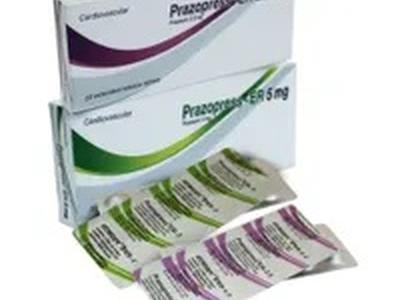
Prazopress ER 5 mg
Prazosin Hydrochloride
Category: Tablet
Manufacturer: Unimed Unihealth MFG. Ltd.

Price: 510.0 ৳
30's pack
10's Strip

Medicine Selling service is not available yet.
Related Medicines

Uses of Prazopress ER:
- Hypertension (high blood pressure)
Hypertension, Benign prostatic hyperplasia, Raynaud's syndrome
Congestive heart failure due to mechanical obstruction. Hypersensitivity. Pregnancy.
Alpha adrenoceptor blocking drugs
Prazosin causes a decrease in total peripheral vascular resistance through selective inhibition of postsynaptic alpha-1-adrenoreceptors in vascular smooth muscle. In hypertensive patients, blood pressure is lowered in both the supine and standing positions; this effect is more pronounced on the diastolic blood pressure. Rebound elevation of blood pressure does not occur following abrupt cessation of Prazosin therapy.The therapeutic efficacy of Prazosin in patients with congestive heart failure is ascribed to a reduction in left ventricular filling pressure, reduction in cardiac impedance and an augmentation of cardiac output. The use of Prazosin in congestive heart failure does not provoke a reflex tachycardia and blood pressure reduction is minimal in normotensive patients. Prazosin reduce the severity of the signs, symptoms, frequency and duration of attacks, in patients with Raynaud's disease. In low dosage, antagonism of alpha-1-receptors on prostatic and urethral smooth muscle has been shown to improve the urinary pressure profile in men and to improve symptoms of benign prostatic hyperplasia. Clinical studies have shown that Prazosin therapy is not associated with adverse changes in the serum lipid profile.
How to use Prazosin Hydrochloride:
Take this medicine in the dose and duration as advised by your doctor. Swallow it as a whole. Do not chew, crush or break it. Prazosin Hydrochloride may be taken with or without food, but it is better to take it at a fixed time.
Administration:
May be taken with or without food. Starting dose is best taken w/ dinner, at least 2-3 hr before retiring. Maintenance doses may be taken w/ or w/o meals.
Adult Dose:
Oral
Hypertension
Conventional Tablet:
Adult: Initially, 0.5 mg bid or tid for 3-7 days, increased to 1 mg bid or tid for the next 3-7 days.
Thereafter, the daily dose should be increased gradually as determined by the patient’s response to the blood pressure lowering effect. Most patients are likely to be maintained on a dosage regimen of Prazosin alone of up to 15 mg daily in divided doses.
Max: 20 mg/day in divided doses.Dosage should be individualized depending on patient tolerance and response.
Extended Release Tablet:
Dosage should be individualized depending on patient tolerance and response.
Adult: Initially, Prazosin extended release 2.5mg once daily.
Dosage may be increased slowly, in general over a 7 to 14 day period, depending on the response to each dose level.
Max:Doses above 20mg once daily have not been studied.
Maintenance dose: Dosage may be increased as clinically indicated to 20mg given in once-daily doses.
Hypertensive patients controlled on Prazosin tablets alone or in combination with other anti-hypertensive medications may be switched to Prazosin extended release tablets at the equivalent or nearest higher total daily dose, e.g. Prazosin tablets 4 mg daily equivalent to Prazosin extended release tablets 5 mg once daily.
Blood pressure measurements should be taken at the end of the dosing interval to assure adequate blood pressure control is maintained throughout the 24 hour period. Further titration may be necessary in some patients.
Benign prostatic hyperplasia;
Adult: Initially, 0.5 mg bid, increased to a maintenance dose not exceeding 2 mg bid.
Raynaud Phenomenon
1-5 PO q12hr
Elderly: Dose reduction needed.
Hepatic impairment: Dose reduction needed.
Renal Dose:
Renal impairment: Dose reduction needed.
Hypotensive effects may be enhanced w/ diuretics and other antihypertensives. Increased risk of 1st dose hypotension w/ ?-blockers or Ca channel blockers. Concomitant admin w/ phosphodiesterase type 5 (PDE5) inhibitors (e.g. sildenafil) may result in additive hypotensive effects and symptomatic hypotension.
Congestive heart failure due to mechanical obstruction. Hypersensitivity. Pregnancy.
Common
- Dizziness
- Headache
- Drowsiness
- Weakness
- Low energy
- Palpitations
- Nausea
1-10%
Dizziness (10%),Drowsiness (8%),Headache (8%),Weakness (7%),Asthenia (6.5%),Nausea (5%),Palpitation (5%)
Frequency Not Defined (Selected)
Edema,Orthostatic hypotension,Syncope,Fever,Rash,Abdominal discomfort/pain,Diarrhea,Vomiting,Abnormal liver function tests,Impotence,Pancreatitis,Urinary incontinence
Potentially Fatal: Rarely, hypotension may be life-threatening.
Pregnancy category C. It should be used only when, in the opinion of the physician, potential benefit outweighs potential risk. Prazosin has been shown to be excreted in small amounts in human milk. Caution should be exercised when Prazosin is administered to nursing mothers.
Precaution:
Prostate cancer should be ruled out before starting therapy. Patients w/ history of micturition syncope, angina pectoris. Treatment of heart failure due to mechanical obstruction (e.g. aortic or mitral valve stenosis, pulmonary embolism and restrictive pericardial disease). During cataract surgery, Intraoperative Floppy Iris Syndrome (IFIS) may occur. Renal and hepatic impairment. Elderly. Pregnancy and lactation. Patient Counselling May impair ability to drive or operate machinery. A low starting dose is given in the evening to lessen the risk of collapse. Hypotensive effects may be exaggerated by exercise and heat. Monitoring Parameters Monitor renal function. Careful monitoring of BP during initial titration or subsequent upward dosage adjustment.
Lactation: Excreted in breast milk; use caution
Accidental ingestion of at least 50 mg of Prazosin in a two-year child resulted in profound drowsiness and depressed reflexes, No decrease in blood pressure was noted. Recovery was uneventful. Should overdosage lead to hypotension, support of the cardiovascular system is of first importance. Restoration of blood pressure and normalization of heart rate may be accomplished by keeping the patient in the supine position. If this measure is inadequate, shock should first be treated with volume expanders. If necessary, vasopressors should then be used. Renal function should be monitored and supported as needed. Laboratory data indicate Prazosin is not dialyzable because it is protein bound.
Keep away from light and moisture, store below 30°C. Keep away from reach out of the children.
Alpha adrenoceptor blocking drugs
Prazosin competitively blocks postsynaptic alpha1-adrenoceptors of veins and arterioles causing vasodilation, reduction in BP and total peripheral resistance usually w/o reflex tachycardia.
Although no teratogenic effects were seen in animal testing; the safety of Prazosin use during. pregnancy has not yet been established. The use of prazosin and a beta-blocker for the control of sever hypertension of 44 pregnant women revealed no drug-related fetal adnormalities or adverse effects. Therapy with prazosin was continued for as long as 14 weeks. Prazosin has also been used alone or in combination with other hypotensive agents in severe hypertension or pregnancy. No fetal or neonatal abnormalities have been reported with the use of Prazosin. There are no adequate and well controlled studies that establish the safety of Prazosin in pregnant women. Prazosin should be used during pregnancy only if in the opinion of the physician the potential benefit justifies the potential risk to the mother and fetus. Prazosin has been shown to be excreted in small amounts in human milk. Caution shold be exercised when Prazosin is adminsitered to nursing mothers.


Samm Care