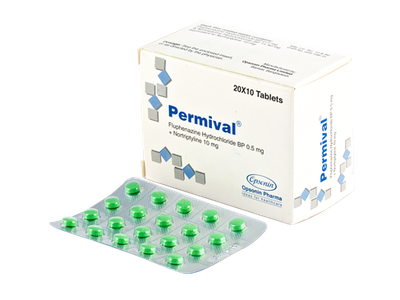
Permival 0.5 mg + 10 mg
Fluphenazine Hydrochloride + Nortriptyline
Category: Tablet
Manufacturer: Opsonin Pharma Limited

Allopathic
MFG. Licence No. Biological
012
MFG. Licence No. Non-Biological
080
Address
Rupatali,
Price: 200.0 ৳
Box
Strip
Piece

Medicine Selling service is not available yet.
Related Medicines

Uses of Permival:
- Schizophrenia
Headache, Depression, Anxiety, Emotional disturbance, Tension, Fatigue, Sleep disorder, Bodyache, Gastric problems
Patients with suspected or established subcortical brain damage, in patients receiving large doses of hypnotics, and in comatose or severely depressed states. The presence of blood dyscrasia or liver damage precludes the use of fluphenazine hydrochloride. Fluphenazine hydrochloride is contraindicated in patients who have shown hypersensitivity to fluphenazine; cross sensitivity to phenothiazine derivatives may occur.
Combined anxiolytics & anti-depressant drugs.
Tricyclic antidepressants, such as nortriptyline hydrochloride, are used to treat depression. Nortriptyline reduces norepinephrine and serotonin absorption at nerve terminals. Nortriptyline has a higher effect on norepinephrine reuptake than on serotonin reuptake than its parent chemical amitriptyline, which is equally effective in blocking norepinephrine and serotonin absorption.
Fluphenazine is a phenothiazine tranquilizer with a piperazine side chain. Fluphenazine is predominantly a neuroleptic medication, with the main therapeutic action thought to be strong dopamine (especially D2 ) receptor antagonism.
How to use
Fluphenazine Hydrochloride + Nortriptyline:
Take this medicine in the dose and duration as advised by your doctor. Swallow it as a whole. Do not chew, crush or break it.
Fluphenazine Hydrochloride + Nortriptyline may be taken with or without food, but it is better to take it at a fixed time.
Adult Dose:
Adult: 1 tablet 2 to 3 times daily.
Child Dose:
Child: Not recommended.
Reduces antihypertensive effects of guanethidine, methyldopa and clonidine. Lithium toxicity. Reduced bioavailability with antacids. Increased risk of arrhythmia when used with drugs that prolong QT interval. May cause electrolyte disturbance when used with diuretics.
Potentially Fatal: Additive CNS depressant effects with alcohol, barbiturates, hypnotics, sedatives, opiates and antihistamines.
Patients with suspected or established subcortical brain damage, in patients receiving large doses of hypnotics, and in comatose or severely depressed states. The presence of blood dyscrasia or liver damage precludes the use of fluphenazine hydrochloride. Fluphenazine hydrochloride is contraindicated in patients who have shown hypersensitivity to fluphenazine; cross sensitivity to phenothiazine derivatives may occur.
Common
- Dryness in mouth
- Constipation
- Weight gain
- Sleepiness
- Orthostatic hypotension (sudden lowering of blood pressure on standing)
- Urinary retention
- Increased prolactin level in blood
- Blurred vision
- Increased heart rate
- Muscle stiffness
- Restlessness
- Tremor
Dryness of mouth, drowsiness, constipation, tachycardia, nasal congestion, blurred vision and excitement.
Unless there are compelling reasons, do not use during pregnancy, especially in the early and final trimesters. There is no proof of medication safety in human pregnancy, and animal trials have had inconclusive outcomes. Breastfeeding is not advised for women who are receiving this combo.
Precaution:
Patients with glaucoma, prostate enlargement, cardiac failure and myocardial infarction. The drug may impair alertness and abilities to drive a car or operating machinery.
Because of the possibility of cross-sensitivity, fluphenazine hydrochloride should be used cautiously in patients who have developed cholestatic jaundice, dermatoses or other allergic reactions to phenothiazine derivatives.
Psychotic patients on large doses of a phenothiazine drug who are undergoing surgery should be watched carefully for possible hypotensive phenomena. Moreover, it should be remembered that reduced amounts of anesthetics or central nervous system depressants may be necessary.
The effects of atropine may be potentiated in some patients receiving fluphenazine because of added anticholinergic effects.
Store at temperatures below 25 degrees Celsius. Keep out of direct sunlight and dampness.
Fluphenazine blocks postsynaptic dopamine D1 and D2 receptors in the mesolimbic system and decreases the release of hypothalamic and hypophyseal hormones. It reduces aggressiveness with disappearance of hallucinations and delusions.
Nortriptyline, a dibenzocycloheptadiene tricyclic antidepressant, is the primary active metabolite of amitriptyline. It increases synaptic concentration of serotonin and/or norepinephrine in the CNS by blocking the neuronal reuptake of norepinephrine and serotonin.


Samm Care