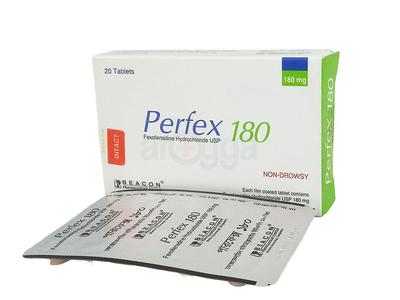
Uses of Perfex 180:
- Allergic conditions
Allergic rhinitis, Hay fever, Urticaria, Allergy
Hypersensitivity.
Non-sedating antihistamines
A selective peripheral H1-receptor antagonist, fexofenadine hydrochloride is an antihistamine. After oral administration, it is quickly absorbed and reaches peak plasma concentration in 2 to 3 hours. The blood-brain barrier does not appear to be crossed by it.
How to use
Fexofenadine Hydrochloride:
Take this medicine in the dose and duration as advised by your doctor. Swallow it as a whole. Do not chew, crush or break it.
Fexofenadine Hydrochloride is to be taken empty stomach.
Administration:
Should be taken on an empty stomach. Take before meals. Do not take w/ fruit juice.
Adult Dose:
Adults:
Allergic rhinitis: 120 mg once daily or 60 mg twice daily
Urticaria: 180 mg once daily
Child Dose:
Children:
Tablet
2-12 years: 30 mg (1 spoonful) or 5 ml twice daily
6 months-2 years: 15 mg (1/2 spoonful) or 2.5 ml twice daily
>12 years: 60 mg PO BID OR 180 mg PO qDay
ODT
6-12 years: 30 mg PO BID
Renal Dose:
Adult: Initially, 60 mg once daily.
Child: 6 mth-<2 yr: 15 mg once daily and 2-11 yr: 30 mg once daily.
>12 years: 60 mg PO qDay, initially
Co-admin with ketoconazole or erythromycin may increase plasma levels of fexofenadine. May increase adverse effects of other anticholinergics and CNS depressants. May increase arrhythmogenic effect of antipsychotic agents (phenothiazines); avoid concurrent usage. May reduce the efficacy of betahistine. Pramlintide may increase the anticholinergic effect of fexofenadine. Bioavailability may be increased by verapamil. Efficacy may be reduced by rifampin.
Fexofenadine Hydrochloride is under category C by the US FDA for pregnancy. Therefore, it is advised to avoid using fexofenadine hydrochloride during pregnancy and lactation unless the advantages to one outweigh the hazards to the fetus.
Precaution:
Renal impairment. Pregnancy, lactation; children <6 yr.
Lactation: Excretion in milk unknown; use with caution (AAP states “compatible with nursing”)
Overdoses of fexofenadine hydrochloride have been associated with symptoms such as dry mouth, sleepiness, weariness, and dizziness. Healthy participants have received single doses of up to 800 mg, doses of up to 690 mg twice daily for one month, or doses of up to 240 mg once daily for one year without experiencing clinically significant adverse responses in comparison to placebo. Fexofenadine hydrochloride has no known upper limit of tolerable dosage. To get rid of any unabsorbed medication, standard procedures should be taken into account. Treatment for symptoms and psychological assistance is advised. Fexofenadine hydrochloride cannot be efficiently removed from the blood by hemodialysate.
Keep dry and away from heat and light. Keep out of children's reach.
Non-sedating antihistamines
Fexofenadine, an active metabolite of terfenadine, is a competitive peripheral histamine H1-receptor antagonist on effector cells in the GI tract, blood vessels and respiratory tract.
Pregnancy category: C
Lactation: Excretion in milk unknown; use with caution (AAP states “compatible with nursing”)