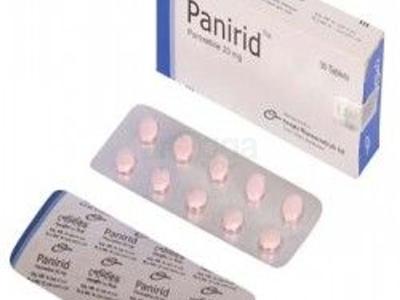
Uses of Panirid:
- Depression
- Obsessive-compulsive disorder
- Post traumatic stress disorder
- Panic disorder
- Anxiety
Depression, Anxiety, Panic disorder, Obsessive-compulsive disorder, Posttraumatic stress disorder, Social anxiety disorder, Premenstrual dysmorphic disorder
Use with or within 14 days of MAOIs; concurrent use with thioridazine or pimozide.
SSRIs & related anti-depressant drugs
The efficacy of Paroxetine is presumed to be linked to potentiation of serotonergic activity in the central nervous system resulting from inhibition of neuronal reuptake of serotonin (5-hydroxy-tryptamine, 5 HT). Studies at clinically relevant doses in humans have demonstrated that paroxetine blocks the uptake of serotonin into human platelets. In vitro studies in animals also suggest that paroxetine is a potent and highly selective inhibitor of neuronal serotonin reuptake and has only very weak effects on norepinephrine and dopamine neuronal reuptake. In vitro radioligand binding studies indicate that paroxetine has little affinity for muscarinic, alpha1, alpha2, beta adrenergic, dopamine (D2), 5-HT1, 5 HT2 and histamine (H1)-receptors; antagonism of muscarinic, histaminergic and alpha1-adrenergic receptors has been associated with various anticholinergic, sedative and cardiovascular effects for other psychotropic drugs. Because the relative potencies of paroxetine’s major metabolites are at most 1/50 of the parent compound, they are essentially inactive.
How to use Paroxetine Hydrochloride:
Take this medicine in the dose and duration as advised by your doctor. Swallow it as a whole. Do not chew, crush or break it. Paroxetine Hydrochloride may be taken with or without food, but it is better to take it at a fixed time.
Administration:
May be taken with or without food. May be taken w/ meals to minimise GI upset.
Adult Dose:
Oral
Depression, Anxiety, Posttraumatic stress disorder
Adult: 20 mg daily, increase gradually, if necessary, by 10-mg increments wkly; max: 50 mg/day.
Obsessive compulsive disorder, Social anxiety disorder
Adult: Initially, 20 mg daily, increase wkly in 10-mg increments. Maintenance: 40-60 mg daily.
Panic disorder with or without agoraphobia
Adult: Initially, 10 mg daily, increase wkly in 10-mg increments according to clinical response. Maintenance: 40-60 mg daily.
Elderly: Initially, 10 mg daily, increase if needed by 10 mg/day at 1 wk intervals; max: 40 mg daily.
Hepatic impairment: Severe: 10 mg daily, increase to a max of 40 mg daily as necessary.
Child Dose:
Safety and efficacy not established
Renal Dose:
Renal impairment: Severe: 10 mg daily, increase to a max of 40 mg daily as necessary.
Levels/effects inhibited by cyproheptadine, phenytoin. Levels/effects increased by carbamazepine, cimetidine, CYP2D6 inhibitors (e.g. chlorpromazine, delavirdine, fluoxetine, miconazole, pergolide, quinidine, quinine, ritonavir, ropinirole). Increases levels/effects of atomoxetine, carvedilol, clozapine, CYP2B6 substrates (e.g. bupropion, promethazine, propofol, selegiline, sertraline), CYP2D6 substrates (e.g. amphetamines, selected beta-blockers, dextromethorphan, fluoxetine, lidocaine, mirtazapine, nefazodone, risperidone, ritonavir, thioridazine, TCAs, venlafaxine), duloxetine, galantamine, mexilitine, pimozide, procyclidine, propafenone. Decreases levels/effects of CYP2D6 prodrug substrates (e.g. codeine, hydrocodone, oxycodone, tramadol). Inhibits the metabolism of dextromethorphan, haloperidol, thioridazine. Enhances bradycardic effect of beta-blockers.
Enhances toxic effects of other CNS depressants. Increased risk of serotonin syndrome with amphetamines, SSRIs, meperidine, nefazodone, trazodone, serotonin agonists, sibutramine, sympathomimetics, tramadol, venlafaxine. Increases risk of bleeding with NSAIDs, aspirin, warfarin, or other drugs affecting coagulation. Increases sensitivity to amphetamines. Neurotoxicity with lithium. Additive hyponatraemia with loop diuretics. Mania or hypertension with selegiline.
Potentially Fatal: Fatal reactions with nonselective MAOI.
Use with or within 14 days of MAOIs; concurrent use with thioridazine or pimozide.
Common
- Delayed ejaculation
- Low sexual desire
- Nausea
- Tremor
- Confusion
- Dizziness
- Dryness in mouth
- Erectile dysfunction
- Fatigue
- Increased sweating
- Insomnia (difficulty in sleeping)
- Loss of appetite
- Nervousness
- Sleepiness
>10% (Based on 40 mg Dose)
Nausea (15-24%),Insomnia (11-24%),Dry mouth (9-18%),Headache (17%),Asthenia (10-15%),Constipation (10-15%),Diarrhea (9-12%),Dizziness (6-14%),Ejaculation disorder (10-15%),Tremor (4-11%),
1-10% (Based on 40 mg Dose)
Anxiety (5-10%),Blurred vision (5-10%),Decreased appetite (5-10%),Impotence (2-9%),Nervousness (2-5%),Paresthesia (2-5%),Hypomania (0.3 to 2.2%)
Frequency Not Defined (Based on 40 mg Dose)
Hypertension,Tachycardia,Emotional lability,Pruritus,Weight gain,Arthralgia,Tinnitus.Vertigo.Angle clossure glaucoma
Serious
Depression exacerbation,Mania (rare),Serotonin syndrome,Suicidal thoughts (rare),Suicide (rare),Seizure (rare),Toxic epidermal necrolysis,Hyponatremia (rare),Bleeding, abnormal (rare).Acute hepatitis (rare).Stevens-Johnson Syndrome
Paroxetine Hydrochloride drug should be used during pregnancy only if the potential benefit justifies the potential risk to the fetus.Labor and Delivery: The effect of Paroxetine on labor and delivery in humans is unknown.Nursing Mothers: Like many other drugs, Paroxetine is secreted in human milk, and caution should be exercised when Paroxetine hydrochloride is administered to a nursing woman.
Precaution:
Epilepsy, glaucoma, history of mania, cardiac disease, DM, history of bleeding disorders, on drugs with increased risk of bleeding; renal and hepatic impairment; patients receiving electroconvulsive therapy; achlorhydria or high gastric pH (reduced absorption of oral suspension). Pregnancy and lactation. The risk of suicidal behaviour may be higher in young adults, closely monitor. May impair ability to drive or perform tasks. Avoid abrupt withdrawal.
Lactation
Excreted in breast milk; use caution (AAP states effect on nursing infants is unknown but may be of concern)
Keep out of the reach of children. Store at a cool and dry place. Protect from light and moisture.
SSRIs & related anti-depressant drugs
Paroxetine selectively inhibits the reuptake of serotonin. It has limited direct action at other neurotransmitter sites including muscarinic receptors.
Paroxetine Hydrochloride drug should be used during pregnancy only if the potential benefit justifies the potential risk to the fetus.Labor and Delivery: The effect of Paroxetine on labor and delivery in humans is unknown.Nursing Mothers: Like many other drugs, Paroxetine is secreted in human milk, and caution should be exercised when Paroxetine Hydrochloride is administered to a nursing woman.