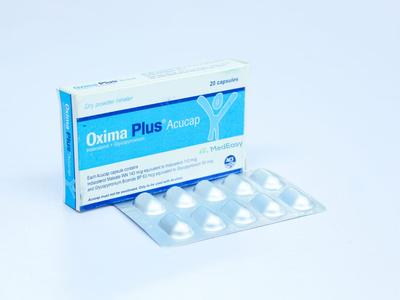
Uses of Oxima Plus:
- Chronic obstructive pulmonary disease (COPD)
Bronchodilator treatment to relieve symptoms in patients with, chronic obstructive pulmonary disease (COPD).
Hypersensitivity to indacaterol, glycopyrronium or to any of the excipients of Indacaterol + Glycopyrronium. All LABAs are contraindicated in patients with asthma without use of a long-term asthma control medication Indacaterol/glycopyrrolate is not indicated for the treatment of asthma
Use in children: This should not be used in patients <18 years.
Combined bronchodilators
Glycopyrronium: Long-acting muscarinic antagonist (LAMA); often referred to as an anticholinergic; produces bronchodilation by inhibiting acetylcholine's effect on muscarinic receptors in the airway smooth muscleIndacaterol: Long-acting β2-agonist (LABA); stimulates intracellular adenyl cyclase, causing conversion of ATP to cyclic AMP; increased cyclic AMP levels cause relaxation of bronchial smooth muscle
How to use
Indacaterol + Glycopyrronium:
Take this medicine in the dose and duration as advised by your doctor. Check the label before use.
Administration:
For inhalation use only. The capsules must not be swallowed.
Adult Dose:
Adult
Chronic Obstructive Pulmonary Disease (COPD)
Inhale 1 cap with inhaler once daily.
Hepatic Impairment: This can be used at the recommended dose in patients with mild and moderate hepatic impairment. There are no data available for the use of Indacaterol + Glycopyrronium Breezhaler in patients with severe hepatic impairment, therefore caution should be observed in these patients.
Child Dose:
Safety and efficacy not established
Renal Dose:
Renal Impairment: This can be used at the recommended dose in patients with mild to moderate renal impairment. In patients with severe renal impairment or end-stage renal disease requiring dialysis it should be used only if the expected benefit outweighs the potential risk.
Decreases levodopa effects. Effects may be enhanced by using drugs with antimuscarinic properties or MAOIs concurrently. May antagonise the GI effects of cisapride, metoclopramide and dompeidone.
Potentially Fatal: IV admin in the presence of cyclopropane anesth can result in ventricular arrhythmias.
Hypersensitivity to indacaterol, glycopyrronium or to any of the excipients of Indacaterol + Glycopyrronium. All LABAs are contraindicated in patients with asthma without use of a long-term asthma control medication Indacaterol/glycopyrrolate is not indicated for the treatment of asthma
Use in children: This should not be used in patients <18 years.
Common
- Indigestion
- High blood pressure
- Nasopharyngitis (inflammation of the throat and nasal passages)
- Chest pain
- Fever
- Urinary retention
- Sore throat
- Cough
- Headache
- Dizziness
- Allergic reaction
- Increased glucose level in blood
- Inflammation of the nose
- Sinus inflammation
- Urinary tract infection
1-10%
Nasopharyngitis (4.1%),Hypertension (2%),Back pain (1.8%),Oropharyngeal pain (1.6%)
Pregnancy Category- Not Classified. FDA has not yet classified the drug into a specified pregnancy category.
Precaution:
Concomitant use w/ long-acting beta-agonists or long-acting muscarinic antagonists. Not for the treatment of asthma. Immediately discontinue use if hypersensitivity & paradoxical bronchospasm occurs. Narrow-angle glaucoma, urinary retention, CV disorders (CAD, acute MI, cardiac arrhythmia, HTN), convulsive disorders or thyrotoxicosis, severe renal impairment; hypokalaemia; hyperglycaemia. Pregnancy & lactation.
An overdose of indacaterol is likely to lead to exaggerated effects typical of beta2-adrenergic stimulants, i.e. tachycardia, tremor, palpitations, headache, nausea, vomiting, drowsiness, ventricular arrhythmias, metabolic acidosis, hypokalaemia and hyperglycaemia. High doses of Glycopyrronium may lead to anticholinergic signs and symptoms.
Do not store above 30°C. Keep away from light and out of the reach of children. Protect from freezing. Insert the ConviCap in the ConviHaler just prior to use to protect from deterioration by moisture.
Combined bronchodilators
Glycopyrronium: Long-acting muscarinic antagonist (LAMA); often referred to as an anticholinergic; produces bronchodilation by inhibiting acetylcholine’s effect on muscarinic receptors in the airway smooth muscle
Indacaterol: Long-acting beta2-agonist (LABA); stimulates intracellular adenyl cyclase, causing conversion of ATP to cyclic AMP; increased cyclic AMP levels cause relaxation of bronchial smooth muscle
There is a limited amount of data from the use of Indacaterol and Glycopyrronium combination in pregnant women. Animal studies do not indicate direct or indirect harmful effects with respect to reproductive toxicity at clinically relevant doses. Indacaterol and Glycopyrronium combination should not be used in pregnant or nursing women unless the expected benefit outweighs any possible risk to the unborn child or the infant.