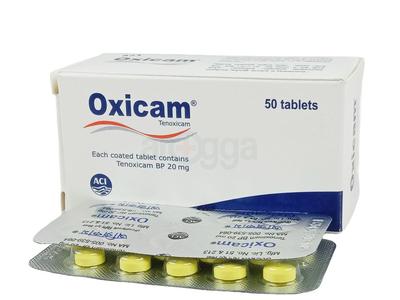
Oxicam 20 mg
Tenoxicam
Category: Tablet
Manufacturer: ACI Limited

Price: 108.0 ৳
Strip
30's pack
piece

Medicine Selling service is not available yet.
Related Medicines

Uses of Oxicam:
- Pain relief
- Rheumatoid arthritis
Pain and inflammation associated w/ musculoskeletal and joint disorders
Active or history of recurrent GI bleed or peptic ulcer, hypersensitivity to NSAIDs, severe heart failure, haemorrhagic diathesis, asthma, pregnancy (3rd trimester).
Drugs for Osteoarthritis, Drugs used for Rheumatoid Arthritis, Non-steroidal Anti-inflammatory Drugs (NSAIDs)
Tenoxicam is a non-steroidal antiinflammatory drug (NSAID) with anti inflammatory, analgesic, antipyretic properties and it also inhibits platelet aggregation. Tenoxicam inhibits prostaglandin biosynthesis and used in the treatment of inflammatory and degenerative disorders of the musculoskeletal system.
How to use
Tenoxicam:
Take this medicine in the dose and duration as advised by your doctor. Swallow it as a whole. Do not chew, crush or break it.
Tenoxicam is to be taken with food.
Administration:
Should be taken with food. Take w/ or immediately after meals.
Adult Dose:
Oral
Acute musculoskeletal disorders; Osteoarthritis; Rheumatoid arthritis
Adult: 20 mg as a single dose, taken at the same time each day. Max: 40 mg/day (short term use).
Treatment duration: Up to 7 days for acute musculoskeletal disorders and up to 14 days for severe cases.
Elderly: Use the lowest effective dose for the shortest possible duration.
Increased risk of adverse effects (particularly GI) w/ salicylates and other NSAIDs. May enhance the anticoagulant effect of warfarin and other anticoagulants. May reduce the effect of antihypertensive drugs. Increased risk of nephrotoxicity w/ ciclosporin. Increased risk of convulsions w/ quinolones. May decrease the elimination of lithium. May interfere w/ the natriuretic action of diuretics. May enhance the toxicity of methotrexate. May reduce the effects of mifepristone. Increased risk of GI bleeding w/ corticosteroids.
Active or history of recurrent GI bleed or peptic ulcer, hypersensitivity to NSAIDs, severe heart failure, haemorrhagic diathesis, asthma, pregnancy (3rd trimester).
Common
- Vomiting
- Nausea
- Stomach pain
- Indigestion
- Diarrhea
Dyspepsia, nausea, abdominal pain and discomfort, constipation, diarrhoea, flatulence, indigestion, epigastric distress, stomatitits, anorexia; peripheral oedema; headache, dizziness; allergic reactions, asthma, bronchospasm, dyspnoea, rash, pruritus; decreased Hb, anaemia, thrombocytopenia, non-thrombocytopenic purpura, leucopenia, eosinophilia, epistaxis; increased serum transaminase levels; swollen eyes, blurred vision, eye irritation, malaise, tinnitus; oedema, HTN, cardiac failure.
Potentially Fatal: Peptic ulceration, GI bleeding, anaphylaxis, Lyell's syndrome, Stevens-Johnson syndrome, exfoliative dermatitis, nephrotoxicity, arterial thrombotic events (e.g. MI or stroke), hepatitis, jaundice.
The safety of Tenoxicam during pregancy has not been established therefore it should be used with caution during pregnancy and only if the benefit to the mother is greater than the risk of the fetus. There is no information available about the safety of Tenoxicam during breastfeeding therefore it should not be used during lactation.
Precaution:
Patient w/ history of or active bronchial asthma, uncontrolled HTN, CHF, established ischaemic heart disease, peripheral arterial disease, cerebrovascular disease, risk factors for CV disease (e.g. HTN, hyperlipidaemia, DM, smoking), history of GI disease, fluid retention and oedema. Patient who will undergo major surgery (e.g. joint replacement). Elderly. Renal and hepatic impairment. Monitoring Parameters Monitor renal, hepatic and cardiac functions.
Although there is no experience of acute overdosage with Tenoxicam, it may be expected that the signs and symptoms mentioned under Undesirable effects would be more pronounced. Overdose should be countered by conventional measures to reduce absorption (e.g. gastrolavage and charcoal) and speed up elimination (e.g. cholestyramine).
Do not store above 30°C, protect from light & moisture. Keep out of the reach of children.
Drugs for Osteoarthritis, Drugs used for Rheumatoid Arthritis, Non-steroidal Anti-inflammatory Drugs (NSAIDs)
Tenoxicam is a potent inhibitor of prostaglandin synthesis by blocking the enzyme cyclo-oxygenase. Additional actions contributing to its anti-inflammatory effect includes inhibition of leucocyte function including phagocytosis and chemotaxis, and scavenging free O2 radicals. It has no effect on renal function at the usual doses.
NSAIDs have an inhibitory effect on prostaglandin synthesis and, when given during late pregnancy, may cause the closure of the fetal ductus arteriosus, prolong labor and delay parturition. Treatment during the third trimester of pregnancy should be avoided. Based on findings from single-dose administration, a very small amount (approximately 0.2%) of tenoxicam passes into breast milk. There is no evidence of adverse reactions in breast-fed infants of mothers taking Tenoxicam. Nevertheless, infants should be weaned or the drug discontinued.


Samm Care