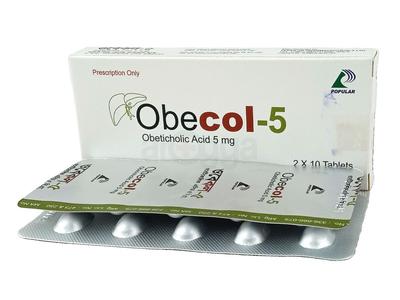
Obecol 5 5 mg
Obeticholic Acid
Category: Tablet
Manufacturer: Popular Pharmaceuticals Ltd.

Price: 272.69 ৳
Strip

Medicine Selling service is not available yet.
Related Medicines

Primary Biliary Cholangitis
Indicated for primary biliary cholangitis (PBC), in combination with ursodeoxycholic acid (UDCA) in adults with an inadequate response to UDCA for at least 1 yr or as monotherapy in adults unable to tolerate UDCA
Complete biliary obstruction
Farnesoid X Receptor Agonists
Obeticholic Acid is an agonist for FXR, a nuclear receptor expressed in the liver and intestine. FXR is a key regulator of bile acid, inflammatory, fibrotic, and metabolic pathways. FXR activation decreases the intracellular hepatocyte concentrations of bile acids by suppressing de novo synthesis from cholesterol as well as by increased transport of bile acids out of the hepatocytes. These mechanisms limit the overall size of the circulating bile acid pool while promoting choleresis, thus reducing hepatic exposure to bile acids.
Administration:
May take with or without food
Concomitant bile-acid binding resin: Separate obeticholic acid dose by at least 4 hr
Adult Dose:
Adult
Tablet
Primary Biliary Cholangitis
Indicated for primary biliary cholangitis (PBC) in combination with ursodeoxycholic acid (UDCA) in adults with an inadequate response to UDCA for at least 1 yr or as monotherapy in adults unable to tolerate UDCA
Before initiating obeticholic acid in patients with suspected cirrhosis, determine patient’s Child-Pugh classification (A, B, or C) using nomogram and determine the appropriate starting dosage
Starting dose and titration
Noncirrhotic or compensated Child-Pugh class A
Starting dose: 5 mg PO qDay
Dosage titration: If an adequate response has not been achieved after 3 months at 5 mg/day, and obeticholic acid is being tolerated, increase dose to 10 mg qDay
Not to exceed 10 mg/day
Child-Pugh class B or C, or prior decompensation event
Starting dose: 5 mg PO once weekly
Dosage titration: If an adequate response has not been achieved after 3 months at 5 mg once weekly, and obeticholic acid is being tolerated, increase dose to 5 mg twice weekly (at least 3 days apart)
May titrate to 10 mg twice weekly (at least 3 days apart) based on response and tolerability
Bile-acid binding resins may reduce the absorption, systemic exposure, and efficacy of obeticholic acid
Coadministration of warfarin and obeticholic acid has been shown to decrease the INR; monitor the INR and adjust warfarin dose accordingly
Coadministration with CYP1A2 substrates (eg, theophylline, tizanidine) may increase exposure of CYP1A2 substrates; monitor CYP1A2 substrates with narrow therapeutic index
Avoid concomitant use of inhibitors of the bile salt efflux pump (BSEP) (eg, cyclosporine); BSEP inhibitors may exacerbate accumulation of conjugated bile salts in the liver and result in clinical symptoms
Complete biliary obstruction
>10%
Pruritus (56-70%)
Fatigue (19-25%)
Severe pruritus (19-23%)
Reduced HDL-C (9-20%)
Abdominal pain and discomfort (10-19%)
1-10%
Rash (7-10%)
Oropharyngeal pain (7-8%)
Dizziness (7%)
Constipation (7%)
Peripheral edema (3-7%)
Palpitations (3-7%)
Pyrexia (7%)
Thyroid function abnormality (4-6%)
Eczema (3-6%)
The limited available human data on the use of Obeticholic Acid during pregnancy are not sufficient to inform a drug-associated risk.There is no information on the presence of Obeticholic Acid in human milk, the effects on the breast-fed infant or the effects on milk production.
Precaution:
Hepatic decompensation and failure, in some cases fatal, reported in patients with PBC who have decompensated cirrhosis or Child-Pugh Class B or C hepatic impairment when obeticholic acid was dosed more frequently than the recommended starting dosage of 5 mg once weekly
Monitor patients for elevations in liver enzymes and risks for hepatic decompensation (eg, worsening renal function, dehydration)
Dose response relationship observed in clinical trials for liver-related adverse reactions, including jaundice, worsening ascites, and primary biliary cholangitis flare (doses >10 mg/day)
Lactation
Unknown if distributed in human breast milk
Consider the developmental and health benefits of breastfeeding along with the mother’s clinical need for the drug, and any potential adverse effects on the breastfed infant from the drug or from the underlying maternal condition
In the clinical trials, PBC patients who received Obeticholic acid 25mg once daily (2.5 times the highest recommended dosage) or 50mg once daily (5 times the highest recommended dosage) experienced a dose-dependent increase in the incidence of hepatic adverse reactions, including elevations in liver biochemical tests, ascites, jaundice, portal hypertension and primary biliary cholangitis flares. Serious hepatic adverse reactions have been reported postmarketing in PBC patients with decompensated cirrhosis when Obeticholic acid was dosed more frequently than the recommended dosage; these adverse reactions were also reported in some patients who received the recommended dosage. In the case of overdosage, patients should be carefully observed and supportive care administered as appropriate.
Store below 30°C in a dry place, and protect from light. Keep out of children’s reach.
Farnesoid X Receptor Agonists
Farnesoid X receptor (FXR) agonist
FXR is a nuclear receptor expressed in the liver, intestine, kidney, and adipose tissue that regulates a wide variety of target genes critically involved in the control of bile acid synthesis and transport, lipid metabolism, and glucose homeostasis
FXR activation suppresses de novo synthesis of bile acids in hepatocytes as well as increasing transport of bile acids out of hepatocytes, thereby reducing exposure of the hepatocytes to bile acid
Pregnancy: The limited available human data on the use of obeticholic acid during pregnancy are not sufficient to inform a drug-associated risk. In animal reproduction studies, no developmental abnormalities or fetal harm was observed when pregnant rats or rabbits were administered obeticholic acid during the period of organogenesis at exposures approximately 13-times and 6-times human exposures, respectively, at the maximum recommended human dose (MRHD) of 10 mg.Lactation: There is no information on the presence of obeticholic acid in human milk, the effects on the breastfed infant or the effects on milk production. The developmental and health benefits of breastfeeding should be considered along with the mother’s clinical need for Obeticholic acid and any potential adverse effects on the breastfed infant from Obeticholic acid or from the underlying maternal condition.


Samm Care