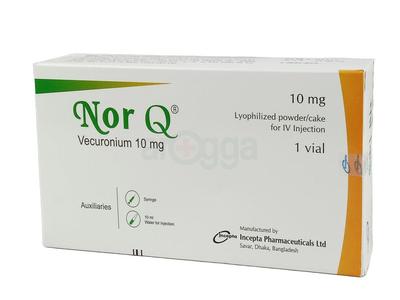
Nor Q 10 mg/ml
Vecuronium Bromide
Category: Injection
Manufacturer: Incepta Pharmaceuticals Ltd.

Allopathic
MFG. Licence No. Biological
193
MFG. Licence No. Non-Biological
108
Address
Zirabo, Savar, Dhaka Dewan Idris Road, Bara Rangamatia
Price: 252.0 ৳
10mg vial

Medicine Selling service is not available yet.
Related Medicines


Uses of Nor Q:
- Skeletal mucle relaxation during surgery
General anaesthesia, Skeletal muscle relaxation
Hypersensitivity to vecuronium or bromide.
Non depolarizing muscle relaxants
Vecuronium bromide is a non-depolarising neuromuscular blocking agent. It blocks the transmission process between the motor nerve-ending and striated muscle by binding competitively with acetylcholine to the nicotinic receptors located in the motor end-plate region of striated muscle.Unlike depolarising neuromuscular blocking agents, such as suxamethonium, Vecuronium bromide does not cause muscle fasciculations. Within the clinical dosage range, Vecuronium bromide exerts neither vagolytic nor ganglion blocking activity.
How to use
Vecuronium Bromide:
Your doctor or nurse will give you this medicine. Kindly do not self administer.
Adult Dose:
Intravenous
Muscle relaxant in general anaesthesia; Facilitate endotracheal intubation; Facilitate mechanical ventilation in intensive care
Adult: Initially, 80-100 mcg/kg by inj. Maintenance: 20-30 mcg/kg by inj or as continuous infusion at 0.8-1.4 mcg/kg/min.
Surgical procedures after intubation w/ suxamethonium: 30-50 mcg/kg.
Caesarean section: <100 mcg/kg.
Surgery under halothane and neurolept anaesth: Initially, 150-300 mcg/kg.
Child Dose:
Intravenous
Muscle relaxant in general anaesthesia; Facilitate endotracheal intubation; Facilitate mechanical ventilation in intensive care
Child: <4 mth Initial test dose: 10-20 mcg/kg, w/ increments according to response;
> 4 month: 80-100 mcg/kg by inj. Maintenance: 20-30 mcg/kg by inj or as continuous infusion at 0.8-1.4 mcg/kg/min.
Neonatal surgery: <100 mcg/kg.
Increases neuromuscular blockade with volatile anaesthetic agents (halothane, ether, enflurane, isoflurane, methoxyflurane, propofol and cyclopropane), fentanyl, other non-depolarising muscle relaxants, prior admin of succinylcholine, tetracyclines, polymyxins, diuretics, thiamine, MAOIs, bacitracin, colistin, sodium colistimethate, acylaminopenicillins, aminoglycoside antibiotics, high dose metronidazole, protamine, beta-adrenergic blocking agents, calcium antagonists e.g. verapamil, and Mg. Decreased neuromuscular blockade with anticholinesterases, prior chronic admin of corticosteroids, phenytoin, carbamazepine, noradrenaline, azathioprine, theophylline, calcium chloride.
Hypersensitivity to vecuronium or bromide.
Common
- Skin rash
- Increased saliva production
- Injection site reactions (pain, swelling, redness)
- High blood pressure
Skeletal muscle weakness or paralysis, resp insufficiency or apnoea, bronchospasm, hypotension, tachycardia, acute urticaria, erythema, minimal induration, redness, itching, CV effects (e.g. changes in heart rate, cardiac index), myopathy.
Potentially Fatal: Anaphylaxis.
There are insufficient data on the use of Vecuronium during animal or human pregnancy to assess potential harm to the foetus. Vecuronium should be given to a pregnant woman only when the attending physician decides that the benefits outweigh the risks.Caesarean section: Studies with Vecuronium, administered in doses up to 0.1mg/kg, have shown its safety for use in caesarean section. In caesarean section the dose should not exceed 0.1mg/kg. In several clinical studies Vecuronium did not affect Apgar score, foetal muscle tonus or cardiorespiratory adaptation. From umbilical cord blood sampling it is apparent that only very little placental transfer of Vecuronium occurs which did not lead to the observation of any clinical adverse effect in the newborn.Reversal of a Vecuronium induced neuromuscular block may be inhibited or unsatisfactory in patients receiving magnesium sulphate for toxaemia of pregnancy because magnesium salts enhance neuromuscular block.Therefore, in patients receiving magnesium sulphate, the dosage of Vecuronium should be reduced and be carefully titrated to twitch response.Lactation: There are no human data on the use of Vecuronium during lactation. Vecuronium should be given to lactating women only when the attending physician decides that the benefits outweigh the risks.
Precaution:
Patient w/ CV disease, oedema, neuromuscular disease, previous poliomyelitis, burn injury, severe electrolyte disturbances, altered blood pH, dehydration; obese patient. Hepatic and renal impairment. Childn. Pregnancy and lactation. Monitoring Parameters Monitor BP, heart rate; peripheral nerve stimulation.
In the event of overdosage and prolonged neuromuscular block, the patient should continue to receive ventilatory support and sedation. Upon start of spontaneous recovery an acetylcholinesterase inhibitor (e.g. neostigmine, edrophonium, pyridostigmine) should be administered in adequate doses.When administration of an acetylcholinesterase-inhibiting agent fails to reverse the neuromuscular effects of Vecuronium, ventilation must be continued until spontaneous breathing is restored. Repeated dosage of an acetylcholinesterase inhibitor can be dangerous.
Store between 20-25° C. Protect from light.
Non depolarizing muscle relaxants
Vecuronium bromide inhibits depolarisation by blocking acetylcholine from binding to receptors on motor endplate.
There are insufficient data on the use of Vecuronium during animal or human pregnancy to assess potential harm to the foetus. Vecuronium should be given to a pregnant woman only when the attending physician decides that the benefits outweigh the risks.Caesarean section: Studies with Vecuronium, administered in doses up to 0.1mg/kg, have shown its safety for use in caesarean section. In caesarean section the dose should not exceed 0.1mg/kg. In several clinical studies Vecuronium did not affect Apgar score, foetal muscle tonus or cardiorespiratory adaptation. From umbilical cord blood sampling it is apparent that only very little placental transfer of Vecuronium occurs which did not lead to the observation of any clinical adverse effect in the newborn.Reversal of a Vecuronium induced neuromuscular block may be inhibited or unsatisfactory in patients receiving magnesium sulphate for toxaemia of pregnancy because magnesium salts enhance neuromuscular block.Therefore, in patients receiving magnesium sulphate, the dosage of Vecuronium should be reduced and be carefully titrated to twitch response.Lactation: There are no human data on the use of Vecuronium during lactation. Vecuronium should be given to lactating women only when the attending physician decides that the benefits outweigh the risks.


Samm Care