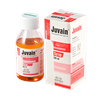
Neurolep 100 ml
Piracetam
Category: Syrup
Manufacturer: Square Pharmaceuticals Ltd.

Price: 151.02 ৳
100 ml bottle

Medicine Selling service is not available yet.
Related Medicines
Uses of Neurolep:
- Alzheimer's disease
- Stroke
- Dementia in Parkinson's disease
- Age related memory loss
- Head injury
Cortical myoclonus, Cognitive enhancer
Hepatic and severe renal impairment. Cerebral haemorrhage. Pregnancy and lactation.
Adjunct anti-epileptic drugs, Drugs used in tremor, tics & related disorder
Piracetam's mechanism of action is not fully understood. The drug influences neuronal and vascular functions and influences cognitive function without acting as a sedative or stimulant. Piracetam is a positive allosteric modulator of the AMPA receptor. It is hypothesized to act on ion channels or ion carriers, thus leading to increased neuron excitability. GABA brain metabolism and GABA receptors are not affected by piracetamIt has been found to increase blood flow and oxygen consumption in parts of the brain, but this may be a side effect of increased brain activity rather than a primary effect or mechanism of action for the drug.Piracetam improves the function of the neurotransmitter acetylcholine via muscarinic cholinergic (ACh) receptors, which are implicated in memory processes. Furthermore, piracetam may have an effect on NMDA glutamate receptors, which are involved with learning and memory processes. Piracetam is thought to increase cell membrane permeability. Piracetam may exert its global effect on brain neurotransmission via modulation of ion channels (i.e., Na+, K+). It has been found to increase oxygen consumption in the brain, apparently in connection to ATP metabolism, and increases the activity of adenylate kinase in rat brains. Piracetam, while in the brain, appears to increase the synthesis of cytochrome b5, which is a part of the electron transport mechanism in mitochondria. But in the brain, it also increases the permeability of the mitochondria of some intermediaries of the Krebs cycle.
How to use
Piracetam:
Take this medicine in the dose and duration as advised by your doctor. Swallow it as a whole. Do not chew, crush or break it.
Piracetam may be taken with or without food, but it is better to take it at a fixed time.
Administration:
Oral soln: May be taken with or without food. Take w/ a glass of water or soft drink to mask bitter taste.
Adult Dose:
Oral
Adjunct in cortical myoclonus
Adult: 7.2 g daily in 2-3 divided doses, increased by 4.8 g/day every 3-4 days. Max dose: 20 g daily.
As a cognitive enhancer in cerebrocortical insufficiency
Adult: 2.4 g daily, given as 2-3 divided doses. Up to 4.8 g daily may be used in severe cases.
Child Dose:
<16 years old: not recommended
> 16 yeras
The daily dosage depends on the weight,
50 mg/kg of body weight in 3 divided doses.
Once the desired results has been obtained, reduce the initial dose by half.
Renal Dose:
Renal impairment:
CrCl (ml/min) Dosage Recommendation
50-79 2/3 usual dose
30-49 1/3 usual dose
20-29 1/6 usual dose
<20 Contra-indicated
May increase prothrombin time in patients who are on warfarin.
Hepatic and severe renal impairment. Cerebral haemorrhage. Pregnancy and lactation.
Common
- Weight gain
- Nervousness
- Abnormality of voluntary movements
Hyperkinesia, nervousness, depression, diarrhoea, rashes. CNS stimulation, sleep disturbances, dizziness, excitement, insomnia, somnolence, wt gain.
Piracetam should not be prescribed during pregnancy or when breast feeding, except under exceptional circumstances. Piracetam is able to cross the placenta.
Precaution:
Avoid abrupt withdrawal. Impaired renal function. Cardiac disorders. Haemostatic disorders. Patients who have recently undergone major surgery. Elderly.
Lactation: contraindicated
Piracetam appears to be devoid of toxicity even at very high doses and, therefore, the need for specific measures to be taken in case of an overdose is avoided. Drug Interactions: In a single case, confusion, irritability and sleep disorders were reported in concomitant use with thyroid extract. At present, no interaction has been observed with the following anti-epileptic drugs, clonazepam, carbamazepine, phenytoin, phenobarbitone and sodium valproate, based on a small number of studies.
Store in a cool and dry place at a temperature below 30˚C , Keep away from sunlight. Keep out of the reach of children.
Adjunct anti-epileptic drugs, Drugs used in tremor, tics & related disorder
Piracetam protects the cerebral cortex against hypoxia. It also inhibits platelet aggregation and reduces blood viscosity.
Piracetam should not be prescribed during pregnancy or when breast feeding, except under exceptional circumstances. Piracetam is able to cross the placenta.

Samm Care