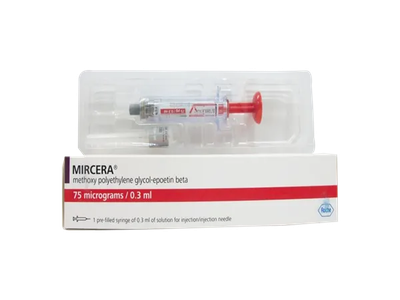
Mircera 75 µg
Generic: Epoetin Beta [Methoxy Polyethyelene Glycol]
Category: Injection
Manufacturer: Roche Bangladesh Ltd.

Price: 9395.52 ৳
75 µg pre-filled syringe

Medicine Selling service is not available yet.
Alternative Brands & Related Medicines
Mircera 50 µg
Epoetin Beta [Methoxy Polyethyelene Glycol]
৳ 6339.2
Mircera 100 µg
Epoetin Beta [Methoxy Polyethyelene Glycol]
৳ 13584.0

0.9% NaCl Saline 9 mg/ml
Sodium Chloride
0.9% Sodium Chloride 9 mg/ml
Sodium Chloride
0.9% Sodium Chloride Inj. 9 mg/ml
Sodium Chloride
0.9% Sodium Chloride Solution 9 mg/ml
Sodium Chloride
Indications
Anaemia associated with chronic kidney disease
Therapeutic Class
Drugs for Haemolytic Hypoplastic & Renal Anemia
Pharmacology
Methoxy Polyethyelene Glycol-Epoetin Beta is an erythropoietin receptor activator with greater activity as well as increased half-life, in contrast to erythropoietin.
Dosage and Administration
Anemia Associated with Chronic Renal Failure:Do not increase dose more frequently than q4 weeks; decreases in dose can occur more frequently; avoid frequent dose adjustmentsIf hemoglobin rises rapidly (e.g., > 1 g/dL in any 2-week period), reduce dose by 25% or more as needed to reduce rapid responsesFor patients who do not respond adequately, if hemoglobin has not increased by >1 g/dL after 4 weeks of therapy, increase dose by 25%For patients who do not respond adequately over a 12-week escalation period, increasing Mircera dose further is unlikely to improve response and may increase risks; use lowest dose that will maintain a hemoglobin level sufficient to reduce need for RBC transfusions; evaluate other causes of anemia; discontinue Mircera if responsiveness does not improvePatients with chronic renal failure on dialysis:Initiate Mircera treatment when hemoglobin level < 10 g/dL If hemoglobin level approaches or exceeds 11 g/dL, reduce or interrupt dose of MirceraDose if not currently on ESA therapy: 0.6 mcg/kg IV/SC q2 week initially Once hemoglobin has been stabilized, dose may be administered once monthly using a dose that is twice that of every-two-week dose and subsequently titrated as necessaryPatients with chronic renal failure not on dialysis:Consider initiating treatment only when hemoglobin level is < 10 g/dL and the following considerations apply. Rate of hemoglobin decline indicates likelihood of requiring a RBC transfusion and reducing risk of alloimmunization and/or other RBC transfusion-related risks is a goalIf hemoglobin level >10 g/dL, reduce or interrupt dose, and use lowest dose sufficient to reduce need for RBC transfusions Dose if not currently on ESA therapy: 0.6 mcg/kg IV/SC q2 week initially Once hemoglobin has been stabilized, Mircera may be administered once monthly using a dose that is twice that of the every-two-week dose and subsequently titrated as necessarySwitching Patients Currently on Other ESA:Receiving epoetin 8000-16000 units/week or darbepoetin 40-80 mcg/week: 200 meg/qmonth or 100 mcg/q2week IV/SC Receiving epoetin >16000 units/week or darbepoetin >80 mcg/week:360 meg/ qmonth or 180 mcg/q2week IV/SC
Interaction
No interaction studies have been performed. There is no evidence that Mircera alters the metabolism of other medicinal products.
Contraindications
Hypersensitivity. Uncontrolled HTN.
Side Effects
Hypertension (13%), Diarrhea (11%), Nasopharyngitis (11%), Headache (9%), Upper respiratory tract infection (9%), Cough (6%), Hypotension (5%), Urinary tract infection (5%), Procedural arteriovenous fistula thrombosis (5%), Coronary artery disease, Anemia, Septic shock, Serious cardiovascular and thromboembolic events, Seizures, Immunogenicity related PRCA, Increased mortality and/or tumor progression in cancer patients, Increased mortality, Concomitant termination of other CRF therapy, Stevens-Johnson syndrome, Toxic epidermal necrolysis
Pregnancy And Lactation
Pregnancy Category - C. Animal reproduction studies have shown an adverse effect on the fetus and there are no adequate and well-controlled studies in humans, but potential benefits may warrant use of the drug in pregnant women despite potential risksLactation: not known if excreted in breast milk, use caution
Precautions And Warnings
Discontinue if pure red cell aplasia. Adequate control of BP. Hemoglobinopathies, seizures, platelet level >500 x 109/L. Patients <18 yr.


Samm Care