
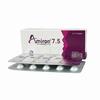
Mirapro 7.5 mg
Mirtazapine
Category: Tablet
Manufacturer: Square Pharmaceuticals Ltd.

Price: 180.0 ৳
30's pack
piece

Medicine Selling service is not available yet.
Related Medicines


Uses of Mirapro:
- Depression
Depression, Major depressive disorder
Mirapro Tablets are contraindicated in patients with a known hypersensitivity to mirtazapine or to any of the excipients.
Atypical anti-depressant drugs
Mirtazapine, a piperazinoazepine tetracyclic antidepressant, enhances noradrenergic and serotonergic activity through blockade of central presynaptic adrenergic α2-receptors.
How to use
Mirtazapine:
Take this medicine in the dose and duration as advised by your doctor. Swallow it as a whole. Do not chew, crush or break it.
Mirtazapine may be taken with or without food, but it is better to take it at a fixed time.
Administration:
May be taken with or without food.
Adult Dose:
Oral
Depression
Adult: Initially, 15 mg daily; may be increased gradually depending on clinical response. Change dose at intervals of at least 1-2 wk. Usual effective dose: 15-45 mg daily given as single dose, preferably at bedtime, or in 2 divided doses.
Elderly
Depression
7.5 mg/day PO qHS; increase by 7.5-15 mg/day no more frequently than q1-2Weeks; not to exceed 45 mg/day
Alzheimer Dementia-related Depression
7.5 mg/day PO qHS; increase by 7.5-15 mg/day no more frequently than q1-2Weeks; not to exceed 60 mg/day
Hepatic impairment: Clearance is reduced; monitor closely
Child Dose:
Safety and efficacy not established
Renal Dose:
Renal impairment (CrCl <39 mL/min): Clearance is reduced; monitor closely
Potentiation of sedative effects with alcohol or benzodiazepines. Increased plasma levels with potent CYP3A4 inhibitors (e.g. HIV-protease inhibitors, azole antifungals including ketoconazole, erythromycin, nefazodone). Reduced plasma levels with carbamazepine and other inducers of CYP3A4. Increased bioavailability with cimetidine.
Potentially Fatal: Do not use with or within 2 wk of stopping an MAOI; at least 1 wk should elapse between discontinuing mirtazapine and initiating any drug which may provoke a serious reaction (e.g. phenelzine).
Mirtazapine Tablets are contraindicated in patients with a known hypersensitivity to mirtazapine or to any of the excipients.
Common
- Sleepiness
- Dryness in mouth
- Increased appetite
- Headache
- Weight gain
>10%
Somnolence (54%),Weight gain (>7% increase in <49% of pediatric patients),Xerostomia (25%),Increased appetite (17%),Constipation (13%)
1-10%
Asthenia (8%),lWeakness (8%),Weight gain (>7% increase in 8% of adults),Dizziness (7%),Serum TGs increased (6%),Dream disorder (4%),Disturbance in thinking (3%),ALT increased (2%),Peripheral edema (2%),Myalgia (2%),Confusion (2%),Urinary frequency (2%),Tremor (2%),Back pain (2%),Dyspnea (1%)
<1%
Mania (0.2%),Grand mal seizure (less than 0.1%)
Frequency Not Defined
Depression exacerbation,Status epilepticus,Suicidal thoughts, suicide (rare),Agranulocytosis,Neutropenia
Mirtazapine Should not be used during pregnancy and lactation.
Precaution:
Epilepsy or history of seizures; avoid completely in unstable cases. Hepatic or renal impairment, cardiac disorders e.g. conduction disturbances, angina pectoris, recent MI. Hypotension, DM, psychoses, history of bipolar disorder. Stop treatment if jaundice develops. Micturition disturbances, angle-closure glaucoma, raised intraocular pressure. Monitor patient for signs of bone marrow depression. Monitor patient for suicidal tendency. Avoid abrupt withdrawal. May impair ability to drive or operate machinery. Pregnancy and lactation. Elderly.
Lactation: Avoid
Symptoms: Disorientation, drowsiness, impaired memory, tachycardia. Management: Ensure an adequate airway, oxygenation, and ventilation. Monitor cardiac functions. General supportive and symptomatic measures are also recommended. Do not induce emesis. Gastric lavage may be used if done soon after ingestion, or in symptomatic patients. Administer activated charcoal. No specific antidotes are known.
Keep away from light and moisture. Store below 30º C. Keep all medicine out of the reach of children.
Atypical anti-depressant drugs
Mirtazapine, a piperazinoazepine tetracyclic antidepressant, enhances noradrenergic and serotonergic activity through blockade of central presynaptic adrenergic alpha 2-receptors.
Pregnancy Category-C. Patients should be advised to notify their physician if they become pregnant or intend to become pregnant during Mirtazapine therapy. Patients should be advised to notify their physician if they are breastfeeding an infant.

Samm Care