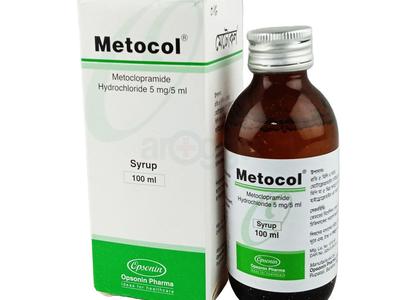
Metocol 5 mg/5 ml
Metoclopramide Hydrochloride
Category: Syrup
Manufacturer: Opsonin Pharma Limited

Allopathic
MFG. Licence No. Biological
012
MFG. Licence No. Non-Biological
080
Address
Rupatali,
Price: 14.28 ৳
100ml bot
100 ml bottle

Medicine Selling service is not available yet.
Related Medicines


Uses of Metocol:
- Nausea
- Vomiting
- Indigestion
Gastro-oesophageal reflux disease, Diabetic gastric stasis, Nausea and vomiting associated w/ cancer chemotherapy or radiotherapy, Postoperative nausea and vomiting
GI haemorrhage, mechanical obstruction or GI perforation; confirmed or suspected pheochromocytoma; history of neuroleptic or metoclopramide-induced tardive dyskinesia; epilepsy, Parkinson's disease; history of methaemoglobinaemia w/ metoclopramide or of NADH cytochrome-b5 deficiency. Concomitant use w/ levodopa or dopaminergic agonists.
Anti-emetic drugs, Prokinetic drugs
Metoclopramide blocks dopamine receptors and in higher doses, it also blocks serotonin receptors in chemoreceptor trigger zone of the CNS. It enhances the response to acetylcholine of tissue in upper GI tract causing enhanced motility and accelerated gastric emptying w/o stimulating gastric, biliary, or pancreatic secretions. It also increases lower esophageal sphincter tone.
How to use
Metoclopramide Hydrochloride:
Take this medicine in the dose and duration as advised by your doctor. Swallow it as a whole. Do not chew, crush or break it.
Metoclopramide Hydrochloride is to be taken empty stomach.
Administration:
Should be taken on an empty stomach. Take ½ hr before meals.
IV Administration
NS is preferred diluent because drug is most stable in this solution
Dose <10 mg: IV push over 1-2 minutes
Dose >10 mg: Dilute in 50 mL D5W or NS, and infuse over at least 15 minutes
Adult Dose:
Oral
Diabetic gastric stasis
Adult: 10 mg 4 times daily for 2-8 wk.
Nausea and vomiting associated with cancer chemotherapy or radiotherapy
Adult: 10 mg, up to tid. Max duration: 5 days.
Gastro-oesophageal reflux disease
Adult: 10-15 mg 4 times daily, depending on severity of symptoms. If symptoms are intermittent, may give single doses of 20 mg prior to provoking situation. Max duration: 12 wk.
Elderly: 5 mg/dose.
Parenteral
Diabetic gastric stasis
Adult: 10 mg 4 times daily by IM inj or slow IV inj over 1-2 min for up to 10 days. Convert to oral admin when symptoms subside sufficiently.
Intravenous
Prophylaxis of chemotherapy-induced nausea and vomiting
Adult: For highly emetogenic drugs/regimens: Initially, 2 mg/kg by slow inj over at least 15 min, 30 min before chemotherapy. Repeat 2 hrly for 2 doses, then 3 hrly for 3 doses. For less emetogenic drugs/regimens: 1 mg/kg may be used. Max duration: 5 days.
Premedication for radiologic examination of the upper gastrointestinal tract; Intubation of the small intestine
Adult: 10 mg as a single dose by slow inj over 1-2 min.
Parenteral
Prophylaxis of postoperative nausea and vomiting
Adult: 10 mg as a single dose by IM or slow IV inj over at least 3 min.
Hepatic impairment: Severe: Reduce dose by 50%.
Child Dose:
Small Bowel Intubation/Radiologic Examination of Upper GI Tract
<6 years old: 0.1 mg/kg IV over 1-2 minutes
6-14 years old: 2.5-5 mg IV over 1-2 minutes
>14 years old: 10 mg IV over 1-2 minutes
Gastroesophageal Reflux Disease
Neonate: 0.15 mg/kg IV q6hr
Infant: 0.1 mg/kg IV/IM/PO q6-8hr 30 minutes before meals and at bedtime
Not to exceed 0.3-0.75 mg/kg/day
Diabetic Gastroparesis
<6 years old: 0.1 mg/kg PO q8hr; not to exceed 0.1 mg/kg
>6 years old: 0.5 mg/kg/day PO divided q8hr
Postoperative Nausea & Vomiting
0.1-2 mg/kg IV q6-8hr PRN
Chemotherapy-Induced Nausea & Vomiting
1-2 mg/kg IV (infused over at least 15 minutes) 30 minutes before chemotherapy; repeat q2-4hr; pretreatment with diphenhydramine decreases risk of extrapyramidal adverse effects
Renal Dose:
Renal impairment: CrCl <40 mL/min, decrease dose by 50%; CrCl <10 mL/min, decrease dose by 75%
Increased sedative effects with CNS depressants. GI effects antagonised by antimuscarinics and opioids. Reduces absorption of digoxin. Increases absorption of ciclosporin, levodopa, aspirin, paracetamol. Interferes with hypoprolactinaemic effect of bromocriptine. Inhibits serum cholinesterase and prolongs neuromuscular blockade produced by suxamethonium and mivacurium.
Potentially Fatal: Serotonin syndrome with sertraline (SSRI).
GI haemorrhage, mechanical obstruction or GI perforation; confirmed or suspected pheochromocytoma; history of neuroleptic or metoclopramide-induced tardive dyskinesia; epilepsy, Parkinson's disease; history of methaemoglobinaemia w/ metoclopramide or of NADH cytochrome-b5 deficiency. Concomitant use w/ levodopa or dopaminergic agonists.
Common
- Restlessness
- Sleepiness
- Fatigue
>10%
Extrapyramidal symptoms (dystonic reactions in 25% of young adults 18-30 years old)
1-10%
Fatigue (2-10%),Restlessness (10%),Sedation (10%),Headache (4-5%),Dizziness (1-4%),Somnolence (2-3%)
Frequency Not Defined
Diarrhea,Nausea,Galactorrhea,Gynecomastia,Impotence,Menstrual disorders,Neuroleptic malignant syndrome,Hematologic abnormalities
Potentially Fatal: Neuroleptic malignant syndrome; cardiac conduction disorders may occur with IV dosage form.
Category B: Either animal-reproduction studies have not demonstrated a foetal risk but there are no controlled studies in pregnant women or animal-reproduction studies have shown an adverse effect (other than a decrease in fertility) that was not confirmed in controlled studies in women in the 1st trimester (and there is no evidence of a risk in later trimesters).
Precaution:
Patients w/ underlying neurological conditions, cardiac conduction disturbances, uncorrected electrolyte imbalance, bradycardia. Children, elderly. Renal or hepatic impairment, porphyria, epilepsy, Parkinson's disease, history of depression. Ability to drive or operate machineries may be impaired. Pregnancy and lactation. Monitor patients on prolonged therapy. Increased risk of tardive dyskinesia in patients on prolonged or high-dose treatment.
Lactation: Drug crosses into breast milk; use caution; concern may be warranted according to American Academy of Pediatrics
Symptoms: Extrapyramidal disorders, drowsiness, decreased level of consciousness, confusion, hallucination, cardiorespiratory arrest. Management: Symptomatic treatment with continuous monitoring of CV and resp functions. In case of extrapyramidal symptoms, treatment is symptomatic (benzodiazepines in childn and/or anticholinergic antiparkinsonian medicinal products in adults).
Store between 20-25°C. Protect from light.
Anti-emetic drugs, Prokinetic drugs
Metoclopramide enhances the motility of the upper GI tract and increases gastric emptying without affecting gastric, biliary or pancreatic secretions. It increases duodenal peristalsis which decreases intestinal transit time, and increases lower oesophageal sphincter tone. It is also a potent central dopamine-receptor antagonist and may also have serotonin-receptor (5-HT3) antagonist properties.
Pregnancy Category B. Reproduction studies performed in rats, mice and rabbits by the IM, IV, subcutaneous (SC), and oral routes at maximum levels ranging from 12 to 250 times the human dose have demonstrated no impairment of fertility or significant harm to the fetus due to metoclopramide. There are, however, no adequate and well-controlled studies in pregnant women. Because animal reproduction studies are not always predictive of human response, this drug should be used during pregnancy only if clearly needed.Nursing Mothers: Metoclopramide is excreted in human milk. Caution should be exercised when metoclopramide is administered to a nursing mother.


Samm Care