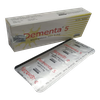
Memanto 10 10 mg
Memantine Hydrochloride
Category: Tablet
Manufacturer: Eskayef Pharmaceuticals Ltd., Tongi,Gazipur

Eskayef Pharmaceuticals Ltd., Tongi,Gazipur
Allopathic
MFG. Licence No. Biological
215
MFG. Licence No. Non-Biological
449
Address
400 Tongi/ I/A. Squibb Road, Gazipur.
Price: 18.0 ৳
10 in Blister Pack

Medicine Selling service is not available yet.
Related Medicines

Uses of Memanto 10:
- Alzheimer's disease
Alzheimer's dementia.
Hypersensitivity to memantine or components of the formulation. Severe renal impairment.
Anti - Alzheimer drugs, Drugs for Dementia
Persistent activation of N-methyl-D-aspartate (NMDA) receptors in Central Nervous System by the excitatory amino acid glutamate has been hypothesized to contribute to the symptomatology of Alzheimer's disease. Memantine is postulated to exert its therapeutic effect through its action as a low to moderate affinity as an uncompetitive (open-channel) NMDA receptor antagonist which binds preferentially to the NMDA receptor-operated cation channels.
How to use
Memantine Hydrochloride:
Take this medicine in the dose and duration as advised by your doctor. Swallow it as a whole. Do not chew, crush or break it.
Memantine Hydrochloride may be taken with or without food, but it is better to take it at a fixed time.
Administration:
May be taken with or without food.
Adult Dose:
Oral
Moderate to severe dementia in Alzheimer's disease
Adult: As hydrochloride: Initially, 5 mg daily in the morning for the 1st wk; increase dose wkly in steps of 5 mg. Max: 20 mg daily. Wait for at least 1 wk between dose changes. Doses >10 mg/day should be given in 2 divided doses.
Suggested titration: 5 mg daily for >1 wk; 5 mg bid for >1 wk; 15 mg daily given in 5- and 10-mg separated doses for >1 wk; then 10 mg bid.
Hepatic impairment
Mild or moderate (Child Pugh A/B): No dosage adjustment required
Severe (Child Pugh C): Caution
Renal Dose:
Renal impairment:
CrCl (ml/min) Dosage Recommendation
5-29 Max: 10 mg daily.
30-49 10 mg daily (after initial dose of 5 mg daily), if well tolerated for at least 7 days, may increase to 20 mg daily.
May increase effects of antimuscarinics and dopaminergics. May reduce effects of antipsychotics and barbiturates. May alter effects of dantrolene, baclofen. Reduced clearance with carbonic anhydrase inhibitors and sodium bicarbonate.
Potentially Fatal: Increased risk of adverse effects with amantadine, dextromethorphan or ketamine.
Hypersensitivity to memantine or components of the formulation. Severe renal impairment.
Common
- Dizziness
- Headache
- Confusion
- Sleepiness
- Diarrhea
- Abnormal liver function tests
- Balance disorder (loss of balance)
- Breathlessness
- Pulmonary hypertension (high blood pressure)
- Hypersensitivity
1-10%
Dizziness (7%),Confusion (6%),Headache (6%),Constipation (5%),Cough (4%),Hypertension (4%),Backache (3%),Pain (3%),Somnolence (3%),Syncope (3%),Vomiting (3%),Dyspnea (2%),Fatigue (2%)
<1%
Acute renal failure,Cerebral infarction,Cerebrovascular accident,Deep venous thrombosis,Hepatitis, liver failure,Intracranial hemorrhage,Neuroleptic malignant syndrome,Seizure (including grand mal),Stevens-Johnson syndrome,Transient ischemic attack
Pregnancy Category B. Yet there are no adequate and well controlled studies of Memantine in pregnant women. Memantine should be used during pregnancy only if the potential benefit justifies the potential risk to the fetus. It is not known whether Memantine is excreted in human breast milk. Because many drugs are excreted in human milk, caution should be exercised when Memantine is administered to a nursing mother.
Precaution:
Renal impairment; epilepsy. Pregnancy and lactation. Closely monitor patients with recent MI, uncompensated CHF, uncontrolled hypertension. Predisposition to convulsions; conditions that increase urinary pH.
Lactation: Unknown whether drug is excreted into breast milk; use with caution
Symptoms: Agitation, asthenia, bradycardia, vomiting, dizziness, vertigo, ECG changes, increased BP, visual hallucinations, confusion, lethargy, restlessness, slowed movement, somnolence, stupor, unsteady gait, weakness, loss of consciousness, psychosis, coma. Management: Symptomatic and supportive treatment. May increase elimination by urinary acidification.
Store in a cool and dry place, protected from light. Keep this medication out of reach of children.
Memantine, a derivative of amantadine, is a noncompetitive N-methyl-D-aspartate (NMDA)-receptor antagonist. It affects transmission of glutamate, the primary excitatory neurotransmitter in the CNS. Glutamate may contribute to the pathogenesis of Alzheimer's disease by overstimulating various glutamate receptors resulting in excitotoxicity and neuronal cell death.
Pregnancy Category B. Yet there are no adequate and well controlled studies of Memantine in pregnant women. Memantine should be used during pregnancy only if the potential benefit justifies the potential risk to the fetus. It is not known whether Memantine is excreted in human breast milk. Because many drugs are excreted in human milk, caution should be exercised when Memantine is administered to a nursing mother.

Samm Care