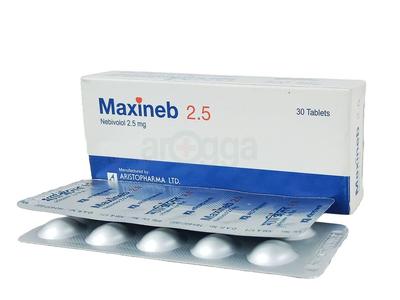
Maxineb 2.5 2.5 mg
Nebivolol
Category: Tablet
Manufacturer: Aristopharma Ltd.

Price: 63.58 ৳
Strip

Medicine Selling service is not available yet.
Related Medicines

Uses of Maxineb 2.5:
- Hypertension (high blood pressure)
Heart failure, Hypertension
Hepatic impairment, sick sinus syndrome, 2nd and 3rd degree heart block (without a pacemaker), history of asthma, metabolic acidosis, severe peripheral arterial disease, severe bradycardia, cardiogenic shock or decompensated heart failure, untreated phaeochromocytoma. Pregnancy and lactation.
Beta-adrenoceptor blocking drugs, Beta-blockers
Nebivolol is a β-adrenergic receptor blocking agent. Nebivolol is a racemate of two enantiomers, d-Nebivolol and l-Nebivolol. Nebivolol exhibits high selectivity for β1-adrenergic receptors and has vasodilating activity due to a direct action on the endothelium, involving nitric oxide release. It lacks intrinsic sympathomimetic and membrane-stabilising activity.
How to use Nebivolol:
Take this medicine in the dose and duration as advised by your doctor. Swallow it as a whole. Do not chew, crush or break it. Nebivolol may be taken with or without food, but it is better to take it at a fixed time.
Administration:
May be taken with or without food.
Adult Dose:
Oral
Hypertension
Adult: Initially, 5 mg once daily. May increase dose at intervals of 2 wk if needed. Max: 40 mg once daily.
Elderly: >65 yr Initially, 2.5 mg once daily increased to 5 mg once daily if required.
Oral
Heart failure
Adult: Initially, 1.25 mg once daily. May double dose every 1-2 wk if tolerated. Max: 10 mg once daily.
Hepatic impairment
2.5 mg/day PO initially; increased cautiously
Renal Dose:
Renal impairment: CrCl <30 mL/min: Initially, 2.5 mg once daily. Maintenance: Increased to 5 mg once daily if required.
Increased plasma concentrations w/ potent CYP2D6 inhibitors (e.g. paroxetine, fluoxetine, propafenone, thioridazine, quinidine). Concomitant use w/ antiarrhythmic drugs (e.g. amiodarone, disopyramide) or nondihydropyridine Ca channel blockers (e.g. diltiazem, verapamil) may cause conduction disturbance. Additive negative effects on AV conduction and heart rate w/ other beta-adrenergic blocking agents or digoxin. Concurrent admin w/ catecholamine-depleting agents (e.g. reserpine) may result in additive hypotension or bradycardia. Abrupt withdrawal of clonidine may increase risk of rebound HTN.
Hepatic impairment, sick sinus syndrome, 2nd and 3rd degree heart block (without a pacemaker), history of asthma, metabolic acidosis, severe peripheral arterial disease, severe bradycardia, cardiogenic shock or decompensated heart failure, untreated phaeochromocytoma. Pregnancy and lactation.
Common
- Nausea
- Headache
- Fatigue
- Constipation
- Diarrhea
- Dizziness
- Cold extremities
1-10%
Headache (6-9%),Fatigue (2-5%),Dizziness (2-4%),Diarrhea (2-3%),Nausea (1-3%),Increased triglyceride levels and insulin resistance, decreased high-density lipoprotein (HDL) levels (1%),Insomnia (1%),Peripheral edema (1%),Weakness (1%)
<1%
Bradycardia.Chest pain,Dyspnea
Potentially Fatal: Anaphylaxis.
Pregnancy category C and not recommended during nursing.
Precaution:
Patients w/ inadequate cardiac function, well-compensated heart failure, myasthenia gravis. Patients undergoing major surgery involving general anaesth. May mask signs and symptoms of hypoglycaemia and hyperthyroidism. Abrupt withdrawal may exacerbate angina symptoms and/or precipitate MI and ventricular arrhythmias in patients w/ coronary artery disease. Pregnancy and lactation. Monitoring Parameters Monitor ECG, BP and blood glucose in diabetic patients.
Lactation: Not known whether drug is excreted into breast milk; use not recommended
Symptoms: Bradycardia, hypotension, cardiac failure, dizziness, fatigue, hypoglycaemia, vomiting, bronchospasm, heart block. Management: Symptomatic and supportive treatment. IV atropine may be given for bradycardia, if it persists, admin IV isoproterenol cautiously. For hypotension, admin IV fluids and vasopressors. IV glucagon may also be useful. A β2-agonist and/or aminophylline for bronchospasm. Admin IV glucose for hypoglycaemia and an IV cardiac glycoside and diuretic may be used for CHF.
Store between 20-25° C. Protect from light. Keep out of the reach of children.
Nebivolol exhibits high selectivity for beta1-adrenergic receptors and has vasodilating activity due to a direct action on the endothelium, involving nitric oxide release. It lacks intrinsic sympathomimetic and membrane-stabilising activity.


Samm Care