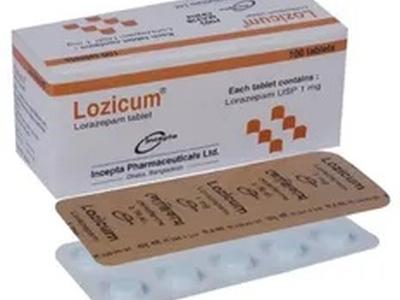
Lozicum 1 mg
Lorazepam
Category: Tablet
Manufacturer: Incepta Pharmaceuticals Ltd.

Allopathic
MFG. Licence No. Biological
193
MFG. Licence No. Non-Biological
108
Address
Zirabo, Savar, Dhaka Dewan Idris Road, Bara Rangamatia
Price: 200.0 ৳
100's pack
10's Strip

Medicine Selling service is not available yet.
Related Medicines


Uses of Lozicum:
- Short term anxiety
- Anxiety disorder
Anxiety, Status epilepticus, Sedation, psychosomatic, organic or psychotic illness, insomnia associated with anxiety, nervousness, restlessness, nausea and vomiting, related to chemotherapy and anticonvulsants, and as a premedicant before dental or general surgery or prior to investigative procedures where there may be discomfort.
Severe hepatic impairment; respiratory depression; acute narrow-angle glaucoma; pregnancy and lactation.
Benzodiazepine hypnotics, Benzodiazepine sedatives
Lorazepam is a short-acting tranquilizer of the benzodiazepine group. It is an agonist at benzodiazepine receptors in the CNS. It exerts a depressant action on the CNS, which may be mediated by potentiating the inhibitory actions of GABA (gamma amino butyric acid) in the CNS. This will result in diminution of the ascending activating systems, particularly the serotonergic and noradrenergic pathway from brain stem or the mid-brain to the cerebral cortex.
How to use
Lorazepam:
Take this medicine in the dose and duration as advised by your doctor. Swallow it as a whole. Do not chew, crush or break it.
Lorazepam may be taken with or without food, but it is better to take it at a fixed time.
Administration:
May be taken with or without food.
Reconstitution: Dilute w/ an equal volume of compatible diluent (e.g. sterile water for inj, NaCl 0.9% inj, dextrose 5% inj).
Oral concentrate soln: Dose should be added to 30 mL or more of diluent (e.g. water, juice, carbonated or soda-like beverage) or to semi-solid food (e.g. applesauce, pudding).
Adult Dose:
Oral
Anxiety Disorders
Adult: 1-6 mg/day in 2 or 3 divided doses, up to 10 mg/day.
Insomnia associated w/ anxiety
1-4 mg/day at bedtime.
Premed in surgery
2-3 mg the night before operation, then a smaller dose in the morning if needed.
Parenteral
Preoperative Sedation, Anxiety Relief, & Anterograde Amnesia
0.05 mg/kg IM for 1 dose; 2 hours before surgery; not to exceed 4 mg (2 mg/dose in elderly), OR
0.044 mg/kg IV for 1 dose; 15-20 minutes before surgery; not to exceed 4 mg (2 mg/dose in elderly)
Status Epilepticus
Usual 4 mg/dose slow IV at 2 mg/min
If seizure persists after 5-10 min, administer 4 mg IV again
Anxiolytic/Sedation in ICU
Intubated and mechanically ventilated patients
0.02-0.04 mg/kg loading dose IV
0.02-0.06 mg/kg intermittent IV q2-6hr PRN, OR
0.01-0.1 mg/kg/hr continuous IV; not to exceed 10 mg/hr
Elderly: Half the usual adult dose or less.
Hepatic impairment: Mild to moderate: May require reduced doses. Severe: Contraindicated.
Child Dose:
Status Epilepticus
Infants and children: 0.05-0.1 mg/kg IV over 2-5 minutes; not to exceed 4 mg/dose; may repeat q10-15min PRN
Alternatively, 0.1 mg/kg at slow IV rate not to exceed rate of 2 mg/min; not to exceed dose of 4 mg
Adolescents: 4 mg slow IV; if seizure persists after 10-15 minutes, administer 4 mg IV again
Renal Dose:
Renal impairment
PO: Dose adjustment not necessary
IV/IM: Use with caution in mild-to-moderate impairment; not recommended in severe impairment or renal failure
Drugs that affect the CNS (e.g. barbiturates, phenothiazines, antidepressants, MAOIs) may have additive CNS effects. Scopolamine may increase sedation, hallucinations and irrational behaviour. May reduce sedative and anxiolytic effect w/ caffeine, theophylline or aminophylline. May increase plasma level w/ Na valproate or probenecid.
Severe hepatic impairment; respiratory depression; acute narrow-angle glaucoma; pregnancy and lactation.
Common
- Dizziness
- Weakness
- Sedation
- Balance disorder (loss of balance)
Sedation, drowsiness, ataxia, dizziness, confusion, depression, unmasking of depression, hypotension, fatigue, muscle weakness, asthenia, transient anterograde amnesia or memory impairment, changes in vital signs (e.g. resp rate, BP). Thrombocytopenia, agranulocytosis, pancytopenia, hyponatraemia, disinhibition, euphoria, suicidal ideation, nausea, constipation, change in libido, impotence, decreased orgasm. Increase in bilirubin, liver transaminases or alkaline phosphatase.
Potentially Fatal: Resp depression.
Safety of Lorazepam in pregnancy has not been established. Because the use of this drug is rarely a matter of urgency, the use of Lorazepam during this period should almost always be avoided.It is not known whether oral Lorazepam is excreted in human milk like other benzodiazepine tranquilizers. As a general rule, nursing should not be undertaken while a patient is on a drug since many drugs are excreted in human milk.
Precaution:
Patient w/ compromised pulmonary function (decreased reserve), myasthenia gravis, CV or cerebrovascular disease, impaired gag reflex; at risk of falls. Patient w/ history of alcohol or drug abuse and those w/ personality disorders. Not intended for treatment of primary depressive or psychotic disorders. It should not be administered by intra-arterial inj. Avoid abrupt withdrawal. Renal and mild to moderate hepatic impairment. Elderly or debilitated patients, childn. Pregnancy and lactation. Patient Counselling May impair ability to perform activities requiring mental alertness or physical coordination (e.g. driving, operating machinery) for 24-48 hr following admin of the drug. Monitoring Parameters Monitor resp and CV status, BP, heart rate, symptoms of anxiety, CBC and LFTs.
Lactation: Excreted in human breast milk; not recommended
Overdosage of Lorazepam is usually manifested by varying degrees of central nervous system depression ranging from drowsiness to coma. In mild cases, symptoms include drowsiness, mental confusion and lethargy. In more serious cases and especially when other drugs or alcohol were ingested, symptoms may include ataxia, hypotonia, hypotension, hypnotic states (stages I to III), coma.
Store between 20-25°C
Benzodiazepine hypnotics, Benzodiazepine sedatives
Lorazepam is a short acting benzodiazepine. It increases neuronal membrane permeability to Cl ions by binding to stereospecific benzodiazepine receptors on the postsynaptic GABA neuron w/in the CNS (including the limbic system, reticular formation) and enhancing the GABA inhibitory effects resulting in hyperpolarisation and stabilisation.
Safety of Lorazepam in pregnancy has not been established. Because the use of this drug is rarely a matter of urgency, the use of Lorazepam during this period should almost always be avoided.It is not known whether oral Lorazepam is excreted in human milk like other benzodiazepine tranquilizers. As a general rule, nursing should not be undertaken while a patient is on a drug since many drugs are excreted in human milk.


Samm Care