
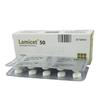
Lamopil 50
Lamotrigine
Category: Tablet
Manufacturer: Sun Pharmaceutical (Bangladesh) Ltd.


Medicine Selling service is not available yet.
Related Medicines

Uses of Lamopil 50:
- Epilepsy/Seizures
- Bipolar disoder
Epilepsy,—adjunctive therapy in patients aged 2 years and older:
• partial-onset seizures.
• primary generalized tonic-clonic seizures.
• generalized seizures of Lennox-Gastaut syndrome
Epilepsy,—monotherapy in patients aged 16 years and older
Bipolar disorder
Hypersensitivity.
Primary anti-epileptic drugs
Lamotrigine controls epileptic seizures by inhibiting voltage-sensitive sodium channels, thereby stabilizes neuronal membranes and consequently inhibits presynaptic excitatory neurotransmitter (e.g., glutamate and aspartate) release.
How to use
Lamotrigine:
Take this medicine in the dose and duration as advised by your doctor. Swallow it as a whole. Do not chew, crush or break it.
Lamotrigine may be taken with or without food, but it is better to take it at a fixed time.
Administration:
May be taken with or without food.
Adult Dose:
Oral
Epilepsy
Adult: Initially, 25 mg once daily for 2 wk followed by 50 mg once daily for 2 wk; thereafter, increase the dose by a max of 50-100 mg every 1-2 wk to usual maintenance doses of 100-200 mg daily, as a single dose or in 2 divided doses. Some patients may require up to 500 mg daily.
Adjunct in epilepsy
Adult: With valproate: Initially, 25 mg on alternate days for 2 wk followed by 25 mg once daily for 2 wk; thereafter, increase by a max of 25-50 mg every 1-2 wk; usual maintenance doses: 100-200 mg daily in 1-2 divided doses.
With enzyme-inducing antiepileptics but not with valproate: 50 mg once daily for 2 wk followed by 50 mg bid for 2 wk; thereafter, increase by a max of 100 mg every 1-2 wk; usual maintenance doses: 200-400 mg/day in 2 divided doses; up to 700 mg/day in some patients.
With oxcarbazepine but no enzyme-inducing or -inhibiting antiepileptics: 25 mg once daily for 2 wk followed by 50 mg once daily for 2 wk; thereafter increase dose by a max of 50-100 mg every 1-2 wk; usual maintenance doses: 100-200 mg daily in 1-2 divided doses; up to 500 mg daily in some patients.
Bipolar disorder
Adult: Monotherapy: Initially, 25 mg once daily for 2 wk followed by 50 mg once daily for 2 wk; thereafter, double the daily dose at wkly intervals to usual maintenance dose of 200 mg daily. Max dose: 200 mg/day.
With valproate: Initially, 25 mg every other day for 2 wk followed by 25 mg once daily for 2 wk; thereafter, double the daily dose at wkly intervals to usual maintenance dose of 100 mg daily.
With enzyme-inducing antiepileptics but not with valproate: Initially, 50 mg once daily for 2 wk followed by 100 mg daily in 2 divided doses for 2 wk; thereafter, increase in 100-mg increments wkly to usual maintenance dose of 400 mg daily in 2 divided doses.
Hepatic impairment: Moderate impairment (Child-Pugh category B): Reduce dose by about 50%. Severe impairment (Child-Pugh category C): Reduce dose by about 75%.
Child Dose:
Oral
Epilepsy
Child: >12 yr: Initially, 25 mg once daily for 2 wk followed by 50 mg once daily for 2 wk; thereafter, increase the dose by a max of 50-100 mg every 1-2 wk to usual maintenance doses of 100 -200 mg daily, as a single dose or in 2 divided doses. Some patients may require up to 500 mg daily.
<12 yr: Not recommended.
Adjunct in epilepsy
Child: With valproate: Initially, 0.15 mg/kg once daily for 2 wk followed by 0.3 mg/kg once daily for 2 wk; thereafter, increase by a max of 0.3 mg/kg every 1-2 wk to usual maintenance doses of 1-5 mg/kg once daily or in 2 divided doses.
Renal Dose:
Renal impairment
Use caution; may consider reduce the dose in significant renal impairment
Metabolism enhanced by enzyme-inducing drugs e.g. phenytoin, carbamazepine, phenobarbitone, primidone, rifampicin, ethinyloestradiol/levonorgestrel combination. Metabolism reduced by sodium valproate.
Hypersensitivity.
Common
- Skin rash
- Headache
- Nausea
- Vomiting
- Dryness in mouth
- Insomnia (difficulty in sleeping)
- Sleepiness
- Dizziness
- Back pain
- Abdominal pain
- Blurred vision
- Double vision
- Impaired coordination
- Nasal congestion (stuffy nose)
- Infection
>10%
Dizziness (38%),Diplopia (26-30%),Headache (29%),Ataxia (22%),Blurred vision (16-20%),Rhinitis (11-15%),Somnolence (14%)
1-10%
Insomnia (6-10%),Fatigue (8%),Chest pain (5%),Peripheral edema (2-5%),Suicidal ideation (2-5%),Dermatitis (2-5%),Dry skin (2-5%),Increased libido (2-5%),Rectal hemorrhage (2-5%),Weakness (2-5%),Agitation (1-5%),Dysarthria (1-5%),Edema (1-5%),Fever (1-5%),Migraine (1-5%),Abnormal thoughts (1-5%),Urinary frequency (1-5%),Tremor (4%)
Frequency Not Defined
Palpitations,Anxiety,Chills,Depression,Decreased memory,Emotional lability,Incoordination,Malaise,Seizure exacerbation,Vertigo,Pruritus,Rash,Amenorrhea,Hot flashes,Abdominal pain,Constipation,Diarrhea,Dyspepsia,Nausea,Vomiting,Arthralgia,Neck pain,Cough,Flu syndrome,Infection,Vaginitis,Nystagmus
Potentially Fatal: Stevens-Johnson syndrome and toxic epidermal necrolysis.
Pregnancy category C. Either studies in animals have revealed adverse effects on the fetus (teratogenic or embryocidal or other) and there are no controlled studies in women or studies in women and animals are not available. Drugs should be given only if the potential benefit justifies the potential risk to the fetus.Nursing Mothers: Lamotrigine is present in milk from lactating women taking Lamotrigine.
Precaution:
Hepatic or renal impairment. Closely monitor patient. Monitor children's body wt. Advise patient to report any hypersensitivity reaction. Avoid abrupt withdrawal unless severe skin reactions have developed. May impair ability to drive or operate machinery. Pregnancy and lactation. Serious skin rashes, Blood Dyscrasias, Suicidal Behavior, Aseptic Meningitis can occur in both adult and pediatric population.
Lactation: Distributed into human breast milk; caution advised
Overdose has resulted in ataxia, nystagmus, seizures (including tonic-clonic seizures), decreased level of consciousness, coma, and intraventricular conduction delay.
Store below 30°C. Protect from light and moisture. Keep out of the reach of children.
Primary anti-epileptic drugs
Lamotrigine inhibits voltage-sensitive sodium channels, thereby stabilising neuronal membranes and consequently inhibiting pathological release of excitatory amino acids (e.g. glutamate and aspartate). These amino acids play a role in the generation and spread of epileptic seizures.
Pregnancy Category C. Lamotrigine is excreted in human milk. Because of the potential for serious adverse reactions in nursing infants from Lamotrigine, a decision should be made whether to discontinue nursing or discontinue the drug, taking into account the importance of the drug to the mother.

Samm Care