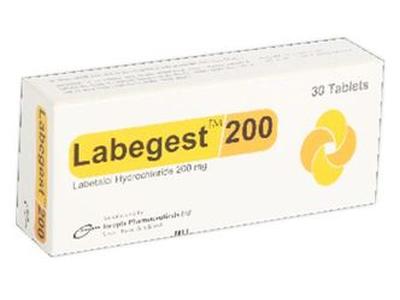
Labegest 200 200 mg
Labetalol Hydrochloride
Category: Tablet
Manufacturer: Incepta Pharmaceuticals Ltd.

Allopathic
MFG. Licence No. Biological
193
MFG. Licence No. Non-Biological
108
Address
Zirabo, Savar, Dhaka Dewan Idris Road, Bara Rangamatia
Price: 90.0 ৳
Strip

Medicine Selling service is not available yet.
Related Medicines
Uses of Labegest 200:
- Hypertension (high blood pressure)
- Angina (heart-related chest pain)
- Prevention of heart attack and stroke
Hypertension, Hypotensive anaesthesia
2nd and 3rd degree heart block, cardiogenic shock, obstructive airway disease e.g. bronchial asthma, uncompensated heart failure, severe bradycardia, sick sinus syndrome, Prinzmetal's angina, severe peripheral arterial disease.
Alpha adrenoceptor blocking drugs, Beta-adrenoceptor blocking drugs
Labetalol competitively inhibits the adrenergic stimulation of β-receptors within the myocardium, bronchial and vascular smooth muscle, and α1-receptors w/in vascular smooth muscle. It also has some intrinsic β2-agonist and membrane-stabilising activity.The capacity of labetalol HCl to block alpha receptors in man has been demonstrated by attenuation of the pressor effect of phenylephrine and by a significant reduction of the pressor response caused by immersing the hand in ice-cold water (“cold-pressor test”). Labetalol HCl's beta1-receptor blockade in man was demonstrated by a small decrease in the resting heart rate, attenuation of tachycardia produced by isoproterenol or exercise, and by attenuation of the reflex tachycardia to the hypotension produced by amyl nitrite. Beta2-receptor blockade was demonstrated by inhibition of the isoproterenol-induced fall in diastolic blood pressure. Both the alpha- and beta-blocking actions of orally administered labetalol HCl contribute to a decrease in blood pressure in hypertensive patients. Labetalol HCl consistently, in dose-related fashion, blunted increases in exercise-induced blood pressure and heart rate, and in their double product. The pulmonary circulation during exercise was not affected by labetalol HCl dosing.Single oral doses of labetalol HCl administered to patients with coronary artery disease had no significant effect on sinus rate, intraventricular conduction, or QRS duration. The atrioventricular (A-V) conduction time was modestly prolonged in two of seven patients. In another study, IV labetalol HCl slightly prolonged A-V nodal conduction time and atrial effective refractory period with only small changes in heart rate. The effects on A-V nodal refractoriness were inconsistent.Labetalol HCl produces dose-related falls in blood pressure without reflex tachycardia and without significant reduction in heart rate, presumably through a mixture of its alpha- and beta-blocking effects. Hemodynamic effects are variable, with small, nonsignificant changes in cardiac output seen in some studies but not others, and small decreases in total peripheral resistance. Elevated plasma renins are reduced.
How to use
Labetalol Hydrochloride:
Take this medicine in the dose and duration as advised by your doctor. Swallow it as a whole. Do not chew, crush or break it.
Labetalol Hydrochloride is to be taken with food.
Administration:
Should be taken with food. Take immediately after meals.
IV Preparation
Standard diluent: 500 mg/250 mL D5W
Minimum volume: 250 mL D5W
IV Administration
Requires infusion pump
Slow direct IV push administered over 2 minutes
Loading infusions (2 mg/min) require close monitoring of HR and BP and are terminated after response occurs or a cumulative dose of 300 mg is reached
Continuous infusions of 2-6 mg/hr have been used in some settings and should not be confused with loading infusions
Adult Dose:
Oral
Hypertension
Adult: Initially, 100 mg bid, may increase gradually according to patients response to 200-400 mg bid. Max: 2.4 g/day in 2-4 divided doses.
Elderly: Initially, 50-100 mg bid. Maintenance: 100-200 mg bid.
Intravenous
Emergency treatment of hypertension
Adult: 20 mg injected slowly for at least 2 min, followed by 40-80 mg dose every 10 min, if necessary up to 300 mg. Patient should remain supine during and 3 hr after the procedure.
Hypertension in pregnancy
Adult: Start infusion at a rate of 20 mg/hr, doubled every 30 min until a satisfactory response is achieved or a dose of 160 mg/hr is reached.
Hypertension after myocardial infarction
Adult: Initiate infusion at a rate of 15 mg/hr, then increase gradually until a favourable response is obtained or a dose of 120 mg/hr is reached.
Hypotensive anaesthesia
Adult: Initially, 10-20 mg, increase at 5-10 mg increments if satisfactory hypotension is not achieved after 5 min. Administer higher initial doses if halothane anaesth is not used.
Incompatibility: Na bicarbonate 5% and alkaline solutions.
Child Dose:
Hypertensive Emergency
0.4-1 mg/kg/hr by continuous IV infusion; not to exceed 3 mg/kg/hr
Synergistic hypotensive effect w/ halothane. Increased absolute bioavailability w/ cimetidine. Decreased absolute bioavailability w/ glutethimide. Additive hypotensive effect w/ nitroglycerin. Increased incidence of tremor w/ TCAs. Increased risk of bradycardia and heart block w/ Ca channel blocker (e.g. verapamil, diltiazem).
2nd and 3rd degree heart block, cardiogenic shock, obstructive airway disease e.g. bronchial asthma, uncompensated heart failure, severe bradycardia, sick sinus syndrome, Prinzmetal's angina, severe peripheral arterial disease.
Common
- Dizziness
- Allergic reaction
- Ejaculation disorder
- Increased liver enzymes
- Difficulty in urination
>10%
Dizziness (1-20%),Lightheadedness (1-20%),Nausea (<19%),Tingling sensation of scalp (4-12%),Fatigue (1-11%)
1-10%
Elevated serum blood urea nitrogen (BUN) (<8%),Elevated serum creatinine (8%),Congestion of nasal sinus (1-6%),Orthostatic hypotension (1-5%),Absence of ejaculation (<5%),Paresthesia (<5%),Elevated liver enzymes (4%),Diaphoresis (<4%),Edema (<2%),Bronchospasm (1-2%),Dyspnea (1-2%),Pruritus (1%),Rash (1%),Altered taste sense (1%),Ventricular arrhythmia (1%; IV)
Frequency Not Defined
Angioedema,Bradycardia,Alopecia,Cholestatic jaundice,Depression,Diabetes insipidus,Hepatitis,Raynaud syndrome,Toxic myopathy,Urinary retention,Urticaria,Raynaud phenomenon
Potentially Fatal: Hepatic injury.
Pregnancy Category C. Teratogenic studies were performed with labetalol in rats and rabbits at oral doses up to approximately six and four times the maximum recommended human dose (MRHD), respectively. No reproducible evidence of fetal malformations was observed. Increased fetal resorptions were seen in both species at doses approximating the MRHD. A teratology study performed with labetalol in rabbits at IV doses up to 1.7 times the MRHD revealed no evidence of drug-related harm to the fetus. There are no adequate and well-controlled studies in pregnant women. Labetalol should be used during pregnancy only if the potential benefit justifies the potential risk to the fetus.Nonteratogenic Effects: Hypotension, bradycardia, hypoglycemia, and respiratory depression have been reported in infants of mothers who were treated with labetalol HCl for hypertension during pregnancy. Oral administration of labetalol to rats during late gestation through weaning at doses of two to four times the MRHD caused a decrease in neonatal survival.Labor and Delivery: Labetalol HCl given to pregnant women with hypertension did not appear to affect the usual course of labor and delivery.Nursing Mothers: Small amounts of labetalol (approximately 0.004% of the maternal dose) are excreted in human milk. Caution should be exercised when Labetalol Tablets are administered to a nursing woman.
Precaution:
Phaeochromocytoma, compensated heart failure, nonallergic bronchospasm. Avoid abrupt withdrawal. DM. Hepatic impairment. Perform LFTs. Elderly. Pregnancy and lactation.
Lactation: Small amounts excreted; use with caution
Store in cool dry place protected from light. Keep out of reach of children.
Labetalol competitively inhibits the adrenergic stimulation of beta-receptors w/in the myocardium, bronchial and vascular smooth muscle, and alpha1-receptors w/in vascular smooth muscle. It also has some intrinsic beta2-agonist and membrane-stabilising activity.


Samm Care