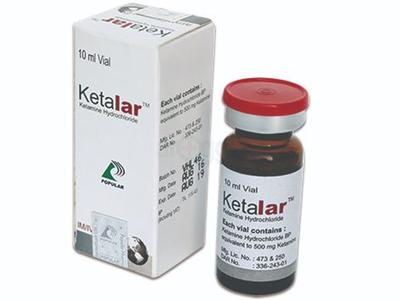
Ketalar 50 mg/ml
Ketamine
Category: IM/IV Injection
Manufacturer: Popular Pharmaceuticals Ltd.

Price: 105.07 ৳
Injection
10 ml vial

Medicine Selling service is not available yet.
Related Medicines

Uses of Ketalar:
- General Anaesthesia
Induction of anesthesia.
Hypertension, history of cerebrovascular accident. Eye injury, raised ocular and intracranial pressure. Psychotic disorders.
General (Intravenous) anesthetics
Ketamine is a noncompetitive N-methyl-D-aspartate receptor antagonist that blocks glutamate. It has a direct action on the cortex and limbic system. It produces a cataleptic-like state wherein the patient is withdrawn from the surrounding environment.
How to use
Ketamine:
Your doctor or nurse will give you this medicine. Kindly do not self administer.
Administration:
Reconstitution: 50 mg/mL and 100 mg/mL vials may be further diluted in 5% dextrose or 0.9% NaCl to prepare a maintenance infusion containing 1 mg/mL (or 2 mg/mL in patients w/ fluid restrictions).
Adult Dose:
Intravenous
Induction of anaesthesia
Adult: 1-4.5 mg/kg via slow IV inj over 60 sec. A dose of 2 mg/kg produces surgical anaesthesia w/in 30 sec after inj lasting for 5-10 min.
Increments of half to the full induction dose may be repeated as needed for maintenance of anesth. Alternatively, a total induction dose of 0.5-2 mg/kg via infusion, given at an appropriate rate, and maintained at a rate of 10-45 mcg/kg/min, adjusted according to response.
Intramuscular
Induction of anaesthesia
Adult: 6.5-13 mg/kg. A dose of 10 mg/kg produces surgical anaesthesia w/in 3-4 min after inj lasting for 12-25 min.
Increments of half to the full induction dose may be repeated as needed for maintenance of anesth. For diagnostic or other procedures not involving intense pain: 4 mg/kg as initial dose.
Prolonged recovery time w/ barbiturates or narcotics. May potentiate neuromuscular blocking effects of atracurium and tubocurarine including resp depression w/ apnoea. May increase risk of bradycardia, hypotension or decreased cardiac output w/ halogenated anaesth. May potentiate CNS depression and risk of resp depression w/ CNS depressants (e.g. phenothiazines, sedating H1-blockers, skeletal muscle relaxants). May antagonise hypnotic effect of thiopental. May increase risk of HTN w/ thyroid hormones. May increase risk of hypotension w/ antihypertensive agents. Reduction in seizure threshold resulting in unpredictable extensor-type seizures when given concurrently w/ theophylline.
Hypertension, history of cerebrovascular accident. Eye injury, raised ocular and intracranial pressure. Psychotic disorders.
Common
- Rash
- Erythema (skin redness)
- Vomiting
- Nausea
- Agitation
- Nightmare
- Abnormal behavior
- Double vision
- Hallucination
- Increased respiratory rate
- High blood pressure
- Confusion
- Nystagmus (involuntary eye movement)
- Muscle coordination impaired
- Tonic-clonic seizures
- Tachycardia
>10%
Emergence rxns (Emergence reactions e.g. vivid dreams, hallucinations, confusion, irrational behaviour)
HTN,Increased cardiac output,Increased ICP,Tachycardia,Tonic-clonic movements,Visual hallucinations,Vivid dreams
1-10%
Bradycardia,Diplopia,Hypotension,Increased IOP,Injection-site pain,Nystagmus
<1%
Anaphylaxis,Cardiac arrhythmia,Depressed cough reflex,Fasciculations,Hypersalivation,Increased IOP,Increased metabolic rate,Hypertonia,Laryngospasm,Respiratory depression or apnea with large doses or rapid infusions
Pregnancy: The safe use of ketamine in pregnancy has not been established, and such use is not recommended.Lactation: Ketamine is likely to be excreted in breast milk and therefore breastfeeding should be discontinued when ketamine is in use.
Precaution:
Minimise verbal and tactile stimulation during recovery period. Chronic alcoholic and alcohol-intoxicated patients. Preanaesthetic elevated CSF pressure. Dependence and tolerance may develop. May impair ability to drive or operate machinery. Monitor cardiac function in patients with hypertension or cardiac decompensation. Pregnancy and lactation.
Symptoms: Resp depression. Management: Employ supportive ventilation. Mechanical support of respiration is preferred to admin of analeptics.
Store between 20-25° C.
Ketamine is a noncompetitive N-methyl-D-aspartate receptor antagonist that blocks glutamate. It has a direct action on the cortex and limbic system. It produces a cataleptic-like state wherein the patient is withdrawn from the surrounding environment.


Samm Care