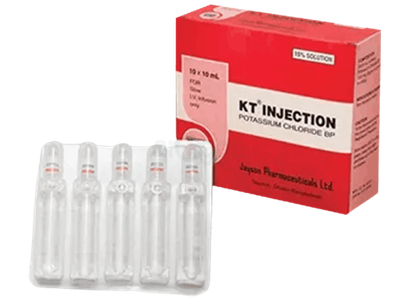
K T 1.5 gm/10 ml
Potassium chloride
Category: Injection
Manufacturer: Jayson Pharmaceuticals Ltd.

Allopathic
MFG. Licence No. Biological
003
MFG. Licence No. Non-Biological
082
Address
231, Tejgoan I/A, Dhaka.
Price: 14.3 ৳
10ml Ampoule

Medicine Selling service is not available yet.
Related Medicines


Uses of K T:
- Potassium deficiency
Hypokalemia, Electrolyte replenisher
Hyperchloraemia, severe renal or adrenal insufficiency.
Electrolytes preparations, Oral electrolytes preparations
Potassium chloride is a major cation of the intracellular fluid. It plays an active role in the conduction of nerve impulses in the heart, brain and skeletal muscle; contraction of cardiac skeletal and smooth muscles; maintenance of normal renal function, acid-base balance, carbohydrate metabolism and gastric secretion.
How to use
Potassium chloride:
Your doctor or nurse will give you this medicine. Kindly do not self administer.
Administration:
Should be taken with food.
Adult Dose:
Oral
Prophylaxis of hypokalaemia and mild K deficiency; Hypokalaemia
Adult: Prevention of hypokalaemia: 20 mEq daily.
Treatment of hypokalaemia
40-100 mEq/day bid-qid. Give in divided doses if >20 mEq/day.
Intravenous
Severe acute hypokalaemia
Adult: If serum potassium level >2.5 mEq/L, give at a rate not exceeding 10 mEq/hr in a concentration of up to 40 mEq/L. Max dose: 200 mEq/24 hr.
If serum potassium level <2 mEq/L, may infuse at a rate of up to 40 mEq/hr. Continuous cardiac monitoring is essential. Max dose: 400 mEq/24 hr.
Max Dosage: 2-3 mmol potassium/kg body wt in 24 hrs.
Child Dose:
Hypokalemia
0.5-2 mEq/kg PO q12hr
Monitor closely: 0.5 mEq/kg/hr IV for 1-2 hr
Potassium-sparing diuretics, ACE inhibitors, ciclosporin and potassium-containing drugs. Antimuscarinics delay gastric emptying time consequently increasing risk of GI adverse effects esp of solid oral dosage forms.
Hyperchloraemia, severe renal or adrenal insufficiency.
Common
- Injection site reactions (pain, swelling, redness)
- Muscle weakness
- Paresthesia (tingling or pricking sensation)
GI ulceration (sometimes with haemorrhage and perforation or with late formation of strictures) following the use of enteric-coated K chloride preparation; hyperkalaemia.
Oral: Nausea, vomiting, diarrhoea and abdominal cramps.
IV: Pain or phloebitis; cardiac toxicity.
Category C: Either studies in animals have revealed adverse effects on the foetus (teratogenic or embryocidal or other) and there are no controlled studies in women or studies in women and animals are not available. Drugs should be given only if the potential benefit justifies the potential risk to the foetus.
Precaution:
Renal or adrenocortical insufficiency; cardiac disease; acute dehydration; extensive tissue destruction. Pregnancy. Ensure adequate urine output; monitor plasma-potassium and other electrolyte concentrations. Discontinue treatment if severe nausea, vomiting or abdominal distress develops. Accumulation of potassium may occur in renal impairment.
Store below 25°C in a dry place, away from light. Keep out of the reach of children.
Electrolytes preparations, Oral electrolytes preparations
Potassium chloride is a major cation of the intracellular fluid. It plays an active role in the conduction of nerve impulses in the heart, brain and skeletal muscle; contraction of cardiac skeletal and smooth muscles; maintenance of normal renal function, acid-base balance, carbohydrate metabolism and gastric secretion.
As a general rule, no drugs should be taken during the first three months of pregnancy and the risks & benefits of taking drugs should be carefully considered throughout pregnancy. There are no contraindications to breastfeeding while taking potassium salts.


Samm Care