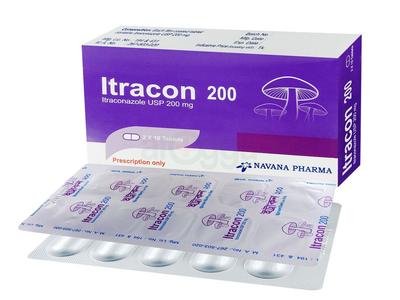
Itracon 200 200 mg
Itraconazole
Category: Tablet
Manufacturer: Navana Pharmaceuticals Ltd.

Allopathic
MFG. Licence No. Biological
194
MFG. Licence No. Non-Biological
431
Address
Rupshi, Rupganj, Narayanganj.
Price: 270.0 ৳
Strip

Medicine Selling service is not available yet.
Related Medicines


Uses of Itracon 200:
- Fungal infections
Candidiasis, Fungal infections, Tinea pedis, Tinea cruris, Tinea corporis, Pityriasis versicolor
Hypersensitivity to azole antifungals; pregnancy and lactation; hepatic disease. IV: CrCl: <30 ml/min.
Drugs for subcutaneous and mycoses
Itraconazole is an orally active triazole antifungal drug that has demonstrated a broad spectrum of activity and favorable pharmacokinetic profile. Itraconazole inhibits Cytochrome P-450 dependent enzymes resulting in impairment of the biosynthesis of ergosterol, a major component of the cell membrane of yeast and fungal cells. Being integral to the proper functioning of the cell membrane, inhibition of the synthesis of ergosterol leads to a cascade of abnormalities in permeability, membrane bound enzyme activity, and co-ordination of chitin synthesis leading to inhibition of growth, abnormal cell wall formation and accumulation of intracellular lipids and membranous vesicles.
How to use
Itraconazole:
Take this medicine in the dose and duration as advised by your doctor. Do not chew, crush or break it.
Itraconazole is to be taken with food.
Administration:
Should be taken with food. Take immediately after a full meal.
Adult Dose:
Oral
Adult: PO: Oropharyngeal candidiasis As cap: 100 mg/day for 15 days.
Vulvovaginal candidiasis As cap: 200 mg twice daily for 1 day.
Pityriasis versicolor As cap: 200 mg/day for 7 days.
Tinea corporis; Tinea cruris As cap: 100 mg/day for 15 days.
Fungal nail infections As cap: 200 mg/day for 3 mth.
Systemic fungal infections As cap: 100-200 mg once daily, up to 200 mg twice daily for invasive or disseminated infections.
Prophylaxis of infections in neutropenic or AIDS patients As cap: 200 mg/day, up to 200 mg twice daily if needed.
Tinea pedis; Tinea manuum As cap: 100 mg/day for 30 days or 200 mg bid for 7 days.
Child Dose:
Child: PO 10 mg/kg/day, max 200 mg/day q12h
5 mg/kg/day for chronic mucocutaneous Candida q24h
<3 years: Safety and efficacy not established
May increase the plasma concentrations of oral anticoagulants, digoxin, cilostazol, alprazolam, midazolam (IV), repaglinide, corticosteroids (e.g. budesonide, dexamethasone, fluticasone, methylprednisolone). May increase plasma concentration w/ HIV protease inhibitors (e.g. ritonavir, indinavir, saquinavir), erythromycin, clarithromycin. May reduce plasma concentration w/ isoniazid, carbamazepine, nevirapine, phenytoin, Phenobarbital, rifampicin, rifabutin. May reduce absorption w/ PPIs, antacids, antimuscarinics, histamine H2 receptor antagonists. Concomitant use w/ dihydropyridines may cause oedema. May increase negative inotropic effects of verapamil. May increase risk of potentially fatal resp depression w/ fentanyl.
Potentially Fatal: May increase risk of QT prolongation or torsades de pointes w/ astemizole, bepridil, cisapride, dofetilide, levacetylmethadol (levomethadyl), mizolastine, pimozide, quinidine, sertindole, terfenadine, methadone, ranolazine, dronedarone, halofantrine. May increase risk of myopathy including rhabdomyolysis w/ HMG-CoA reductase inhibitors (e.g. atorvastatin, lovastatin, simvastatin). May increase risk of ergotism w/ ergot alkaloids (e.g. ergotamine, dihydroergotamine, ergometrine, methylergometrine). May potentiate hypnotic and sedative effect of triazolam and oral midazolam. May increase plasma concentration of eletriptan, nisoldipine, felodipine, disopyramide, irinotecan, lurasidone; colchicine (patient w/ renal or hepatic failure). May increase risk of hypotension and hyperkalaemia w/ eplerenone.
Hypersensitivity to azole antifungals; pregnancy and lactation; hepatic disease. IV: CrCl: <30 ml/min.
Common
- Nausea
- Common cold
- Cough
- Blurred vision
- Menstrual disorder
>10%
Nausea (11%)
1-10%
Rash (9%),Vomiting (5%),Edema (4%),Headache (4%),Abnormal liver function test results (3%),Diarrhea (3%),Fever (3%),Hypertension (3%),Pruritus (3%),Fatigue (2-3%),Abdominal pain (2%),Dizziness (2%),Hypertriglyceridemia (2%),Hypokalemia (2%),Albuminuria (1%),Anorexia (1%),Decreased libido (1%),Hepatitis (1%),Malaise (1%)
Potentially Fatal: Liver failure; heart failure; pulmonary oedema; CV disease.
Itraconazole is contraindicated in pregnancy. Breast feeding while receiving Itraconazole is not recommended.
Precaution:
Renal insufficiency; CHF, history of CHF, COPD; monitor liver function.
Lactation: Drug enters breast milk; weigh risk against benefit
There is no experience of overdosage with itraconazole.
Store below 30°C, away from light & in a dry place. Keep out of the reach of children.
Drugs for subcutaneous and mycoses
Itraconazole decreases ergosterol synthesis by interfering w/ cytochrome P450 activity. This inhibits cell membrane function of susceptible fungi including Microsporum spp., Trichophyton spp., Candida spp., Aspergillus spp., Epidermophyton spp., Cryptococcus neoformans, Histoplasma capsulatum, Blastomyces dermatitidis, sporothrix schenckii, Malassezia furfur, Coccidioides immitis and Paracoccidiodes brasiliensis. It also has antiprotozoal activity against Leishmania spp.
Not recommended during pregnancy & lactation, unless otherwise indicated by the physician.


Samm Care