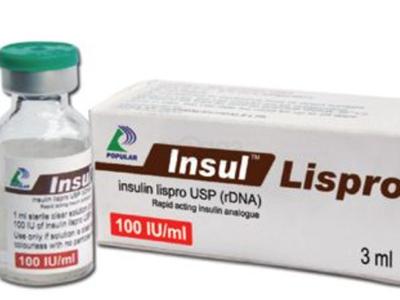
Insul Lispro 100 IU/ml
Insulin Lispro
Category: Injection
Manufacturer: Popular Pharmaceuticals Ltd.

Price: 508.62 ৳
1 x 3 of 3 ml Ampoule in Blister Pack

Medicine Selling service is not available yet.
Related Medicines

Humalog Cartridge 100 unit/ml
Insulin Lispro
৳ 895.0
Humalog Kwik pen 3.5mg/ml (100IU)
Insulin Lispro
Humalog Kwikpen 100
Insulin Lispro
৳ 985.0
Humalog Kwik pen100u/ml 3.5mg/ml (100IU)
Insulin Lispro
Humalog Mix 25(100 U/ML) 3.5mg/ml (100IU)
Insulin Lispro
Humalog Mix 50 (100 U/ML) 3.5mg/ml (100IU)
Insulin Lispro
Diabetes mellitus
Hypoglycaemia.Hypersensitivity to any of the components.
Rapid Acting Insulin
Insulin Lispro (insulin lispro, rDNA origin) is a human insulin analogue that is a rapid-acting, parenteral blood glucose-lowering agent. Chemically, it is Lys(B28), Pro(B29) human insulin analogue, created when the amino acids at positions 28 and 29 on the insulin B -chain are reversed. Insulin Lispro is synthesized in a special non-pathogenic laboratory strain of Escherichia coli bacteria that has been genetically altered by the addition of the gene for insulin lispro. The blood glucose lowering effect of insulin lispro is due to the facilitated uptake of glucose following binding of insulin to receptors on muscle and fat cells and to the simultaneous inhibition of glucose output from the liver.
Administration:
Administer within 15 minutes before a meal or immediately after a meal by injection into the subcutaneous tissue of the abdominal wall, thigh, upper arm, or buttocks. To reduce the risk of lipodystrophy, rotate the injection site within the same region from one injection to the next.
Adult Dose:
Subcutaneous
Type 1 diabetes mellitus
Approximately one third of the total daily insulin requirements SC; rapid-acting or short-acting, premeal insulin should be used to satisfy the remainder of the daily insulin requirements
Usual daily maintenance range is 0.5-1 unit/kg/day in divided doses;
nonobese may require 0.4-0.6 unit/kg/day;
obese may require 0.8-1.2 units/kg/day
Type 2 diabetes mellitus
Type 2 diabetes mellitus inadequately controlled with oral medication
Adult: SC Usual range: 0.5-1 u/kg/day.
Rapid-acting formulations, such as insulin lispro, given before meals with an intermediate- or long-acting insulin as a dose of
10 units/day SC (or 0.1-0.2 unit/kg/day) given at bedtime generally recommended
Continuous SC injection (insulin pump)
May be administered by continuous SC infusion in the abdominal wall
Do not use diluted or mixed insulins in external insulin pumps
Infusion sites should be rotated within the same region to reduce the risk of lipodystrophy
Continuous subcutaneous infusion pump (i.e., insulin pump) not for Insulin Lispro U-200 administration;Insulin Lispro U-100 only
Initial programming of the external insulin infusion pump should be based on the total daily insulin dose of the previous regimen
Intravenous Administration
Dilute Insulin Lispro U-100 to concentrations from 0.1 unit/mL to 1.0 unit/mL using 0.9% sodium chloride.
Administer Insulin Lispro U-100 intravenously ONLY under medical supervision with close monitoring of blood glucose and potassium levels to avoid hypoglycemia and hypokalemia
Dosing Considerations
When given subcutaneously, insulin lispro has a more rapid onset of action and a shorter duration of action than regular human insulin
Dosage must be individualized; blood glucose monitoring is essential in all patients receiving insulin therapy
Insulin requirements may be altered during stress, major illness, or with changes in exercise, meal patterns, or coadministered drugs
Child Dose:
Type I Diabetes Mellitus
Rapid-acting human insulin analogue indicated to improve glycemic control in adults and children with diabetes mellitus
<3 years: Safety and efficacy not established
>3 years: May require 0.8-1.2 units/kg/day SC during growth spurts; otherwise, use adult dosing (0.5-1 unit/kg/day)
Renal Dose:
Renal impairment: Dose reduction may be needed.
Effects may be increased by: oral antidiabetic agents, ACE inhibitors, disopyramide, fibrates, fluoxetine, MAOIs, propoxyphene, salicylates, somatostatin analog (e.g., octreotide), sulfonamide antibiotics. Effects may be decreased by: corticosteroids, niacin, danazol, diuretics, sympathomimetic agents, isoniazid, phenothiazine derivatives, somatropin, thyroid hormones, oral contraceptives, lithium. Signs of hypoglycaemia may be masked by beta-blockers, clonidine.
Hypoglycaemia.Hypersensitivity to any of the components.
Hypoglycaemia; hypokalemia, oedema; pruritus; pulpitation, nausea, rash; hypersensitivity reactions; lipoatropy or lipohypertrophy with SC Inj.
Pregnancy Category B. All pregnancies have a background risk of birth defects, loss, or other adverse outcome regardless of drug exposure. This background risk is increased in pregnancies complicated by hyperglycemia and may be decreased with good metabolic control. It is essential for patients with diabetes or history of gestational diabetes to maintain good metabolic control before conception and throughout pregnancy. In patients with diabetes or gestational diabetes insulin requirements may decrease during the first trimester, generally increase during the second and third trimesters, and rapidly decline after delivery. Careful monitoring of glucose control is essential in these patients. Therefore, female patients should be advised to tell their physicians if they intend to become, or if they become pregnant while taking Insulin Lispro.Nursing Mothers: It is unknown whether insulin lispro is excreted in human milk. Because many drugs are excreted in human milk, caution should be exercised when insulin lispro is administered to a nursing woman. Use of insulin lispro is compatible with breastfeeding, but women with diabetes who are lactating may require adjustments of their insulin doses.
Precaution:
Renal or hepatic impairment; pregnancy, lactation; transferring from other insulin. Monitor serum glucose, potassium, electrolytes, HbA1c and lipid profile. Concomitant illness esp infections.
Lactation: Considered safe for use during breastfeeding
Excess insulin administration may cause hypoglycemia and hypokalemia. Mild episodes of hypoglycemia usually can be treated with oral glucose. Adjustments in drug dosage, meal patterns, or exercise may be needed. More severe episodes with coma, seizure, or neurologic impairment may be treated with intramuscular/subcutaneous glucagon or concentrated intravenous glucose. Sustained carbohydrate intake and observation may be necessary because hypoglycemia may recur after apparent clinical recovery. Hypokalemia must be corrected appropriately.
Store at 2°C - 8°C in a refrigerator. Do not freeze. In case of insulin for recent use need not be refrigerated, try to keep it in a cool place and keep away from heat and light. The insulin in use can be kept under the room temperature for a month.
Rapid Acting Insulin
Insulin lispro, a rapid-acting analog of human insulin, lowers blood glucose levels. It regulates carbohydrate, protein and fat metabolism by inhibiting hepatic glucose production and lipolysis, and enhancing peripheral glucose disposal.
Pregnancy Category B. All pregnancies have a background risk of birth defects, loss, or other adverse outcome regardless of drug exposure. This background risk is increased in pregnancies complicated by hyperglycemia and may be decreased with good metabolic control. It is essential for patients with diabetes or history of gestational diabetes to maintain good metabolic control before conception and throughout pregnancy. In patients with diabetes or gestational diabetes insulin requirements may decrease during the first trimester, generally increase during the second and third trimesters, and rapidly decline after delivery. Careful monitoring of glucose control is essential in these patients. Therefore, female patients should be advised to tell their physicians if they intend to become, or if they become pregnant while taking Insulin Lispro.Nursing Mothers: It is unknown whether insulin lispro is excreted in human milk. Because many drugs are excreted in human milk, caution should be exercised when insulin lispro is administered to a nursing woman. Use of insulin lispro is compatible with breastfeeding, but women with diabetes who are lactating may require adjustments of their insulin doses.


Samm Care