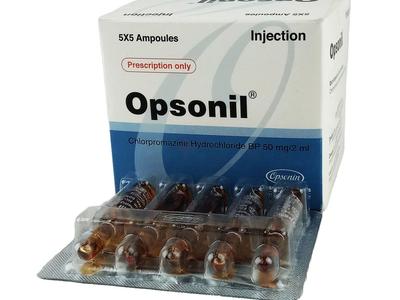
Uses of Opsonil:
- Schizophrenia
Schizophrenia, Bipolar disorder, Anxiety, Psychoses, Delirium, Porphyria, Hiccups, Nausea, Vomiting
Do not use in patients with known hypersensitivity to phenothiazines.
Do not use in comatose states or in the presence of large amounts of central nervous system depressants (alcohol, barbiturates, narcotics, etc.).
Anti-emetic drugs, Phenothiazine drugs, Phenothiazine related drugs
Chlorpromazine is a neuroleptic that acts by blocking the postsynaptic dopamine receptor in the mesolimbic dopaminergic system and inhibits the release of hypothalamic and hypophyseal hormones. It has antiemetic, serotonin-blocking, and weak antihistaminic properties and slight ganglion-blocking activity.
How to use
Chlorpromazine Hydrochloride:
Take this medicine in the dose and duration as advised by your doctor. Swallow it as a whole. Do not chew, crush or break it.
Chlorpromazine Hydrochloride may be taken with or without food, but it is better to take it at a fixed time.
Administration:
May be taken with or without food. May be taken w/ meals to reduce GI discomfort.
Direct IV injection is only for control of nausea and vomiting during surgery and for adjunctive treatment of tetanus
IV infusion is only for adjunctive treatment of intractable hiccups in adults
IV Administration
Direct IV injection: Dilute with NS to concentration no higher than 1 mg/mL, and administer at rate of 1 mg/min in adults and 0.5 mg/min in children; avoid administering undiluted drug
IV infusion: Add appropriate dose to 500-1000 mL of NS, and administer slowly
Adult Dose:
Schizophrenia, Psychotic Disorders
PO: 30-75 mg/day divided q6-12hr initially; maintenance: usually 200 mg/day (up to 800 mg/day in some patients; some patients may require 1-2 g/day)
IV/IM: 25 mg initially, followed PRN with 25-50 mg after 1-4 hours, then increased to maximum of 400 mg q4-6hr until patient is controlled; usual dosage 300-800 mg/day
Nausea & Vomiting
PO: 10-25 mg q4-6hr PRN
IV/IM: 25-50 mg q4-6hr PRN
Preoperative Apprehension
25-50 mg PO 2-3 hours before surgery
12.5-25 mg IM 1-2 hours before surgery
Intraoperative Sedation
12.5 IM q30min or 2 mg IV q2min; total dose not to exceed 25 mg
Intractable Hiccups
25-50 mg PO q6-8hr; if hiccups persist after 2-3 days of oral therapy, administer 25-50 mg IM q3-4hr; if symptoms persist, administer 25-50 mg by slow IV infusion with patient lying flat in bed; monitor BP
Acute Intermittent Porphyria
25-50 mg PO q6-8hr
Elderly: Initially, 1/3-½ the normal adult dose.
Child Dose:
Behavioral Disorders, Hyperactivity
>6 months: 50-100 mg/day PO/IM; 200 mg/day or more may be necessary for older hospitalized patients; for outpatients, may administer 0.55 mg/kg q4-6hr PRN
Nausea & Vomiting
>6 months: 0.5-1 mg/kg PO/IM q6-8hr PRN
Preoperative Apprehension
>6 months: 0.55 mg/kg PO/IM 1-2 hours before surgery
<6 months: Safety and efficacy not established
Potentiation of anticholinergic effects of antiparkinson agents and TCAs may lead to an anticholinergic crisis. Additive orthostatic hypotensive effect in combination with MAOIs. Reverses antihypertensive effect of guanethidine, methyldopa and clonidine.
Potentially Fatal: Additive depressant effect with sedatives, hypnotics, antihistamines, general anaesthetics, opiates and alcohol.
Do not use in patients with known hypersensitivity to phenothiazines.
Do not use in comatose states or in the presence of large amounts of central nervous system depressants (alcohol, barbiturates, narcotics, etc.).
Common
- Sleepiness
- Orthostatic hypotension (sudden lowering of blood pressure on standing)
- Dryness in mouth
- Abnormality of voluntary movements
- Weight gain
- Increased prolactin level in blood
- Urinary retention
- Constipation
- Muscle stiffness
Extrapyramidal symptoms. Tardive dyskinesia (on long-term therapy). Involuntary movements of extremities may also occur. Dry mouth, constipation, urinary retention, mydriasis, agitation, insomnia, depression and convulsions; postural hypotension, ECG changes. Allergic skin reaction, amenorrhoea, gynaecomastia, weight gain. Hyperglycaemia and raised serum cholesterol.
Potentially Fatal: Agranulocytosis. Instantaneous deaths associated with ventricular tachyarrhythmias. Marked elevation of body temperature with heat stroke. Neuroleptic malignant syndrome, extrapyramidal dysfunction.
Category C: Either studies in animals have revealed adverse effects on the foetus (teratogenic or embryocidal or other) and there are no controlled studies in women or studies in women and animals are not available. Drugs should be given only if the potential benefit justifies the potential risk to the foetus.
Precaution:
Some patients exposed chronically to antipsychotics will develop tardive dyskinesia,
Chlorpromazine should be administered cautiously to persons with cardiovascular, liver or renal disease. There is evidence that patients with a history of hepatic encephalopathy due to cirrhosis have increased sensitivity to the CNS effects of chlorpromazine (i.e., impaired cerebration and abnormal slowing of the EEG).
Because of its CNS depressant effect, chlorpromazine should be used with caution in patients with chronic respiratory disorders such as severe asthma, emphysema and acute respiratory infections, particularly in children (1 to 12 years of age).
Because chlorpromazine can suppress the cough reflex, aspiration of vomitus is possible.
Lactation: Drug enters breast milk; not recommended (American Academy of Pediatrics [AAP] states that this is "of concern")
Symptoms include somnolence, coma, hypotension and extrapyramidal symptoms. Other possible manifestations include agitation and restlessness, convulsions, fever, autonomic reactions such as dry mouth and ileus, EKG changes and cardiac arrhythmias. Treatment is symptomatic and supportive. Early gastric lavage may be helpful. Observe patient and maintain an open airway.
Keep below 30°C temperature, away from light & moisture. Keep out of the reach of children.
Anti-emetic drugs, Phenothiazine drugs, Phenothiazine related drugs
Chlorpromazine is a neuroleptic that acts by blocking the postsynaptic dopamine receptor in the mesolimbic dopaminergic system and inhibits the release of hypothalamic and hypophyseal hormones. It has antiemetic, serotonin-blocking, and weak antihistaminic properties and slight ganglion-blocking activity.
Pregnancy category: C; neonates exposed to antipsychotic drugs during 3rd trimester of pregnancy are at risk for EPS or withdrawal symptoms after delivery; these complications vary in severity, with some being self-limited and others necessitating ICU support and prolonged hospitalization
Lactation: Drug enters breast milk; not recommended (American Academy of Pediatrics [AAP] states that this is "of concern")