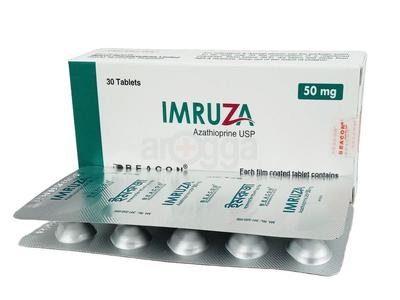
Imruza 50 50 mg
Azathioprine
Category: Tablet
Manufacturer: Beacon Pharmaceuticals Ltd.

Price: 184.83 ৳
Strip

Medicine Selling service is not available yet.
Related Medicines

G-Azathioprine 50 mg
Azathioprine
৳ 8.0
500 mg + 400 IU
Calcium (Coral Calcium) + Cholecalciferol (Vit. D3)
5 mg + 500 mg
Empagliflozin + Metformin Hydrochloride
Amiodarone Hydrochloride
10 10mg
Bisoprolol Fumarate
৳ 14.4
21st Century Vitamin C Orange Chewable 1000mg
Vitamin C [Ascorbic acid]
৳ 20.83
Uses of Imruza 50:
- Prevention of organ rejection in transplant patients
- Rheumatoid arthritis
Rheumatoid arthritis, Prevention of rejection in organ and tissue transplantation, Auto-immune diseases, Renal homotransplantation
Hypersensitivity; previous treatment with alkylating agents; pregnancy, lactation.
Cytotoxic immunosuppressants
Azathioprine antagonizes purine metabolism and may inhibit synthesis of DNA, RNA, and proteins. It may also interfere with cellular metabolism and inhibit mitosis. Its mechanism of action is likely due to incorporation of thiopurine analogues into the DNA structure, causing chain termination and cytotoxicity.
How to use
Azathioprine:
Take this medicine in the dose and duration as advised by your doctor. Swallow it as a whole. Do not chew, crush or break it.
Azathioprine is to be taken with food.
Administration:
May be taken with or without food. Preferably taken w/ or after meals to reduce GI discomfort.
Adult Dose:
Rheumatoid Arthritis
1 mg/kg/day PO initially in single daily dose or divided q12hr; may be increased by 0.5 mg/kg/day after 6-8 weeks, then by 0.5 mg/kg/day every 4 weeks; not to exceed 2.5 mg/kg/day
Maintenance: Reduce daily dose by 0.5 mg/kg every 4 weeks until lowest effective dosage is reached
Kidney Transplantation
Prevention of transplant rejection
3-5 mg/kg/day PO initially on day of transplant or 3 days before transplant (rare)
Maintenance: 1-3 mg/kg/day PO
Auto-immune diseases 1-3 mg/kg/day.
Hepatic Impairment Reduce dose.
Child Dose:
Juvenile Idiopathic Arthritis
1 mg/kg/day PO initially in single daily dose or divided q12hr; may be increased by 0.5 mg/kg/day after 6-8 weeks, then by 0.5 mg/kg/day every 4 weeks; not to exceed 2.5 mg/kg/day
Maintenance: Reduce daily dose by 0.5 mg/kg every 4 weeks until lowest effective dosage is reached
Renal Dose:
Reduce dose.
Increased risk of haematotoxicity with aminosalicylates, drugs that affect myelopoesis e.g. co-trimoxazole or trimethoprim. Increased risk of infections with intra-uterine devices and live vaccines. Increased risk of leucopenia with ACE inhibitors. Concurrent use may reduce the anticoagulant effect of vitamin K antagonists e.g. warfarin. Increased risk of myelosuppressive effects when used with drugs that inhibit TPMT (thiopurine methyltransferase) or xanthine oxidase e.g. olsalazine, allopurinol.
Potentially Fatal: Increased risk of serious haematotoxicity or hepatotoxicity with leflunomide. Increased risk of bone marrow suppression with mycophenolate mofetil. Increased risk of infections and malignancies with efalizumab.
Hypersensitivity; previous treatment with alkylating agents; pregnancy, lactation.
Common
- Decreased white blood cell count
- Increased bleeding tendency
- Nausea
- Infection
- Loss of appetite
>10%
Leukopenia (28-50%),Infection (20%)
<1%
Lymphoma
Frequency Not Defined
Fever, chills; bone marrow depression, thrombocytopenia or anaemia; anorexia, nausea, diarrhoea; arthralgias; secondary infections; hepatotoxicity, rash, alopoecia.
Potentially Fatal: Myelosuppression, mutagenicity and carcinogenicity; veno-occlussive liver disease.
Pregnancy Category D. There is positive evidence of human foetal risk, but the benefits from use in pregnant women may be acceptable despite the risk
Precaution:
Increased risk of serious infections and neoplasia in chronic immunosuppression; leucopenia, thrombocytopenia, renal or hepatic impairment. Increased risk of haematologic toxicity in patients with thiopurine methyltransferase deficiency. Monitor CBC (including platelet count) wkly during 1st mth, twice mthly for 2nd and 3rd mth, then mthly; monitor more frequently if there are dosage adjustments. Monitor LFT periodically; discontinue treatment if jaundice occurs. Reduce dose promptly or withdraw drug temporary if there is rapid decrease/persistently low WBC or signs of bone marrow depression. Dose reduction may be necessary in patients with reduced TPMT (thiopurine methyltransferase) activity.
Lactation: Drug excreted at low levels in breast milk; use not recommended
Symptoms and signs: Unexplained infection, ulceration of the throat, bruising and bleeding are the main signs of overdosage with azathioprine and result from bone marrow depression which may be maximal after 9 to 14 days. These signs are more likely to be manifest following chronic overdosage, rather than after a single acute overdose. There has been a report of a patient who ingested a single overdose of 7.5 g of azathioprine. The immediate toxic effects of this overdose were nausea, vomiting and diarrhoea, followed by mild leucopenia and mild abnormalities in liver function. Recovery was uneventful.Treatment: As there is no specific antidote, blood counts should be closely monitored and general supportive measures instituted if necessary. Active measures (such as the use of activated charcoal) may not be effective in the event of azathioprine overdose unless the procedure can be undertaken within 60 minutes of ingestion. Further management should be as clinically indicated or as recommended by the national poisons centre, where available. The value of dialysis in patients who have taken an overdose of azathioprine is not known, though azathioprine is partially dialysable.
Store below 25°C. Protect from light.
Cytotoxic immunosuppressants
Azathioprine is an imidazolyl derivative of mercaptopurine, which inhibits DNA, RNA and protein synthesis and antagonises purine synthesis. It also inhibits mitosis and interferes with cellular metabolism of susceptible organisms. Azathioprine inj should be converted to oral therapy as soon as the drug can be tolerated.
Pregnancy category: D
Lactation: Drug excreted at low levels in breast milk; use not recommended


Samm Care