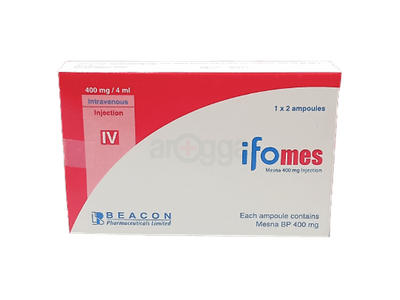
Ifomes 400 mg/4 ml
Mesna
Category: IV Injection
Manufacturer: Beacon Pharmaceuticals Ltd.

Price: 175.0 ৳
Injection
2's pack
400 mg vial

Medicine Selling service is not available yet.
Related Medicines

Mesna is a cytoprotective agent indicated as a prophylactic agent in reducing the incidence of ifosfamide-induced hemorrhagic cystitis.
Antidote preparations
Mesna is used to prevent urothelial toxicity associated with oxazaphosphorine, ifosfamide or cyclophosphamide. It acts in the kidney; reacting with thiol groups of urotoxic metabolites (e.g. acrolein) of ifosfamide and cyclophosphamide. It is used as a mucolytic in the management of some respiratory tract conditions e.g. cystic fibrosis where other mucolytics have failed. It acts by reducing the viscosity of pulmonary secretions; the drug's free sulfhydryl group is thought to reduce disulfide linkages of mucoproteins.
Intravenous-Prophylaxis against urothelial toxicity:
Adult: Refer to individual and local protocol. Dose calculated according to cytotoxic dose. Normally given at a dose ≥cytotoxic dose. Duration of treatment should be as long as cytotoxic treatment; plus the time it takes for concentration of antineoplastic metabolites in urine to fall. Administered either by short (15-30 minutes) or continuous (24 hr) infusion.
Child: Refer to individual and local protocol. Has been used in children >4 mth.
Oral-Prophylaxis against urothelial toxicity:
Adult: Refer to individual and local protocol. Dose calculated according to cytotoxic dose. Normally given at a dose ≥cytotoxic dose. Duration of treatment should be as long as cytotoxic treatment; plus the time it takes for concentration of antineoplastic metabolites in urine to fall.
Child: Refer to individual and local protocol.
Hypersensitivity to thiol-containing compounds.
Nausea, vomiting, colic, diarrhoea, anorexia, dyspepsia, unpleasant taste, constipation; headache, malaise, fatigue, depression, irritability, somnolence, hyperaesthesia, dizziness, confusion; rash, pruritus, generalised urticaria, alopecia, inj site reactions, flushing; leucopenia, thrombocytopenia, anaemia, granulocytopenia, chest pain, oedema (peripheral, facial and periorbital), hypotension, tachycardia, hypertension, increased heart rate, ST-segment elevation; dyspnoea, coughing, pneumonia, tachypnea; fever; hypocalcaemia; increased sweating; back pain, limb pain, myalgia; increased hepatic enzyme concentrations; pharyngitis; ulceration of mucous membranes. In patients receiving oral and/or IV mesna and were specifically not treated with concurrent cytotoxic therapy: flatulence; rhinitis; rigors; back pain; rash; conjunctivitis; arthralgia. Inhalation: bronchospasm.
Pregnancy Category B. Either animal-reproduction studies have not demonstrated a foetal risk but there are no controlled studies in pregnant women or animal-reproduction studies have shown an adverse effect (other than a decrease in fertility) that was not confirmed in controlled studies in women in the 1st trimester (and there is no evidence of a risk in later trimesters).
Protective effect applies only to the urinary tract; pregnancy, lactation. Patients with auto-immune disorders. IV formulation may contain benzyl alcohol as a preservative; avoid in neonates or infants. Instruct patients to seek medical attention if discolouration of urine occurs. During treatment, monitor urine for erythrocytes and haematuria. Maintain adequate hydration in all patients. Patients who vomit within 2 hr of oral dose should repeat dose or receive IV dose.
Should be stored at 15-30° C.
Antidote preparations
Mesna is used to prevent urothelial toxicity associated with oxazaphosphorine, ifosfamide or cyclophosphamide. It acts in the kidney; reacting with thiol groups of urotoxic metabolites (e.g. acrolein) of ifosfamide and cyclophosphamide. It is used as a mucolytic in the management of some respiratory tract conditions e.g. cystic fibrosis where other mucolytics have failed. It acts by reducing the viscosity of pulmonary secretions; the drug's free sulfhydryl group is thought to reduce disulfide linkages of mucoproteins.
Pregnancy Category B. Either animal-reproduction studies have not demonstrated a foetal risk but there are no controlled studies in pregnant women or animal-reproduction studies have shown an adverse effect (other than a decrease in fertility) that was not confirmed in controlled studies in women in the 1st trimester (and there is no evidence of a risk in later trimesters).


Samm Care