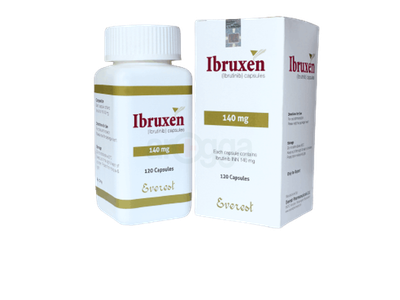
Ibruxen 140 mg
Ibrutinib
Category: Capsule
Manufacturer: Everest Pharmaceuticals Ltd.

Allopathic
MFG. Licence No. Biological
178
MFG. Licence No. Non-Biological
336
Address
BSCIC Industrial Estate, Kanchpur Plot No. B-45 & 46
Price: 145728.0 ৳
Box
30's pack

Medicine Selling service is not available yet.
Related Medicines


Ibrutinib, is a kinase inhibitor indicated for the treatment of patients with:
• Mantle cell lymphoma (MCL), who have received at least one prior therapy
Accelerated approval was granted for this indication based on overall response rate.
Continued approval for this indication may be contingent upon verification of clinical benefit in confirmatory trials.
• Chronic lymphocytic leukemia (CLL), who have received at least one prior therapy
• Chronic lymphocytic leukemia with 17p deletion
• Waldenström’s macroglobulinemia (WM)
Hypersensitivity. Concomitant use w/ St. John's wort-containing prep.
Targeted Cancer Therapy
Ibrutinib is a small-molecule inhibitor of BTK. Ibrutinib forms a covalent bond with a cysteine residue in the BTK active site, leading to inhibition of BTK enzymatic activity. BTK is a signaling molecule of the B-cell antigen receptor (BCR) and cytokine receptor pathways. BTK’s role in signaling through the B-cell surface receptors results in activation of pathways necessary for B-cell trafficking, chemotaxis, and adhesion. Nonclinical studies show that ibrutinib inhibits malignant B-cell proliferation and survival in vivo as well as cell migration and substrate adhesion in vitro.
Administration:
Administer once daily at approximately the same time each day. Capsules should be taken orally with a glass of water. The capsules should not be opened, broke, or chewed.
Adult Dose:
Chronic Lymphocytic Leukemia/Small Lymphocytic Lymphoma, Waldenström Macroglobulinemia
420 mg taken orally once daily (three 140 mg capsules once daily)
Mantle Cell Lymphoma
560 mg taken orally once daily (four 140 mg capsules once daily)
Hepatic impairment
Mild (Child Pugh class A): 140 mg PO qDay
Moderate-to-severe (Child Pugh Classes B and C): Avoid use
Child Dose:
Safety and efficacy not established
Increased exposure w/ medicinal products that strongly or moderately inhibit CYP3A4. Avoid grapefruit & Seville oranges as these contain moderate inhibitors of CYP3A4. Decreased exposure w/ drugs increasing stomach pH (eg, PPIs). To minimize the potential GI tract interaction, oral narrow therapeutic range, P-gp or BCRP substrates eg, digoxin or methotrexate should be taken at least 6 hr before or after treatment.
Hypersensitivity. Concomitant use w/ St. John's wort-containing prep.
>10% (MCL)
Increased serum creatinine, 1.5 x ULN (67%)
Platelets decreased, all grades (57%)
Diarrhea (51%)
Hemorrhage (48%)
Neutrophils decreased, all grades (47%)
Hemoglobin decreased, all grades (41%)
Fatigue (41%)
Musculoskeletal pain (37%)
Peripheral edema (35%)
URI infection (34%)
Nausea (31%)
Bruising (30%)
Neutropenia, grades 3 or 4 (29%)
Dyspnea (27%)
Constipation (25%)
Rash (25%)
Abdominal pain (24%)
Vomiting (23%)
Decreased appetite (221%)
Cough (19%)
Pyrexia (18%)
Stomatitis (17%)
Thrombocytopenia, grades 3 or 4 (17%)
UTI infection (14%)
Pneumonia (14%)
Skin infections (14%)
Asthenia (14%)
Muscle spasms (14%)
Dizziness (14%)
Sinusitis (13%)
Headache (13%)
Dehydration (12%)
Dyspepsia (11%)
Petechiae (11%)
Arthralgia (11%)
Epistaxis (11%)
>10% (CLL)
Platelets decreased, all grades (71%)
Diarrhea (63%)
Bruising (54%)
Neutrophils decreased, all grades (54%)
URT infection (48%)
Hemoglobin decreased, all grades (44%)
Fatigue (31%)
Rash (27%)
Musculoskeletal pain (27%)
Neutropenia, grades 3 or 4 (27%)
Pyrexia (25%)
Peripheral edema (23%)
Constipation (23%)
Arthralgia (23%)
Nausea (21%)
Stomatitis (21%)
Sinusitis (21%)
Dizziness (21%)
Vomiting (19%)
Cough (19%)
Muscle spasms (19%)
Headache (19%)
Skin infection (17%)
Petechiae (17%)
Decreased appetite (17%)
Hypertension (17%
Abdominal pain (15%)
Oropharyngeal pain (15%)
Dyspepsia (13%)
Asthenia (13%)
Chills (13%)
1-10% (MCL)
Anemia, grades 3 or 4 (9%)
Increased serum creatinine, 1.5-3 x ULN (9%)
Hemorrhage, grades 3 or 4 (5%)
Secondary primary malignancies (5%)
1-10% (CLL)
Pneumonia (10%)
UTI (10%)
Dyspnea (10%)
Peripheral neuropathy (10%)
Second malignancies (10%)
Anxiety (10%)
Insomnia (10%)
Thrombocytopenia, grades 3 or 4 (10%)
Pregnancy: Ibrutinib, a kinase inhibitor, can cause fetal harm based on findings from animal studies. In animal reproduction studies, administration of Ibrutinib to pregnant rats and rabbits during the period of organogenesis at exposures up to 2-20 times the clinical doses of 420-560 mg daily produced embryofetal toxicity including malformations. If Ibrutinib is used during pregnancy or if the patient becomes pregnant while taking Ibrutinib, the patient should be apprised of the potential hazard to the fetus. The estimated background risk of major birth defects and miscarriage for the indicated population is unknown.Lactation: There is no information regarding the presence of Ibrutinib or its metabolites in human milk, the effects on the breast fed infant, or the effects on milk production.
Precaution:
• Hemorrhage: Should be monitored for bleeding
• Infections: Patients should be monitored for fever and infections and evaluated
promptly
• Cytopenias: Complete blood counts should be checked monthly
• Atrial Fibrillation: Patients should be monitored for atrial fibrillation
• Second Primary Malignancies: Other malignancies have occurred in patients, including skin cancers, and other carcinomas
• Tumor Lysis Syndrome (TLS): Patients should be monitored at risk for TLS (e.g. high tumor burden)
• Embryo-Fetal Toxicity: Can cause fetal harm. Women should be advised of the potential risk to a fetus and to avoid pregnancy while taking the drug
There is no specific experience in the management of Ibrutinib over dose in patients. One healthy subject experienced reversible Grade 4 hepatic enzyme increases (AST and ALT) after a dose of 1680 mg. Closely monitor patients who ingest more than the recommended dosage and provide appropriate supportive treatment.
Store in a dry place below 30°C, protect from light. Keep out of the reach of children.
Targeted Cancer Therapy
Ibrutinib is a small-molecule inhibitor of BTK. Ibrutinib forms a covalent bond with a cysteine residue in the BTK active site, leading to inhibition of BTK enzymatic activity. BTK is a signaling molecule of the B-cell antigen receptor (BCR) and cytokine receptor pathways. BTK’s role in signaling through the B-cell surface receptors results in activation of pathways necessary for B-cell trafficking, chemotaxis, and adhesion. Nonclinical studies show that ibrutinib inhibits malignant B-cell proliferation and survival in vivo as well as cell migration and substrate adhesion in vitro.
Pregnancy: Ibrutinib, a kinase inhibitor, can cause fetal harm based on findings from animal studies. In animal reproduction studies, administration of Ibrutinib to pregnant rats and rabbits during the period of organogenesis at exposures up to 2-20 times the clinical doses of 420-560 mg daily produced embryofetal toxicity including malformations. If Ibrutinib is used during pregnancy or if the patient becomes pregnant while taking Ibrutinib, the patient should be apprised of the potential hazard to the fetus. The estimated background risk of major birth defects and miscarriage for the indicated population is unknown.Lactation: There is no information regarding the presence of Ibrutinib or its metabolites in human milk, the effects on the breast fed infant, or the effects on milk production.


Samm Care