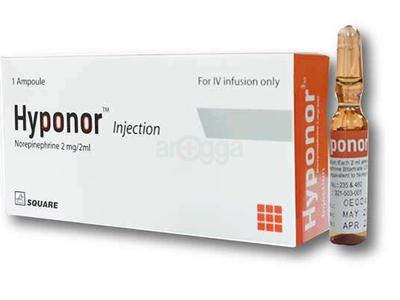
Hyponor 2 mg/2 ml
Norepinephrine
Category: IV Infusion
Manufacturer: Square Pharmaceuticals Ltd.

Price: 225.0 ৳
2ml Ampoules
2 ml vial

Medicine Selling service is not available yet.
Related Medicines
For blood pressure control in certain acute hypotensive states (e.g., pheochromocytomectomy, sympathectomy, poliomyelitis, spinal anesthesia, myocardial infarction, septicemia, blood transfusion, and drug reactions). As an adjunct in the treatment of cardiac arrest and profound hypotension.
Alpha and Beta-adrenergic agonist
Norepinephrine is a direct-acting sympathomimetic which stimulates β1- and α-adrenergic receptors. Its α-agonist effects cause vasoconstriction, thereby raising systolic and diastolic BP with reflex slowing of heart rate.
Upper gastrointestinal haemorrhage:
Adult: Intraperitoneal admin: 8 mg in 250 ml of 0.9% sodium chloride inj. Alternatively, instill 8 mg in 100 ml of 0.9% sodium chloride solution through a nasogastric tube every hr for 6–8 hr, then every 2 hr for 4–6 hr. Withdraw drug gradually.
Acute hypotensive states:
Adult: Initially, 8-12 mcg/minute, up to 8-30 mcg/minute in refractory shock. Infuse using a solution of 4 mcg/ml in glucose 5%, or sodium chloride 0.9% and glucose 5% at a rate of 2-3 ml/minute. Adjust according to BP response. Average maintenance dose: 0.5-1 ml/minute (2-4 mcg/minute). Infuse via a central venous catheter or into a large vein.
Child: Administer at a rate of 2 mcg/minute. Alternatively, 2 mcg/m2/minute. Adjust rate according to BP response and perfusion.
Elderly: Initial dose should be at low end of dose range.
Guanethidine, methyldopa, reserpine, TCAs may increase pressor response to norepinephrine.
Hypertension. Pregnancy. Patients with peripheral or mesenteric vascular thrombosis unless necessary as a life-saving procedure.
Hypertension, headache, peripheral ischaemia, bradycardia, arrhythmias, anxiety, skin necrosis (with extravasation), dyspnoea, respiratory difficulty.
Pregnancy Category C. Either studies in animals have revealed adverse effects on the foetus (teratogenic or embryocidal or other) and there are no controlled studies in women or studies in women and animals are not available. Drugs should be given only if the potential benefit justifies the potential risk to the foetus.
Not a substitute for replacement of blood, plasma, fluids, and/or electrolytes; correct volume depletion prior to admin. Identify and correct hypoxia, hypercapnia and acidosis prior to or during admin. Avoid extravasation as tissue necrosis may occur. Avoid inj into leg veins, especially in elderly or those with occlusive vascular diseases, arteriosclerosis, DM or Buerger's disease. Hypertensive or hyperthyroid patients. In conjunction with local anaesthetics, do not use in fingers, toes, ears, nose or genitalia. Lactation.
Symptoms: Hypertension, sweating, cerebral haemorrhage, convulsions.
Store at room temperature (25°C) and protect from light.


Samm Care