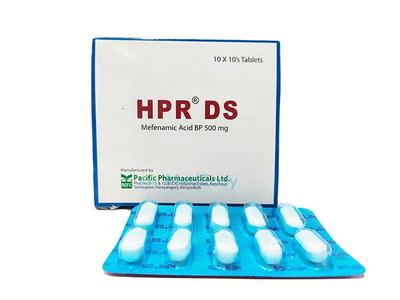
HPR-DS 500 mg
Generic: Mefenamic Acid
Category: Tablet
Manufacturer: Pacific Pharmaceuticals Ltd.

Allopathic
MFG. Licence No. Biological
206
MFG. Licence No. Non-Biological
354
Address
Narayangonj. Kanchpur, Sonargaon Plot No. B-11/12, BSCIC I/A
Price: 700.0 ৳
100's pack
10's Strip
piece

Medicine Selling service is not available yet.
Alternative Brands & Related Medicines


Indications
Mefenamic Acid is indicated for-
Fever
Toothache
Headache
Migraine
Primary dysmenorrhoea
Menorrhagia
Mild to moderate pain in rheumatoid arthritis and osteoarthritis
Traumatic pain
Low-back pain
Juvenile chronic arthritis in children etc.
Therapeutic Class
Drugs for Osteoarthritis, Drugs used for Rheumatoid Arthritis, Non-steroidal Anti-inflammatory Drugs (NSAIDs)
Pharmacology
Mefenamic acid, an anthranilic acid derivative, is a prototypical NSAID. It reversibly inhibits the cyclooxygenase-1 and cyclooxygenase-2 (COX-1 and COX-2) enzymes, thus resulting in reduced synthesis of prostaglandin precursors. It has analgesic and antipyretic properties with minor anti-inflammatory activity.
Dosage and Administration
As with other NSAIDs, the lowest dose should be sought for each patient. Therefore, after observing the response to initial therapy with Mefenamic acid, the dose and frequency should be adjusted to suit an individual patient's needs. Administration is by the oral route, preferably with food.Adult: A 500 mg dose should be given to adults up to three times (1.5 g total) per day.Infants over 6 months: 25 mg/kg of body weight daily in divided doses for not longer than 7 days.
Interaction
Aspirin: As other NSAIDs, concomitant administration of Mefenamic Acid and Aspirin is not generally recommended because of the potential of increased adverse effects.Warfarin: Mefenamic Acid can inhibit platelet aggregation and may prolong the prothrombin time in patients on warfarin therapy
Contraindications
It is contraindicated in patients with known hypersensitivity to Mefenamic Acid. It should not be used in patients with peptic ulcer, inflammatory bowel diseases, hepatic or renal impairment. It is also contraindicated in patients, whom aspirin and/or other NSAID's have induced symptoms of bronchospasm, skin rashes etc.
Side Effects
The most frequently reported adverse experiences occurring in approximately 1-10% of patients are gastrointestinal: abdominal pain, constipation, diarrhoea, dyspepsia, flatulence, nausea, Gl ulcers, vomiting, dizziness, abnormal renal function, pruritus, rashes.
Pregnancy And Lactation
Pregnancy: In late pregnancy, as with other NSAIDs, Mefenamic acid should be avoided because it may cause premature closure of the ductus arteriosus. In general there are no adequate and well controlled studies in pregnant women. Mefenamic acid should be used during pregnancy only if the potential benefit justifies the potential risk to the foetus. Rated as Pregnancy Category C.Lactation: Trace amounts of Mefenamic acid may be present in breast milk. Taking into account the importance of the drug to the mother , decision should be made whether to discontinue nursing or to discontinue the drug.
Precautions And Warnings
It should be administered with caution in allergic diseases especially in asthma. The treatment should be withdrawn in diarrhoea, rashes, cholestatic jaundice, thrombocytopenia, haemolytic anaemia.
Overdose Effects
Symptoms: Headache, nausea, vomiting, epigastric pain, GI bleeding. Rarely, diarrhoea, disorientation, excitation, coma, drowsiness, tinnitus, fainting, and occasionally convulsions. Management: Symptomatic and supportive treatment. In acute overdosage, empty the stomach immediately by inducing emesis or by gastric lavage followed by admin of activated charcoal.
Storage Conditions
Keep away from light, store in a cool and dry place. Keep out of reach of children.
Drug Classes
Drugs for Osteoarthritis, Drugs used for Rheumatoid Arthritis, Non-steroidal Anti-inflammatory Drugs (NSAIDs)
Mode of Action
Mefenamic acid contains Mefenamic Acid which is a nonsteroidal agent with demonstrated analgesic, anti-inflammatory and antipyretic activity due to its dual action on prostaglandins. It inhibits the enzymes of prostaglandin synthetase and also antagonizes the actions of prostaglandin at the receptor sites.
Pregnancy Category
The safety of Mefenamic acid on reproductive capacity and pregnancy has not been established. Thus, mefenamic acid should be used in women of childbearing potential and during pregnancy only when the potential benefits are expected to outweigh the potential risks. Trace amounts of Mefenamic acid may be present in breast milk and transmitted to the nursing infant. Thus Mefenamic acid should not be taken by the nursing mother because of the effects of this class of drugs on the infant's cardiovascular system.


Samm Care