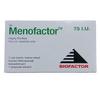
HMG 75 75 IU/vial
Human Menopausal Gonadotrophin
Category: Injection
Manufacturer: Popular Pharmaceuticals Ltd.

Price: 920.0 ৳
1 x 1 in Blister Pack

Medicine Selling service is not available yet.
Related Medicines

Female infertility, Male infertility, In vitro fertilisation procedures or other assisted conception techniques
Ovarian cysts or enlargement not caused by polycystic ovarian syndrome; tumors of breast, uterus, ovaries, testes or prostate; vaginal bleeding of unknown cause; pregnancy and lactation.
Female Sex hormones
Pharmacodynamic properties: Human Menopausal Gonadotrophin directly affects the ovaries and the testes. Human Menopausal Gonadotrophin has gametotropic and steroidogenic effect. In the ovaries, the FSH-component in Human Menopausal Gonadotrophin induces an increase in the number of growing follicles and stimulates their development. FSH increase the production of estradiol in the granulose cells by aromatizing androgens that originate in the Theca cells under the influence of the LH-component. In the testes, FSH induces the transformation of premature to mature Sertoli cells. It mainly causes the maturation of the seminal canals and development of the spermatozoa. However, a high concentration of androgens within the testes is necessary and can be attained by a prior treatment using HCG.Pharmacokinetic properties: Human Menopausal Gonadotrophin is not effective when taken orally and is injected i.m. or s.c. Human Menopausal Gonadotrophin's biological effectiveness is mainly due to its FSH and LH content. The pharmacokinetics of Human Menopausal Gonadotrophin following i.m. or s.c. administration were tested product specifically. The maximum serum level of FSH is reached 6-48 hours hours after i.m. injection and 6-36 hours after s.c. injection respectively. After that, the serum level decreases by a half-life of 56 hours (i.m.) and 51 hours (s.c.) respectively. Administered Human Menopausal Gonadotrophin is predominantly discharged renally.
Adult Dose:
Parenteral
Female infertility
Adult: 75-150 units of FSH daily via IM or SC inj; adjust gradually until adequate response is achieved. Treatment is stopped and followed after 1 or 2 days by single dose of chorionic gonadotrophin 5000-10,000 units.
In menstruating patients, start within the 1st 7 days of menstrual cycle. Alternatively, 3 equal doses IM or SC, each providing 225-375 units of FSH on alternate days followed by chorionic gonadotrophin 1 wk after the 1st dose. Stop treatment if no response is seen in 3 wk. Course may be repeated twice more, if necessary.
Male infertility
Adult: Stimulate spermatogenesis with chorionic gonadotrophin, then with human menopausal gonadotrophin in a dose of 75 or 150 units of FSH 2 or 3 times wkly by IM or SC. Treatment should be continued for at least 3 or 4 mth.
In vitro fertilisation procedures or other assisted conception techniques
Adult: (In conjunction with chorionic gonadotrophin and sometimes clomiphene citrate or a gonadorelin analogue.) 75-300 units of FSH daily via IM or SC inj usually beginning on the 2nd or 3rd day of menstrual cycle.
Combined regimen: 100 mg clomiphene citrate on days 2-6, with human menopausal gonadotrophins beginning on day 5 in a dose providing 150-225 units of FSH daily. Continue until an adequate response is obtained; final inj of human menopausal gonadotrophins is followed 1-2 days later with up to 10,000 units of chorionic gonadotrophin.
Drugs with luteinising hormone activity may increase risk of ovarian hyperstimulation syndrome.
Ovarian cysts or enlargement not caused by polycystic ovarian syndrome; tumors of breast, uterus, ovaries, testes or prostate; vaginal bleeding of unknown cause; pregnancy and lactation.
Ovarian hyperstimulation, risk of multiple pregnancy and miscarriage, hypersensitivity and local reactions at Inj site, nausea, vomiting, joint pain, fever. In men, gynecomastia, acne, weight gain.
Potentially Fatal: Rupture of ovarian cysts and intraperitoneal haemorrhage.
There is no indication for Human Menopausal Gonadotrophin to be used during pregnancy and lactation period
Precaution:
Hyperprolactinemia or tumors of the pituitary or hypothalamus. Ovarian enlargement at risk of rupture, care in pelvic examinations. Risk of multiple births.
Treatment with Human Menopausal Gonadotrophin can lead to hyper-stimulation of the ovaries. This, however, mostly becomes clinically relevant only after HCG has been administered to induce ovulation (please see Undesirable effects paragraph). No therapy is necessary when a slight hyper-stimulation is present (Level I) accompanied by a slight enlargement of the ovaries (over size 5-7 cm), excessive steroid secretion, and abdominal pain. The patient should be informed, however, and carefully watched. Clinical supervision and symptomatic treatment, and perhaps an intravenous volume replacement in case of high hemoglobin concentration, is necessary if hyper-stimulation (Level II) with ovarian cysts (ovary size 8-10 cm) is present, accompanied by abdominal symptoms, nausea, and vomiting. Hospitalization is imperative when serious hyper-stimulation (Level III) with large ovarian cysts (ovary size more than 10 cm) is present accompanied by ascites, hydrothorax, enlarged abdomen, abdominal pain, dyspnea, salt retention, hemoglobin concentration, increased blood viscosity, and platelet aggregation with the danger of thromboembolisms. Undesirable effects Sensitivity to Human Menopausal Gonadotrophin - Febrile reaction which may be accompanied by chills, musculoskeletal aches or pain, malaise and fatigue have occurred after the administration of Human Menopausal Gonadotrophin. It is not clear whether or not these were pyrogenic responses or possible allergic reactions. In addition, reports of "flu-like symptoms" including fever, Chills, musculoskeletal aches, joint pains, nausea, headache and malaise have been received - Gastrointestinal symptoms (nausea, vomiting, diarrhea, abdominal cramps, bloating). - Pain, rash, swelling and/or irritation at the site of injection. - Body rashes. - Dizziness, tachycardia, dyspnea, tachypnea. The following medical events have been reported subsequent to pregnancies resulting from Human Menopausal Gonadotrophin therapy: - Ectopic pregnancy. - Congenital abnormalities
Store at 2°C to 8°C, Do not freeze. Store below 25°C for single period of not more than 3 months. Protect from light and keep in dry place. The reconstituted solution of the vial should be used immediately after piercing of the rubber stopper. Discard any remaining solution.
Female Sex hormones
Human menopausal gonadotrophins possess both follicle-stimulating hormone (FSH) and luteinizing hormone (LH) activities.
There is no indication for Human Menopausal Gonadotrophin to be used during pregnancy and lactation period

Samm Care