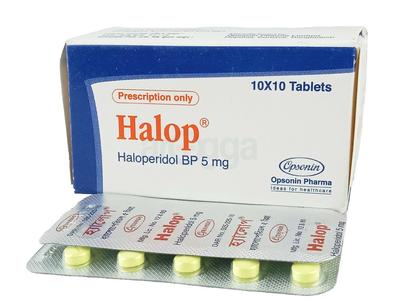
Halop 5 mg
Haloperidol
Category: Tablet
Manufacturer: Opsonin Pharma Limited

Allopathic
MFG. Licence No. Biological
012
MFG. Licence No. Non-Biological
080
Address
Rupatali,
Price: 9.0 ৳
Strip
100's pack
piece

Medicine Selling service is not available yet.
Related Medicines


Uses of Halop:
- Schizophrenia
Schizophrenia, Delirium, Hiccups, Acute psychosis, Hyperactivity, Aggression, Agitation and confusion, Tic disorders, Tourette syndrome, Chorea, Nausea and vomiting, Dementia.
Severe toxic CNS depression; preexisting coma; Parkinson's disease; lactation.
Butyrophenone drugs, Drugs used in tremor, tics & related disorder
Haloperidol blocks postsynaptic dopamine D1 and D2 receptors in the mesolimbic system and decreases the release of hypothalamic and hypophyseal hormones. It produces calmness and reduces aggressiveness with disappearance of hallucinations and delusions.
How to use
Haloperidol:
Take this medicine in the dose and duration as advised by your doctor. Swallow it as a whole. Do not chew, crush or break it.
Haloperidol may be taken with or without food, but it is better to take it at a fixed time.
Administration:
May be taken with or without food. May be taken w/ meals to minimise GI irritation.
Adult Dose:
Oral
Psychoses
Adult: 0.5-5 mg bid/tid, may increase up to 100 mg daily in severe or resistant cases. Usual maintenance: 3-10 mg daily.
Tourette's syndrome; Severe tics
Adult: Initially, 0.5-1.5 mg tid. Up to 30 mg daily may be required in Tourette's syndrome; adjust dose carefully to obtain optimum response; usual maintenance: 4 mg daily.
Short-term adjunct in severe anxiety or behavioral disturbances
Adult: 0.5 mg bid.
Restlessness and confusion
Adult: 1-3 mg every 8 hr.
Intractable hiccup
Adult: 1.5 mg tid, adjust according to response.
Intramuscular
Acute psychosis
Adult: Doses range from 2-10 mg, may be given every hr or at intervals of 4-8 hr, until symptoms are controlled. Max: 18 mg/day. For emergency control of severely disturbed patients: Up to 18 mg may be given IV/IM.
Elderly:
PO: Lower initial doses and more gradual adjustments recommended; 0.25-0.5 mg PO q8-12hr initially
IM (prompt-acting): Lower adult doses and longer dosing intervals recommended compared with typical adult doses
Child Dose:
<3 years: Safety and efficacy not established
Psychosis/Sedation
3-12 years (15-40 kg): 0.25-0.5 mg/day PO divided q8-12hr initially; may be increased by 0.5 mg/day every 5-7 days PRN; maintenance: 0.05-0.15 mg/kg/day PO divided q8-12hr
6-12 years: Lactate (prompt-acting): 1-3 mg IM q4-8hr PRN; not to exceed 0.15 mg/kg/day
>12 years: Moderate disease, 0.5-2 mg PO q8-12hr initially; severe disease, 3-5 mg PO q8-12hr; not to exceed 30 mg/day
Tourette Disorder
3-12 years: 0.5 mg/day PO initially; dose increased by 0.5 mg every 5-7 days until therapeutic effect achieved, then reduced to lowest effective maintenance level of 0.05-0.075 mg/kg/day PO divided q8-12hr
>12 years: 0.5-2 mg PO q8-12hr initially; if severe symptoms necessitate increased dosage, titrate upward to 3-5 mg PO q8-12hr; if patient remains inadequately controlled, daily doses up to 100 mg have been used (safety not determined)
Behavioral Disorders
3-12 years: 0.5 mg/day PO initially; dose increased PRN by 0.5 mg every 5-7 days until therapeutic effect achieved, then reduced to lowest effective maintenance level of 0.05-0.075 mg/kg/day PO divided q8-12hr
Acute Agitation
<12 years: Safety and efficacy not established
>12 years: 0.5-3 mg PO, repeated in 1 hour PRN; alternatively, 2-5 mg IM, repeated in 1 hr PRN
Carbamazepine and rifampicin reduce plasma concentrations. Symptoms of CNS depression may be enhanced by CNS depressants e.g. alcohol, hypnotics, general anaesthetics, anxiolytics and opioids. May reduce antihypertensive action of guanethidine. May increase risk of arrhythmia when used with drugs that prolong QT interval or diuretics that can cause electrolyte imbalance. May increase plasma levels of haloperidol when used with clozapine or chlorpromazine.
Potentially Fatal: Increases lithium blood levels and may predispose to neuroleptic malignant syndrome.
Severe toxic CNS depression; preexisting coma; Parkinson's disease; lactation.
Common
- Abnormality of voluntary movements
- Constipation
- Dryness in mouth
- Increased prolactin level in blood
- Orthostatic hypotension (sudden lowering of blood pressure on standing)
- Sleepiness
- Weight gain
Extrapyramidal symptoms
Akathisia,Dystonia,Muscle stiffness,Neuroleptic malignant syndrome (NMS; infrequent but serious),Parkinsonism,Tardive dyskinesia
Common
Anticholinergic effects,Sedation,Weight gain,Erectile dysfunction,Oligomenorrhea or amenorrhea
Less common
Orthostatic hypotension (after IM injection), tachycardia
Agitation, anxiety, cerebral edema, depression, dizziness, euphoria, headache, insomnia, poikilothermia, restlessness, weakness, confusion
Anorexia, constipation, dyspepsia, ileus, decreased gag reflex
Lens opacities (prolonged use)
Uncommon
ECG changes,Photosensitivity,Pruritus,Diarrhea,Blood dyscrasia,Ejaculatory disorder,Galactorrhea
Rare
Seizure,Cholestatic jaundice,Priapism
Potentially Fatal: Neuroleptic malignant syndrome
There is no proven harmful effect in the first trimester, however there have been some reports of limb malfonnations, so the drug is best avoided if possible. The principal hazard in late pregnancy is extrapyramidal adverse effects in the neonate. The drug is excreted only in trace amounts and sedation or extrapyramidal rigidity in the neonate can occur but is rarely a problem.
Precaution:
Parkinsonism; epilepsy, allergy, angle-closure glaucoma, benign prostatic hyperplasia; severe cardiac or hepatic disease; extremes in temp (hot and cold weather); presence of acute infections or leucopenia; hyperthyroidism; pregnancy, elderly, children. Patients receiving anticoagulants. Discontinue upon signs of neurological toxicity in patients taking haloperidol and lithium.
Lactation: Drug enters breast milk; not recommended
In general, the symptoms of overdosage would be an exaggeration of known pharmacologic effects and adverse reactions, the most prominent of which would be: severe extrapyramidal reactions, hypotension or sedation.The patient would appear comatose with respiratory depression and hypotension which could be severe enough to produce a shock-like state.
Do not store above 30°C. Keep away from light and out of the reach of children.
Butyrophenone drugs, Drugs used in tremor, tics & related disorder
Haloperidol blocks postsynaptic dopamine D1 and D2 receptors in the mesolimbic system and decreases the release of hypothalamic and hypophyseal hormones. It produces calmness and reduces aggressiveness with disappearance of hallucinations and delusions.
Safety for use in pregnancy and lactation has not been established; do not administer to women of childbearing potential or nursing mothers unless, in the opinion of the physician, the expected benefits of the drug outweigh the potential hazard to the fetus or child. Haloperidol is excreted in breast milk.


Samm Care