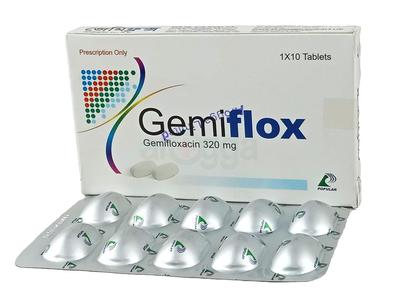
Gemiflox 320 mg
Generic: Gemifloxacin
Category: Tablet
Manufacturer: Popular Pharmaceuticals Ltd.
Unclassified — prescription required · Upload a prescription at checkout. Pharmacist approval is required before preparation.
Currently unavailable to order.


Alternative Brands & Related Medicines



Indications
Uses of Gemiflox:
- Bacterial infections
Chronic bronchitis, Community-acquired pneumonia
Hypersensitivity. Patients receiving class IA or III antiarrhythmics.
Therapeutic Class
4-Quinolone preparations
Pharmacology
Gemifloxacin is a fluoroquinolone antibiotic. It is bactericidal with minimum bactericidal concentrations. Gemifloxacin acts by inhibiting DNA synthesis through inhibition of the bacterial type II topoisomerases, DNA gyrase, and/or topoisomerase IV (TOPO IV) which are both essential for bacterial growth.Gemifloxacin is rapidly absorbed after oral administration. It is widely distributed throughout the body. Studies in healthy subjects showed that gemifloxacin is distributed rapidly into target tissues and body fluids such as the lung (epithelial lining fluid, alveolar macrophages, bronchial tissue) and nasal secretions. Following oral administration of gemifloxacin, approximately 36% and 61% of the dose is excreted in the urine and feces, respectively, as unchanged drug and metabolites. AUC values were generally only slightly higher (approx. 10%) in women than in men. No dose adjustment is required based on gender
Dosage and Administration
How to use
Gemifloxacin:
Take this medicine in the dose and duration as advised by your doctor. Swallow it as a whole. Do not chew, crush or break it.
Gemifloxacin may be taken with or without food, but it is better to take it at a fixed time.
Administration:
May be taken with or without food.
Adult Dose:
Oral
Acute bacterial exacerbation of chronic bronchitis
Adult: 320 mg once daily for 5 days.
Community-acquired pneumonia
Adult: Mild to moderate: 320 mg once daily for 7 days.
Child Dose:
Safety and efficacy not established
Renal Dose:
Renal impairment:
CrCl (ml/min)
<40 (or patient on haemodialysis/CAPD) 160 mg once daily.
Interaction
Additive effect on QT interval prolongation w/ class IA (e.g. quinidine) or class III (e.g. amiodarone) antiarrhythmics and other drugs that prolong QT interval (e.g. erythromycin, TCAs, antipsychotic agents). Renal clearance reduced w/ probenecid. Decreased absorption w/ Al or Mg-containing antacids, buffered didanosine, sucralfate or dietary supplements containing metal cations (e.g. Zn, Mg, Fe).
Increased risk of severe tendon disorders esp in elderly (>60 yr) w/ corticosteroids. May increase prothrombin time, INR and/or bleeding w/ warfarin.
Contraindications
Hypersensitivity. Patients receiving class IA or III antiarrhythmics.
Side Effects
Common
- Rash
- Vomiting
- Headache
- Dizziness
- Stomach pain
- Nausea
- Diarrhea
1-10%
Diarrhea (5%),Headache (4%),Nausea (4%),Rash (4%),Transaminases increased (1-4%),Abdominal pain (2%),Dizziness (2%),Vomiting (2%),Neutropenia (1%),Platelets increased (1%),Thrombocythemia (1%),GGT increased (1%)
<1%
Peripheral neuropathy,Photosensitivity,Tendon rupture
Pregnancy And Lactation
Gemifloxacin should not be used in pregnant or lactating women. The safety and efficacy of Gemifloxacin in pregnant or lactating women have not been established.
Precautions And Warnings
Precaution:
Patient w/ known or suspected CNS disorders (e.g. seizure disorders) or other risk factors predisposing to seizures, myasthenia gravis, previous tendon disorders (e.g. rheumatoid arthritis), history of QT interval prolongation, significant bradycardia or acute myocardial ischaemia, uncorrected electrolyte disorders. Kidney, heart or lung transplant recipients. Renal impairment. Pregnancy and lactation. Patient Counselling May impair ability to perform activities that require mental alertness or coordination (e.g. driving, operating machinery).
Rest and refrain from doing strenuous physical activity as it may increase risk of tendon rupture. Avoid excessive exposure to sunlight or artificial UV light (e.g. tanning beds) and use protective measures (e.g. sunscreen, wear loose-fitting clothes) if staying outdoors is necessary during therapy. Monitoring Parameters Monitor WBC, signs and symptoms of infection and renal function.
Lactation: excretion in milk unknown; do not use unless benefit to mother outweighs risk
Overdose Effects
No specific antidote is known. Dialysis does not remove Gemifloxacin sufficiently to be useful in overdose. In the event of acute oral overdosage, the stomach should be emptied by inducing vomiting or by gastric lavage; the patient should be carefully observed, treated symptomatically and adequate hydration should be maintained.
Storage Conditions
Keep below 30°C temperature, away from light & moisture. Keep out of the reach of children.
Drug Classes
4-Quinolone preparations
Mode of Action
The bactericidal action of gemifloxacin results from inhibition of the enzymes topoisomerase II (DNA gyrase) and topoisomerase IV, which are required for bacterial DNA replication, transcription, repair, and recombination.
Pregnancy Category
Gemifloxacin should not be used in pregnant or lactating women. The safety and efficacy of Gemifloxacin in pregnant or lactating women have not been established.


Samm Care