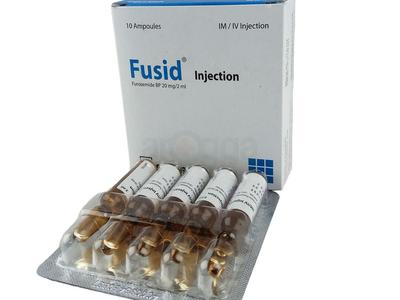
Fusid 20 mg/2 ml
Furosemide
Category: IM/IV Injection
Manufacturer: Square Pharmaceuticals Ltd.

Price: 40.54 ৳
Strip
10's pack
2 ml ampoule

Medicine Selling service is not available yet.
Related Medicines

Fusid is indicated in-
Fluid retention associated with chronic congestive cardiac failure (if diuretic treatment is required).
Fluid retention associated with acute congestive cardiac failure.
Fluid retention associated with chronic renal failure.
Maintenance of fluid excretion in acute renal failure, including that due to pregnancy or burns. ... Read moreFusid is indicated in-
Fluid retention associated with chronic congestive cardiac failure (if diuretic treatment is required).
Fluid retention associated with acute congestive cardiac failure.
Fluid retention associated with chronic renal failure.
Maintenance of fluid excretion in acute renal failure, including that due to pregnancy or burns.
Fluid retention associated with nephrotic syndrome (if diuretic treatment is required).
Fluid retention associated with liver disease (if necessary to supplement treatment with aldosterone antagonists).
Hypertension.
Hypertensive crisis (as a supportive measure).
Support of forced diuresis.
Loop diuretics
Furosemide is a monosulphonyl diuretic. It is an effective diuretic that retains its activity even in low glomerular filtration rate (GFR). Furosemide has a distinctive action on renal tubular function. It affects a peak diuresis far greater than that observed with other agents. Other features are (I) prompt onset of action (II) inhibition of sodium and chloride transport in the ascending limb of the loop of Henle and (III) independence of their action from acid-base balance changes. Furosemide acts primarily to inhibit electrolyte reabsorption in the thick ascending limb of the loop of Henle. Furosemide is readily absorbed from the gastrointestinal tract and considerable proportions are bound to plasma proteins. It is rapidly excreted in the urine. With an hour after intravenous injection, its effect is evident in about 5 minutes and last for about 2 hours.
A marked fall in blood pressure may be seen when ACE inhibitors are added to furosemide therapy. Serum lithium levels may be increased when lithium is given concomitantly with furosemide. The toxic effects of nephrotoxic antibiotics may be increased by concomitant administration of potent diuretics such as furosemide.
Furosemide is contraindicated in anuria, electrolyte deficiency and pre-comatose states associated with liver cirrhosis. Hypersensitivity to furosemide or sulphonamides.
As with other diuretics, electrolytes and water balance may be disturbed as a result of diuresis of prolonged therapy. Prolonged use can produce alkalosis. It may also cause uric acid retention and may rarely produce acute gout. Furosemide may provoke hyperglycemia and glycosuria.
Pregnancy Category C. Frusemide should be cautiously used in cardiogenic shock complicated by pulmonary oedema and in the first trimester of pregnancy. Blood pressure and pulse during rapid diuresis should be monitored. Caution should be observed in patients liable to electrolyte deficiency. In case of nursing mother, Frusemide may inhibit lactation because it may pass into breast milk. In that case it should be used with caution.
Patients with prostatic hypertrophy or impairment of micturition have an increased risk of developing acute retention. A marked fall in blood pressure may be seen when ACE inhibitors are added to furosemide therapy. The toxic effects of nephrotoxic antibiotics may be increased by concomitant administration of potent diuretics such furosemide.Driving a vehicle or performing other hazardous tasks: Some adverse effects (e.g. an undesirably pronounced fall in blood pressure) may impair the patient's ability to concentrate and react, and, therefore, constitute a risk in situations where these abilities are of special importance (e.g. operating a vehicle or machinery).
Signs and symptoms: The clinical picture in acute or chronic overdose depends primarily on the extent and consequences of electrolyte and fluid loss, e.g. hypovolaemia, dehydration, haemoconcentration, cardiac arrhythmias (including AV block and ventricular fibrillation).
Management: No specific antidote to furosemide is known. If ingestion has only just taken place, attempts may be made to limit further systemic absorption of the active ingredient by measures such as gastric lavage or those designed to reduce absorption (e.g. activated charcoal).
Protect from light. Do not use it later than the date of expiry. Keep all medicines out of the reach of children. To be dispensed only on the prescription of a registered physician.
Loop diuretics
Furosemide is a monosulphonyl diuretic. It is an effective diuretic that retains its activity even in low glomerular filtration rate (GFR). Furosemide has a distinctive action on renal tubular function. It affects a peak diuresis far greater than that observed with other agents. Other features are (I) prompt onset of action (II) inhibition of sodium and chloride transport in the ascending limb of the loop of Henle and (III) independence of their action from acid-base balance changes. Furosemide acts primarily to inhibit electrolyte reabsorption in the thick ascending limb of the loop of Henle. Furosemide is readily absorbed from the gastrointestinal tract and considerable proportions are bound to plasma proteins. It is rapidly excreted in the urine. With an hour after intravenous injection, its effect is evident in about 5 minutes and last for about 2 hours.
Pregnancy category C. Furosemide should be cautiously used in cardiogenic shock complicated by pulmonary oedema and in the first trimester of pregnancy. Blood pressure and pulse during rapid diuresis should be monitored. Caution should be observed in patients liable to electrolyte deficiency. In case of nursing mother, furosemide may inhibit lactation or may pass into breast milk. In that case it should be used with caution.


Samm Care