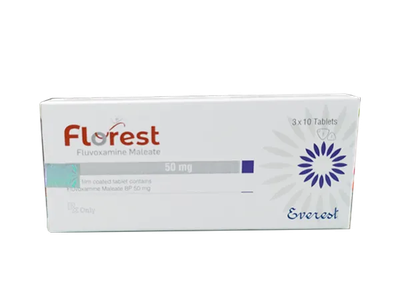
Florest 50 mg
Fluvoxamine Maleate
Category: Tablet
Manufacturer: Everest Pharmaceuticals Ltd.

Allopathic
MFG. Licence No. Biological
178
MFG. Licence No. Non-Biological
336
Address
BSCIC Industrial Estate, Kanchpur Plot No. B-45 & 46
Price: 15.0 ৳
1 x 10 in Blister Pack
30's Pack
10's Strip

Medicine Selling service is not available yet.
Related Medicines


Uses of Florest:
- Depression
- Obsessive-compulsive disorder
Major depressive disorder, Anxiety disorders, Depression, Panic disorder, Obsessive-compulsive disorder, Posttraumatic stress disorder
Hypersensitivity. Not to be used with thioridazine, terfenadine, astemizole, cisapride, pimozide, aloestron, tizanidine. Lactation.
SSRIs & related anti-depressant drugs
The mechanism of action of fluvoxamine maleate in obsessive compulsive disorder is presumed to be linked to its specific serotonin reuptake inhibition in brain neurons. Fluvoxamine has been shown to be a potent inhibitor of the serotonin reuptake transporter in preclinical studies, both in vitro and in vivo.In in vitro studies, fluvoxamine maleate had no significant affinity for histaminergic, alpha or beta adrenergic, muscarinic, or dopaminergic receptors. Antagonism of some of these receptors is thought to be associated with various sedative, cardiovascular, anticholinergic, and extrapyramidal effects of some psychotropic drugs.
How to use
Fluvoxamine Maleate:
Take this medicine in the dose and duration as advised by your doctor. Swallow it as a whole. Do not chew, crush or break it.
Fluvoxamine Maleate may be taken with or without food, but it is better to take it at a fixed time.
Administration:
May be taken with or without food.
Adult Dose:
Oral
Obsessive compulsive disorder
Adult: 50 mg once daily; may increase by 50 mg every 4-7 days. Daily doses >100 mg should be given in 2 divided doses. Max: 300 mg daily.
Elderly: Initial 25mg once daily.
Depression
Adult: Initially, 50-100 mg daily, may increase gradually up to 300 mg daily, if necessary. Doses >150 mg should be given in 2 or 3 divided doses.
Hepatic impairment: Decrease dose
Child Dose:
Oral
Obsessive compulsive disorder
Child: >8 yr: 25 mg once daily, may increase by 25 mg every 4-7 days. Doses >50 mg should be given in 2 divided doses.
Reassess if no improvement after 10 wk of treatment. Max: 200 mg daily.
Co-admin with fluvoxamine may increase carbamazepine toxicity and serum levels of theophylline. Lithium enhances the serotonergic effects of fluvoxamine. Anticoagulants may require dosage adjustments. Diltiazem with fluvoxamine may lead to bradycardia. Avoid alcohol.
Potentially Fatal: Fluvoxamine should not be used in combination with MAOIs, or within 14 days of discontinuing treatment with MAOIs.
Hypersensitivity. Not to be used with thioridazine, terfenadine, astemizole, cisapride, pimozide, aloestron, tizanidine. Lactation.
Common
- Delayed ejaculation
- Drowsiness
- Erectile dysfunction
- Low sexual desire
- Nausea
- Vomiting
- Dryness in mouth
- Fatigue
- Increased sweating
- Indigestion
- Insomnia (difficulty in sleeping)
- Loss of appetite
- Nervousness
- Tremor
>10%
Nausea (40%),Headache (22-35%),Somnolence (22-27%),Weakness (14-26%),Insomnia (20-35%),Diarrhea (11-18%),Dizziness (11-15%),Xerostomia (10-14%),Anorexia (6-14%),Abnormal ejaculation (8-11%)
1-10%
Pain (10%),Dyspepsia (8-10%),Constipation (4-10%),Decreased libido (2-10%),Upper respiratory infections (9%),Anxiety (5-8%),Tremor (5-8%),Sweating (6-7%),Vomiting (4-6%),Abdominal pain (5%),Myalgia (5%),Abnormal taste (2-5%),Bruising (4%),Abnormal dreams (3%),Abnormal thinking (3%),Chest pain (3%),Palpitation (3%),Agitation (2-3%),Vasodilation (2-3%),Hypertension (1-2%),Increased LFTs (1-2%),Weight change (1-2%),Manic reaction
<1%
Activation of mania/hypomania, seizures (discontinue),Sinusitis
Frequency Not Defined
Edema,Amnesia,Apathy,Asthenia,Malaise,Nervousness,Dry mouth,Myoclonus,Cough
Category C: Either studies in animals have revealed adverse effects on the foetus (teratogenic or embryocidal or other) and there are no controlled studies in women or studies in women and animals are not available. Drugs should be given only if the potential benefit justifies the potential risk to the foetus.
Precaution:
History of mania or seizures; liver dysfunction; presence of depressive symptoms; smokers. Treatment with MAOI should only be started at least 2 wk after stopping fluvoxamine treatment. Increased risk of suicidal ideation and behaviour when used in children, adolescents and young adults <24 yr. Pregnancy, elderly; operating hazardous machinery; withdraw gradually. Monitor prothrombin time in patients who are taking oral anticoagulants concurrently.
Lactation
Present in breast milk; avoid
Keep below 30°C temperature, away from light & moisture. Keep out of the reach of children.
SSRIs & related anti-depressant drugs
Fluvoxamine, derived from aralkylketone, inhibits the re-uptake of serotonin in brain neurons.
Pregnancy
Prolonged experience with fluvoxamine in pregnant women over decades, based on published observational studies, have not identified a clear drug-associated risk of major birth defects or miscarriage; there are risks associated with untreated depression in pregnancy and risks of persistent pulmonary hypertension of newborn (PPHN) and poor neonatal adaptation with exposure to selective serotonin reuptake inhibitors (SSRIs), including fluvoxamine, during pregnancy
Women who discontinue antidepressants during pregnancy are more likely to experience a relapse of major depression than women who continue antidepressants; consider risk of untreated depression when discontinuing or changing treatment with antidepressant medication during pregnancy and postpartum
Neonates exposed to therapy and other SSRIs or SNRIs late in the third trimester have developed complications requiring prolonged hospitalization, respiratory support, and tube feeding; such complications can arise immediately upon delivery; reported clinical findings have included respiratory distress, cyanosis, apnea, seizures, temperature instability, feeding difficulty, vomiting, hypoglycemia, hypotonia, hypertonia, hyperreflexia, tremor, jitteriness, irritability, and constant crying; these features are consistent with either a direct toxic effect of SSRIs and SNRIs or, possibly, a drug discontinuation syndrome; it should be noted that, in some cases, the clinical picture is consistent with serotonin syndrome
Animal findings suggest fertility may be impaired while taking fluvoxamine
Lactation
Data from published literature report presence of drug in human milk; no adverse effects on breastfed infant have been reported in most cases of maternal use of fluvoxamine during breastfeeding; however, there are reports of diarrhea, vomiting, decreased sleep, and agitation; there are no data on effect of fluvoxamine on milk production
Developmental and health benefits of breastfeeding should be considered along with mother’s clinical need for fluvoxamine and any potential adverse effects on breastfed child from drug or from the underlying maternal condition
Monitor infants exposed to fluvoxamine through breast milk for diarrhea, vomiting, decreased sleep, and agitation


Samm Care