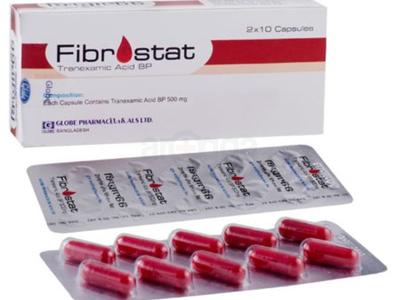
Fibrostat 500 mg
Tranexamic Acid
Category: Capsule
Manufacturer: Globe Pharmaceuticals Ltd.

Allopathic
MFG. Licence No. Biological
182
MFG. Licence No. Non-Biological
50
Address
Begumganj, Noakhali.
Price: 18.0 ৳
Capsule

Medicine Selling service is not available yet.
Related Medicines

Uses of Fibrostat:
- Bleeding
Haemorrhage, Hereditary angioedema
Severe renal failure, active intravascular clotting, thromboembolic disease, colour vision disorders, subarachnoid bleeding.
Anti-fibrinolytic drugs, Haemostatic drugs
Tranexamic acid competitively inhibits activation of plasminogen (via binding to the kringle domain), thereby reducing conversion of plasminogen to plasmin (fibrinolysin), an enzyme that degrades fibrin clots, fibrinogen, and other plasma proteins, including the procoagulant factors V and VIII. Tranexamic acid also directly inhibits plasmin activity, but higher doses are required than are needed to reduce plasmin formation. Tranexamic acid is rapidly absorbed from the gastrointestinal tract. Maximum serum levels are reached within 2-3 hours. After oral administration, about 40% of the dose is excreted in the urine during the first 24 hours. After intravenous administration 45% of the dose is excreted in the urine during the first day.
How to use
Tranexamic Acid:
Take this medicine in the dose and duration as advised by your doctor. Swallow it as a whole. Do not chew, crush or break it.
Tranexamic Acid is to be taken with food.
Administration:
May be taken with or without food.
Adult Dose:
Oral
Short-term management of haemorrhage
Adult: 1-1.5 g or 15-25 mg/kg bid or tid.
Management of hereditary angioedema
Adult: 1-1.5 g bid or tid.
Intravenous
Short-term management of haemorrhage
Adult: 0.5-1 g or 10 mg/kg tid or 25-50 mg/kg daily by continuous infusion.
Child Dose:
Oral
Short-term management of haemorrhage
Child: 25 mg/kg bid or tid.
Management of hereditary angioedema
Child: 25 mg/kg bid or tid.
Intravenous
Short-term management of haemorrhage
Child: 10 mg/kg bid or tid.
Renal Dose:
Renal impairment: Adjust dose based on serum creatinine concentration: 120-250 micromol/l: 15 mg/kg bid daily; 250-500 micromol/l: 15 mg/kg once daily; >500 micromol/l: 7.5 mg/kg once daily or 15 mg/kg once every 48 hr.
Potentially Fatal: Increased risk of thrombus formation with estrogens, Factor IX complex concentrates or anti-inhibitor coagulant concentrates. Increased risk of fatal thrombotic complications with tretinoin in acute promyelocytic leukaemia.
Severe renal failure, active intravascular clotting, thromboembolic disease, colour vision disorders, subarachnoid bleeding.
Common
- Tiredness
- Nasal congestion (stuffy nose)
- Musculoskeletal (bone, muscle or joint) pain
>10%
Headache (50.4%),Nasal and sinus symptoms (25.4%),Back pain (20.7%),Abdominal pain (19.8%),Musculoskeletal pain (11.2%)
1-10%
Arthralgia (6.9%),Muscle cramps and spasms (5.8%),Migraine (6%),Anemia (5.6%),Fatigue (5.2%)
Frequency Not Defined
Visual abnormalities,Hypotension (with rapid injection),Nausea,Vomiting,Diarrhea
Tranexamic acid crosses the placenta. Clinical experience of use in pregnant women is limited. Animal studies have not supplied any evidence of an increased incidence of fetal damage. Tranexamic acid is excreted into breast milk, but it is not likely to influence the child at therapeutic doses.
Precaution:
Mild to moderate renal impairment, irregular menstrual bleeding, previous history of thromboembolic disease, haematuria. Monitor closely in disseminated intravascular coagulation. Monitor LFT and eye examination regularly during long-term use. Discontinue if disturbance in colour vision occurs. Avoid IV inj rate >1 ml/minute due to risk of hypotension. Pregnancy, lactation.
Store in a dry place at 15-30°C, away from light and keep out of children's reach.
Anti-fibrinolytic drugs, Haemostatic drugs
Tranexamic acid is an antifibrinolytic agent that competitively inhibits breakdown of fibrin clots. It blocks binding of plasminogen and plasmin to fibrin, thereby preventing haemostatic plug dissolution.
Since the transplacental passage of the drug and its possible effects on the fetus are unknown, Tranexamic Acid should not be administered during known and presumed pregnancy. Tranexamic Acid passes into breast milk to a concentration of approximately one hundredth of the concentration in the maternal blood. An antifibrinolytic effect in the infant is unlikely.


Samm Care