
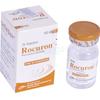
ESMERON 50mg/5ml Injection 10.00mg
Rocuronium Bromide
Category: Injection
Manufacturer: N.V Organon Netherland


Medicine Selling service is not available yet.
Related Medicines


Uses of ESMERON 50mg/5ml Injection:
- Skeletal mucle relaxation during surgery
Non depolarizing muscle relaxants
Rocuronium acts by competing for cholinergic receptors at the motor end-plate. This action is antagonized by acetylcholinesterase inhibitors, such as neostigmine and edrophonium. Rocuronium acts by competitively binding to nicotinic cholinergic receptors. The binding of vecuronium decreases the opportunity for acetylcholine to bind to the nicotinic receptor at the postjunctional membrane of the myoneural junction. As a result, depolarization is prevented, calcium ions are not released and muscle contraction does not occur. Evidence also suggests that nondepolarizing agents can affect ACh release. It has been hypothesized that nondepolarzing agents bind to postjunctional ("curare") receptors and may therefore interfere with the sodium and potassium flux, which is responsible for depolarization and repolarization of the membranes involved in muscle contraction.
How to use
Rocuronium Bromide:
Your doctor or nurse will give you this medicine. Kindly do not self administer.
The following agents have been shown to influence the magnitude and/or duration of action of non-depolarizing neuromuscular blocking agents:
Effect of other agents on Rocuronium Bromide-
Increased Effect: Halogenated volatile anesthetics potentiate the neuromuscular block of Rocuronium Bromide. The effect only becomes apparent with maintenance dosing. Reversal of the block with anti-cholinesterase inhibitors could also be inhibited. Long-term concomitant use of corticosteroids and Rocuronium Bromide in the ICU may result in prolonged duration of neuromuscular block or myopathy.Other drugs:
Antibiotics: aminoglycoside, lincosamide and polypeptide antibiotics, acylamino-penicillin antibiotics.
Diuretics, quinidine and its isomer quinine, magnesium salts, calcium channel blocking agents, lithium salts, local anaesthetics (lidocaine i.v., bupivacaine epidural) and acute administration of phenytoin
Recurarization has been reported after post-operative administration of: aminoglycoside, lincosamide, polypeptide and acylamino-penicillin antibiotics, quinidine, quinine and magnesium.
Decreased Effect: Prior chronic administration of phenytoin or carbamazepine. Protease inhibitors (gabexate, ulinastatin) Variable Effect: Administration of other non-depolarizing neuromuscular blocking agents in combination with Rocuronium Bromide may produce attenuation or potentiation of the neuromuscular block, depending on the order of administration and the neuromuscular blocking agent used. Suxamethonium given after the administration of Rocuronium Bromide may produce potentiation or attenuation of the neuromuscular blocking effect of Rocuronium Bromide. Effect of Rocuronium Bromide on other drugs: Rocuronium Bromide combined with lidocaine may result in a quicker onset of action of lidocaine.
Hypersensitivity to Rocuronium or to the Bromide ion or to any of the excipients.
Common
- High blood pressure
Pregnancy: For Rocuronium Bromide, no clinical data on exposed pregnancies are available. Animal studies do not indicate direct or indirect harmful effects with respect to pregnancy, embryonal/foetal development, parturition or postnatal development. Caution should be exercised when prescribing Rocuronium Bromide to pregnant women.Caesarean section: In patients undergoing Caesarean section, Rocuronium Bromide can be used as part of a rapid sequence induction technique, provided no intubation difficulties are anticipated and a sufficient dose of anesthetic agent is administered or following suxamethonium facilitated intubation. Rocuronium Bromide, administered in doses of 0.6mg/kg, has been shown to be safe in parturient undergoing Caesarean section. Rocuronium Bromide does not affect Apgar score, foetal muscle tone nor cardio-respiratory adaptation. From umbilical cord blood sampling it is apparent that only limited placental transfer of Rocuronium Bromide occurs which does not lead to the observation of clinical adverse effects in the newborn.Lactation: It is unknown whether Rocuronium Bromide is excreted in human breast milk. Animal studies have shown insignificant levels of Rocuronium Bromide in breast milk. Animal studies do not indicate direct or indirect harmful effects with respect to pregnancy, embryonal/foetal development, parturition or postnatal development. Rocuronium Bromide should be given to lactating women only when the attending physician decides that the benefits outweigh the risks.
Instructions for use/handling: Compatibility studies with the following infusion fluids have been performed. In nominal concentrations of 0.5mg/mL and 2.0mg/mL, Rocuronium Bromide has been shown to be compatible with: 0.9% NaCl, 5% dextrose, 5% dextrose in saline, sterile water for injections, Lactated Ringers and Haemaccel. Administration should be commenced immediately after mixing, and should be completed within 24 hours. Unused solutions should be discarded.For use/handling: If Rocuronium Bromide is administered via the same infusion line that is also used for other medicines, it is important that this infusion line is adequately flushed (e.g. with 0.9% NaCl) between administration of Rocuronium Bromide and medicines for which incompatibility with Rocuronium Bromide has been demonstrated or for which compatibility with Rocuronium Bromide has not been established.
In the event of overdosage and prolonged neuromuscular block, the patient should continue to receive ventilatory support and sedation. In this situation there are two options for the reversal of neuromuscular block: Sugammadex can be used for reversal of intense (profound) and deep block. The dose of sugammadex to be administered depends of the level of neuromuscular block. An acetylcholinesterase inhibitor (e.g. neostigmine, edrophonium, pyridostigmine), with appropriate vagolytic (e.g atropine) can be used at reappearance of T2 or at the first signs of clinical recovery and should be administered in adequate doses. When administration of an acetylcholinesterase inhibiting agent fails to reverse the neuromuscular effects of Rocuronium Bromide, ventilation must be continued until spontaneous breathing is restored. Repeated dosage of an acetylcholinesterase inhibitor can be dangerous.
Rocuronium Bromide should be stored in the refrigerator at 2-8° C and not be frozen.
Non depolarizing muscle relaxants
Rocuronium acts by competing for cholinergic receptors at the motor end-plate. This action is antagonized by acetylcholinesterase inhibitors, such as neostigmine and edrophonium. Rocuronium acts by competitively binding to nicotinic cholinergic receptors. The binding of vecuronium decreases the opportunity for acetylcholine to bind to the nicotinic receptor at the postjunctional membrane of the myoneural junction. As a result, depolarization is prevented, calcium ions are not released and muscle contraction does not occur. Evidence also suggests that nondepolarizing agents can affect ACh release. It has been hypothesized that nondepolarzing agents bind to postjunctional ("curare") receptors and may therefore interfere with the sodium and potassium flux, which is responsible for depolarization and repolarization of the membranes involved in muscle contraction.
Pregnancy: For Rocuronium Bromide, no clinical data on exposed pregnancies are available. Animal studies do not indicate direct or indirect harmful effects with respect to pregnancy, embryonal/foetal development, parturition or postnatal development. Caution should be exercised when prescribing Rocuronium Bromide to pregnant women.Caesarean section: In patients undergoing Caesarean section, Rocuronium Bromide can be used as part of a rapid sequence induction technique, provided no intubation difficulties are anticipated and a sufficient dose of anesthetic agent is administered or following suxamethonium facilitated intubation. Rocuronium Bromide, administered in doses of 0.6mg/kg, has been shown to be safe in parturient undergoing Caesarean section. Rocuronium Bromide does not affect Apgar score, foetal muscle tone nor cardio-respiratory adaptation. From umbilical cord blood sampling it is apparent that only limited placental transfer of Rocuronium Bromide occurs which does not lead to the observation of clinical adverse effects in the newborn.Lactation: It is unknown whether Rocuronium Bromide is excreted in human breast milk. Animal studies have shown insignificant levels of Rocuronium Bromide in breast milk. Animal studies do not indicate direct or indirect harmful effects with respect to pregnancy, embryonal/foetal development, parturition or postnatal development. Rocuronium Bromide should be given to lactating women only when the attending physician decides that the benefits outweigh the risks.

Samm Care