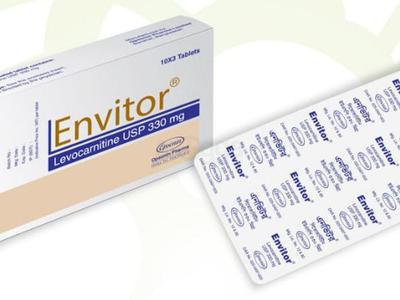
Envitor 330 mg
Levocarnitine
Category: Tablet
Manufacturer: Opsonin Pharma Limited

Allopathic
MFG. Licence No. Biological
012
MFG. Licence No. Non-Biological
080
Address
Rupatali,
Price: 4.52 ৳
Tablet
30's pack
piece

Medicine Selling service is not available yet.
Related Medicines


Uses of Envitor:
- Carnitine deficiency
Congestive heart failure, Diabetic nephropathy, Intermittent claudication, Kidney disease, Chronic Fatigue Syndrome, Heart Diseases, High Cholesterol, Dementia and Memory impairment, Down Syndrome, Male infertility
Hypersensitivity.
Drugs for muscular energy metabolism
Levocarnitine is a naturally occurring substance required in mammalian energy metabolism. It has been shown to facilitate long-chain fatty acid entry into cellular mitochondria, thereby delivering substrate for oxidation and subsequent energy production in the form of Adenosine Tri phosphate or ATP. Fatty acids are utilized as an energy substrate in all tissues except the brain. In skeletal and cardiac muscle, fatty acids are the main substrate for energy production.
How to use
Levocarnitine:
Take this medicine in the dose and duration as advised by your doctor. Swallow it as a whole. Do not chew, crush or break it.
Levocarnitine is to be taken with food.
Administration:
Consume oral solution slowly, may be mixed with drinks and space doses evenly throughout the day (q3-4hr) preferably during or after meals (may decrease GI distress)
Adult Dose:
Adults: Tablet: 330 mg two or three times daily.
Child Dose:
Infants and children: 50 to 100 mg/kg/day in divided doses, with a maximum of 3 g/day. Dosage should begin at 50 mg/kg/day.
The exact dosage will depend on clinical response.
Reports of INR increase with the use of warfarin have been observed. It is recommended that INR levels be monitored in patients on warfarin therapy after the initiation of treatment with levocarnitine or after dose adjustments.
Hypersensitivity.
Common
- Vomiting
- Nausea
Generally Levocarnitine is well tolerated. However, few side effects including transient nausea and vomiting, abdominal cramps, and diarrhoea may occur
Levocarnitine is categorized by the USFDA as Pregnancy Category B. There are no adequate and well-controlled studies in pregnant women. Supplemental Levocarnitine should be used by pregnant women only if clearly indicated and only under medical supervision. It is not known whether Levocarnitine is excreted in human milk. Supplemental Levocarnitine is not advised for nursing mothers. Those with seizure disorders should only use Levocarnitine under medical advisement and supervision.
Precaution:
Gastrointestinal reactions may result from a too rapid consumption of Levocarnitine.
The safety and efficacy of oral levocarnitine has not been evaluated in patients with renal insufficiency. Chronic administration of high doses of oral levocarnitine in patients with severely compromised renal function or in ESRD patients on dialysis may result in accumulation of the potentially toxic metabolites, trimethylamine (TMA) and trimethylamine-N-oxide (TMAO), since these metabolites are normally excreted in the urine
There have been no reports of toxicity from levocarnitine overdosage.
Do not store above 30°C. Keep away from light and out of the reach of children.
Drugs for muscular energy metabolism
Quaternary ammonium compound found in all mammalian tissue (particularly striated muscle).
Important for lipid catabolism; essential for FFA transport from cytosol to mitochondria where they are oxidized.
There is no adequate and well-controlled studies in pregnant women. This drug should be used during pregnancy only if clearly needed. Levocarnitine supplementation in nursing mothers has not been specifically studied. In nursing mothers receiving levocarnitine, any risks to the child of excess carnitine intake need to be weighed against the benefits of levocarnitine supplementation to the mother. Consideration may be given to discontinuation of nursing or of levocarnitine treatment.


Samm Care