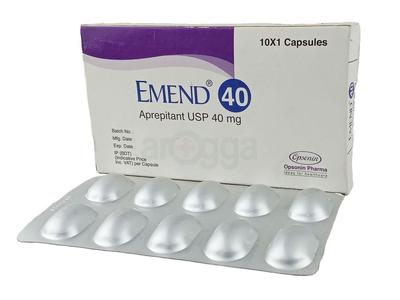
Emend 40 mg
Aprepitant
Category: Capsule
Manufacturer: Opsonin Pharma Limited

Allopathic
MFG. Licence No. Biological
012
MFG. Licence No. Non-Biological
080
Address
Rupatali,
Price: 40.62 ৳
Capsule
10's pack
piece

Medicine Selling service is not available yet.
Related Medicines

Uses of Emend:
- Nausea and vomiting due to chemotherapy
Prevent nausea and vomiting caused by certain types of cancer medicines (chemotherapy), prevent nausea and vomiting after surgery.
Coadministration of astemizole, cisapride, pimozide, or terfenadine; hypersensitivity to any component of the product.
Anti-emetic drugs
Aprepitant is a selective high affinity antagonist of human substance P neurokinin 1 (NK1) receptors. When substance P attaches to these receptors, it causes nausea and vomiting. Aprepitant stops substance P from binding to the NK1 receptors. By blocking the receptors, Aprepitant can prevent nausea and vomiting, which often happens after chemotherapy or as a complication of surgery.
How to use
Aprepitant:
Your doctor or nurse will give you this medicine. Kindly do not self administer.
Administration:
May be taken with or without food.
Adult Dose:
Prevention of Postoperative Nausea and Vomiting
Adults
PO 40 mg within 3 h prior to induction of anesthesia.
Prevention of Chemotherapy–Induced Nausea and Vomiting
PO 125 mg 1 h prior to chemotherapy treatment on day 1 and 80 mg/day in the morning on days 2 and 3. Administer in combination with a corticosteroid and 5-HT 3 antagonist.
Use with caution in Moderate to severely decreased liver function.
Child Dose:
Capsule: Aged <12 years and weight <30 kg: Safety and efficacy not established
Concurrent use with CYP3A4 inhibitors (e.g. clarithromycin, troleandomycin, diltiazem, verapamil, itraconazole, ketoconazole, nefazodone, ritonavir, nelfinavir) may lead to increased plasma levels of Aprepitant; concurrent use with CYP3A4 inducers (e.g. carbamazepine, phenytoin, rifampicin, primidone, phenobarbital) may lead to reduced efficacy of Aprepitant. May decrease concentrations of CYP2C9 substrates e.g. phenytoin, tolbutamide, warfarin. May increase plasma levels of dexamethasone and methylprednisolone. May increase plasma levels of benzodiazepine (e.g. midazolam, diazepam, alprazolam).
Serum concentrations of colchicine may increase with Aprepitant. May increase toxicity of chemotherapy drug metabolised by CYP3A4 e.g. docetaxel, etoposide, ifosfamide, imatinib, paclitaxel, vincristine, vinblastin. May increase levels of ergot derivatives resulting in ergotism. May reduce efficacy of oral contraceptives, use additional methods of contraception during treatment and for at least 1 mth following the last dose of Aprepitant.
Potentially Fatal: May result in increased serum levels of astemizole, cisapride, pimozide and terfenadine which can lead to life-threatening torsade de pointes arrhythmias.
Coadministration of astemizole, cisapride, pimozide, or terfenadine; hypersensitivity to any component of the product.
Common
- Headache
- Dizziness
- Hiccup
- Loss of appetite
- Fatigue
- Constipation
>10% (only seen in CINV)
Headache,Asthenia/fatigue,Anorexia,Constipation,Diarrhea,Nausea,Alopecia,Hiccups
1-10% (selected)
Dizziness,Insomnia,Bradycardia,Hypotension,Pharyngolargeal pain,Mucosal inflammation,Stomatitis,Dyspepsia,Anemia,Neutropenia,Hot flash,Pruritus,Dehydration,Fever
Pregnancy Category B. This drug should be used during pregnancy only if clearly needed. It is not known whether this drug is excreted in human milk. A decision should be made whether to discontinue nursing or to discontinue the drug based on patient’s importance.
Precaution:
This medicine could make hormonal contraceptives, eg the pill, mini-pill or patch less effective at preventing pregnancy. If you are using hormonal contraceptives, you should use an extra back-up method of contraception, eg condoms, to prevent pregnancy, both during treatment with this medicine and for two months after the last dose.
Lactation: It is not known whether this drug is excreted in milk. A decision should be made whether to discontinue nursing or to discontinue the drug, taking into account the importance of the drug to the mother.
No specific information is available on the treatment of overdosage with Aprepitant. Single doses up to 600 mg of Aprepitant were generally well tolerated in healthy subjects. Drowsiness and headache can be seen due to overdose. In the event of overdose, Aprepitant should be discontinued. General supportive treatment and monitoring should be provided. Because of the antiemetic activity of Aprepitant, medicine-induced emesis may not be effective. Aprepitant cannot be removed by hemodialysis.
Keep below 30°C temperature, away from light & moisture. Keep out of the reach of children.
Anti-emetic drugs
Aprepitant is an antiemetic which acts as a substance P/neurokinin 1 (NK1) receptor antagonist. It also enhances antiemetic activity of 5HT3 antagonists and corticosteroid.
Pregnancy
Insufficient data on use in pregnant women to inform a drug associated risk; in animal reproduction studies, no adverse developmental effects observed in rats or rabbits exposed during period of organogenesis to systemic drug levels (AUC) ~1.5 times adult human exposure at 125-mg/80-mg/80-mg regimen
Avoid use of aprepitant IV emulsion in pregnant women due to the alcohol content
Coadministration with aprepitant may reduce the efficacy of hormonal contraceptives; advise females of reproductive potential using hormonal contraceptives to use an effective alternative or back-up non-hormonal contraceptive (such as condoms or spermicides) during treatment and for 1 month following the last dose of aprepitant IV emulsion or oral aprepitant, whichever is administered last
Lactation
It is not known whether this drug is excreted in milk. A decision should be made whether to discontinue nursing or to discontinue the drug, taking into account the importance of the drug to the mother


Samm Care