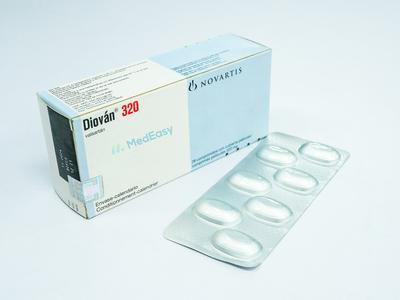
Diovan 320 mg
Valsartan
Category: Tablet
Manufacturer: Novartis (Bangladesh) Ltd.

Price: 1960.0 ৳
28's pack
7's Strip

Medicine Selling service is not available yet.
Related Medicines

Uses of Diovan:
- Hypertension (high blood pressure)
- Heart failure
- Prevention of heart attack and stroke
Heart failure, Hypertension, Post myocardial infarction
Hypersensitivity; severe hepatic impairment, cirrhosis or biliary obstruction; primary hyperaldosteronism. Pregnancy (2nd and 3rd trimesters) and lactation.
Angiotensin-ll receptor blocker
Valsartan is an oral medication that belongs to a class of drugs called angiotensin receptor blockers (ARBs). It is orally active and specific angiotensin II antagonist acting on the AT1 subtype. Angiotensin's attachment to the receptors cause the blood vessels to narrow (vasoconstrict) which leads to an increase in blood pressure (hypertension). Valsartan blocks the angiotensin II receptor. By blocking the action of angiotensin, Valsartan dilates blood vessels and reduces blood pressure without affecting pulse rate. Valsartan has much greater affinity (about 20,000-fold) for the AT1 receptor than for the AT2 receptor. It does not bind or block other hormone receptors or ion channels known to be important in cardiovascular regulation.
How to use
Valsartan:
Take this medicine in the dose and duration as advised by your doctor. Swallow it as a whole. Do not chew, crush or break it.
Valsartan may be taken with or without food, but it is better to take it at a fixed time.
Administration:
May be taken with or without food.
Adult Dose:
Oral
Hypertension
Adult: Initially, 80 mg once daily, may be increased to 160 mg once daily if needed. Max: 320 mg once daily.
Heart failure
Adult: Initially, 40 mg bid, may be increased to 160 mg bid if tolerated.
Post myocardial infarction
Adult: Start as early as 12 hr after MI in stable patients at an initial dose of 20 mg bid, doubled at intervals over a few wk up to 160 mg bid if tolerated.
Elderly: No dosage adjustment needed.
Hepatic impairment: Mild to moderate: Max: 80 mg once daily. Severe: Contraindicated.
Child Dose:
Oral
Hypertension
Child: As tab: >6 yr <35 kg: Initially, 40 mg once daily. Max: 80 mg once daily;
35-80 kg: Initially, 80 mg once daily. Max: 160 mg once daily;
>80 kg: Initially, 80 mg once daily. Max: 320 mg once daily.
Renal Dose:
Renal impairment
CrCl >30 mL/min: No dose adjustment necessary in adults
CrCl <30 mL/min: Use with caution in adults; not studied in children
May antagonise hypotensive effects and increase the risk of renal impairment w/ NSAIDs. Increased risk of hyperkalaemia w/ K-sparing diuretics, K supplements or K-containing salt substitutes.
Potentially Fatal: Increased risk of hypotension, hyperkalemia and changes in renal function (including acute renal failure) when used w/ aliskiren in patients w/ diabetes and renal impairment (GFR <60 mL/min).
Hypersensitivity; severe hepatic impairment, cirrhosis or biliary obstruction; primary hyperaldosteronism. Pregnancy (2nd and 3rd trimesters) and lactation.
Common
- Headache
- Dizziness
- Flu-like symptoms
- Stomach pain
- Decreased blood pressure
- Diarrhea
- Back pain
- Rash
- Increased creatinine level in blood
>10%
Dizziness (17%; heart failure),Increased blood urea nitrogen (BUN; 17%)
1-10%
Hyperkalemia (4-10%),Dizziness (2-8%; hypertension),Hypotension (1-7%; heart failure),Fatigue (3%),Viral infection (3%),Neutropenia (2%),Syncope (>1%),Upper abdominal pain (>1%),Vertigo (>1%)
Frequency Not Defined
Headache,Cough (rare)
Potentially Fatal: Blood dyscrasias (e.g. neutropenia).
Pregnancy: Valsartan should not be used in pregnancy, as in 2nd and 3rd trimester it can cause injury and even death to fetus. When pregnancy is detected, Valsartan should be stopped as soon as possible.Nursing mothers: It is not known whether Valsartan is excreted in human milk. Because of the potential for adverse effects on the nursing infant, a decision should be made whether to discontinue nursing or discontinue the drug, taking into account the importance of the drug to the mother.
Precaution:
Patients w/ renal artery stenosis, heart failure, aortic or mitral stenosis, severe Na and/or volume depletion. Renal and mild to moderate hepatic impairment. Lactation. Monitoring Parameters Monitor BP, electrolytes, renal function. Monitor serum K levels every dose increment and periodically thereafter.
Limited data are available related to overdosage in humans. The most likely manifestations of overdosage would be hypotension and tachycardia, bradycardia could occur from parasympathetic (vagal) stimulation. If excessive hypotension occurs, the patient should be placed in the supine position and if necessary, has to be given an intravenous infusion of normal saline.
Store between 15-30° C. Protect from moisture and heat.
Angiotensin-ll receptor blocker
Valsartan, an angiotensin II type 1 (AT1) receptor antagonist, produces its BP lowering effects by inhibiting angiotensin II-induced vasoconstriction, aldosterone release and renal reabsorption of Na.
Pregnancy: Valsartan should not be used in pregnancy, as in 2nd and 3rd trimester it can cause injury and even death to fetus. When pregnancy is detected, Valsartan should be stopped as soon as possible.Nursing mothers: It is not known whether Valsartan is excreted in human milk. Because of the potential for adverse effects on the nursing infant, a decision should be made whether to discontinue nursing or discontinue the drug, taking into account the importance of the drug to the mother.


Samm Care