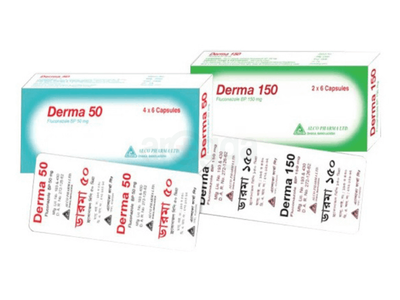
Derma 50 50mg
Fluconazole
Category: Capsule
Manufacturer: Alco Pharma Limited

Allopathic
MFG. Licence No. Biological
193
MFG. Licence No. Non-Biological
430
Address
House No. 3/B, Plot No. 33, Section-7, Mirpur, Dha
Price: 72.72 ৳
Strip
Capsule

Medicine Selling service is not available yet.
Related Medicines




Derma 50 a member of the triazole class of antifungal agents, is a potent and selective inhibitor of fungal enzymes necessary for the synthesis of ergosterol. Derma 50 is indicated for:
Vaginal candidiasis (acute or recurrent) Candidal balanitis: The treatment of partners who present with symptomatic genital candidiasis should be considered. ... Read moreDerma 50 a member of the triazole class of antifungal agents, is a potent and selective inhibitor of fungal enzymes necessary for the synthesis of ergosterol. Derma 50 is indicated for:
Vaginal candidiasis (acute or recurrent) Candidal balanitis: The treatment of partners who present with symptomatic genital candidiasis should be considered.
Mucosal candidiasis: These include oropharyngeal, oesophegeal, noninvasive bronchopulmonary infections, candiduria, mucocutaneous and chronic oral atrophic candidiasis (denture sore mouth). Normal hosts and patients with compromised immune function may be treated.
Tinea pedis, tinea cruris, tinea versicolor and dermal Candidial Infections: Derma 50 is also indicated for nail fungal infections.
Systemic candidiasis including candidaemia, disseminated candidiasis and other forms of invasive candidal infections of the peritoneum, endocardium and pulmonary and urinary tracts. Candidal infections in patients with malignancy, in intensive care units or those receiving cytotoxic or immunosuppressive therapy, may be treated.
Cryptococcosis, including cryptococcal meninigitis and infections of other sites (e.g. pulmonary cutaneous) normal hots and patients with acquired immune defciency syndrome (AIDS), organ transplants or other causes of immunosuppression may be treated. Derma 50 can be used as maintainance therapy to prevent relapse of cryptococcal disease in patients with AIDS.
For the prevention of fungal infections in immunocompromised patients considered at risk as a consequence of neutropenia following cytotoxic chemotherapy or radiotherapy, including bone marrow transplant patients.
Other uses:
Fungal urinary tract infections
Disseminated candidiasis
Prophylaxis for fungal infection in neutropenic cancer patients.
Acute treatment of other systemic fungal infections such as coccidioidomycosis and histoplasmosis.
Drugs for subcutaneous and mycoses
Fluconazole is a triazole antifungal agent. It is a potent inhibitor of fungal cytochrome P-450 dependent enzymes. Cytochrome P-450 enzyme system is essential component of fungal cell membrane which is responsible for the synthesis of ergosterol.
Adult (oral)-
Vaginal candidiasis: 150 mg as a single dose.
Oropharyngeal candidiasis: 200 mg on the first day, followed by 100 mg once daily. Clinical evidence of this infection generally resolves within several days, but treatment should be continued for at least 2 weeks to decrease the likelihood of relapse.
Esophageal candidiasis: 200 mg on the first day, followed by 100 mg once daily. Doses up to 400 mg/day may be used. Patients should be treated for a minimum of three weeks and for at least two weeks following resolution of symptoms.
Systemic candida infections: Optimal therapeutic dosage and duration of therapy have not been established. Sometimes, doses of up to 400 mg daily have been used.
Urinary tract infections caused by candida and peritonitis: 50-200 mg daily have been used.
Cryptococcal meningitis: 400 mg on the first day, followed by 200 mg once daily.
Prophylaxis in patients undergoing bone marrow transplantation: 400 mg once daily.
Child (oral):
Doses of 3-6 mg/kg daily have been used. Doses up to 12 mg/kg is recommended.
Intravenous-
Adult: Invasive candidal infections including candidaemia and disseminated candidiasis and cryptococcal infections including meningitis, by IV, 400 mg initially then 200 mg daily, increased if necessary to 400 mg daily, treatment continued according to response (at least 6-8 weeks for cryptococcal meningitis)
Child: 6-12 mg/kg daily (every 72 hours in neonate up to 2 weeks old, every 48 hours in neonate 2-4 weeks old); maximum 400 mg daily. Prevention of relapse of cryptococcal meningitis, by IV, 100-200 mg daily.
In an interaction study, fuconazole increased the prothombin time after warfarin administration in healthy males. Though the magnitude of change was small (12%) careful monitoring of prothombin time in patients receiving coumarin type anticoagulants is recommended.Fluconazole has been shown to prolong the serum half-life of concomitantly administed oral sulphonyl ureas (chlorpropamide, gilbenclamide, glipizide and tolbutamide) in healthy volunteers. Fluconazole and oral sulphonylureas may be co-administered to diabetic patients, but the possibility of a hypoglycemic episode should be borne in mind.In a kinetic interaction study, co-administration of multiple-dose hydrochlorothiazide to healthy volunteers receiving fuconazole increased plasma concentrations of fuconazole by 40%. An efect of this magnitude should not necessitate a change in the fuconazole dose regimen in subjects recieving concomitant diureties, although the prescribers should bear it in mind.Concomitant administration of fuconazole and phenytoin may increase the level of phenytoin to a clinically signifcant degree. Administration of fuconazole and rifampicin has resulted in a 25% decrease in the AUC and 20% shorter half-life of fuconazole. Patients recieving concomitant rifampicin, an increase in the fuconazole dose should be considered.Two kinetic studies with combined oral contraceptive have been performed using muitiple dose of fuconazole. There were no relevant efects on either hormone level in the 50 mg fuconazole study, while at 200 mg daily the AUCs of ethinyl estradiol and levonorgestrel were increased 40% and 4% respectively. Thus multipule dose use of fuconazole at these dose is unlikely to have an efect on the efcacy of the combined oral contraceptives. Fluconazole 50 mg daily does not afect endogenous steroid levels in females. 200-400 mg daily has no clinically singnifcant efect on endogenous steroid levels or on ACTH stimulated response in healthy male volunteers.A kinetic study in renal transplant patients found fuconazole 200 mg daily to slowly increase cyclosporin concentrations. However, in another multiple dose study with 100 mg daily, fuconazole did not afect cyclosporin levels in patients with bone marrow transplants. Cyclosporin plasma concentration monitoring in patients receiving fuconazole is recommended.Interaction studies have shown that when oral fuconazole is co-administered with food. cemetidine, antacids or following total body irradiation for bone marrow transplantation, no clinically signifcant impairment of fuconazole absorption occurs.In placebo-controlled interaction study, the administration of fuconazole 200mg for 14 days resulted in an 18% decrease, in the mean plasma clearance of theophyline, Patients who are receiving dose of theophyline or who are otherwise at increased risk for theophyline toxicity should be observed for sign of toxicity while receiving fuconazole, and the therapy modifed appropriately if sign of toxicity while receiving fuconazole, and the therapy modifed appropriately if sign of toxicity develop.Physicians should be aware that drug-drug interaction studies with other medications have not been conducted, but that such interactions may occur.
Fluconazole should not be used in patients with known hypersensitivity to Fluconazole or to related triazole compounds.
Fluconazole is generally well tolerated. The commonest side-efects associated Fluconazole are symptoms associated with the gastrointestinal tract; these include nausea, abdominal discomfort, diarrhoea and fatulence. Other adverse events such as rash are rarely encountered (Incidence less than 1%). In rare cases, as with other azoles, anaphylaxis has been reported.
US FDA Pregnancy category of Fluconazole is C. So, Fluconazole should be avoided in pregnancy and lactation unless the potential benefits to the other outweigh the possible risks to the fetus.
in some patients, particularly those with serious underlying diseases such as AIDS and cancer, abnormalities of hepatic, renal, haematological and other biochemical function tests have been observed during treatment with fuconazole, but the clinical signifcance and relationship to treatment is uncertain. Very rarely. patients who died with severe underlying disease and who had received multiple dose fuconazole, had post-mortem fndings which included hapatic necrosis. These patients were receiving multiple concomitant medications, some known to be potentially hepatotoxic, and/or had underlying diseases, which could have caused the hepatic necrosis. Consequently, because a causal relationship with fuconazole cannot be excluded, the risk-beneft ratio of continued fuconazole treatment should be assessed in those patients in whom a signifcant rise of liver enzymes occurs.Patients have rarely developed exfoliative cutaneous reactions, such pa Stevens Johnson Syndrome and toxic epidermal necrolysis, during treatment with fuconazole. AIDS patients are more prone to the development of severe cutaneous reactions to many drugs. If a rash develops in a patients treated for a superfaclal fungal infection which is considered attributable to fuconazole further therapy with this agent should be discontinued. In patients with invasive/ systemic fungal infections who develop rashes, they should be monitored closely and fuconazole should be discontinued if bolbous lesions or erythema multiform develop.Use during lactation: Fluconazole is found in human breast milk at concentrations similar to plasma. hence its use in nursing mothers is not recommended.Driving/Use of machinery: Experience with fuconazole indicates that therapy a unlikely to impair a patient's ability to drive or use machinery.
In the event of overdosage, supportive measures and symptomatic treatment with gastric lavage if necessary may be adequate. As fuconazole is excreted largely in the urine, forced volume diuresis would probably increase the elimination rate. A three hour session of haemodialysis decreases plasma levels by approximately 50%
Keep in a dry place away from light and heat. Keep out of the reach of children.
Drugs for subcutaneous and mycoses
Fluconazole is a triazole antifungal agent. It is a potent inhibitor of fungal cytochrome P-450 dependent enzymes. Cytochrome P-450 enzyme system is essential component of fungal cell membrane which is responsible for the synthesis of ergosterol.
Fluconazole adverse fetal efects have been seen in animals only at dose levels associated with maternal toxicity. These levels are many times in excess of those recommended for therapeutic use. There has been little use during human pregnancy. Accordingly, fuconazole should not be used in pregnancy or in women of child bearing potential unless adequate contraception is employed.


Samm Care