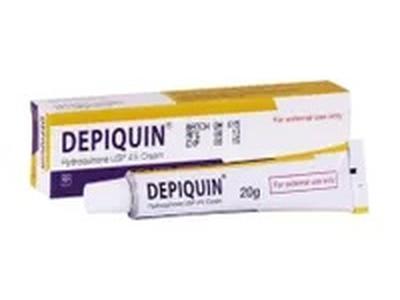
Depiquin 4%
Hydroquinone
Category: Cream
Manufacturer: Unimed Unihealth MFG. Ltd.

Price: 200.0 ৳
20 gm tube

Medicine Selling service is not available yet.
Related Medicines

Uses of Depiquin:
- Melasma
Chloasma, Melasma, Freckles, Senile lentigines, Hyperpigmentation
Depiquin is contraindicated to patients with prior history of hypersensitivity or allergic reaction to hydroquinone or other ingredients in the preparation.
Hydroquinone Preparations
Hydroquinone is a topical depigmentating agent that produces a reversible depigmentation of the skin by inhibiting enzymatic oxidation of tyrosine to 3,4-dihydroxyphenylalanine and suppressing melanocyte metabolic processes.
How to use
Hydroquinone:
This medicine is for external use only. Use it in the dose and duration as advised by your doctor. Check the label for directions before use. Clean and dry the affected area and apply the cream. Wash your hands after applying, unless hands are the affected area.
Administration:
Hydroquinone should be applied to the affected area and rubbed in well. Most discolorations begin to lighten after 4 weeks of treatment but it may take longer. After desired bleaching, use only as needed to maintain results of treatment.
Hydroquinone bleaching is faster, more dependable and easier if the treated area is protected from ultraviolet light. Therefore, exposure to sunlight should be minimized at the period of treatment.
During day, an effective broad-spectrum sunscreen should be used, unnecessary solar exposure should be avoided and protective clothing should be used to prevent repigmentation of treated areas.
After reduction of hyperpigmentation, use of sunscreen agents and/or protective clothing should continue.
Adult Dose:
Topical/Cutaneous
Hyperpigmentated skin conditions
Adult: Apply and rub in a thin layer preparation to affected area bid.
Child Dose:
Safety and efficacy in paediatric patients below the age of 12 years have not been established.
Hydroquinone is contraindicated to patients with prior history of hypersensitivity or allergic reaction to hydroquinone or other ingredients in the preparation.
Common
- Erythema (skin redness)
- Dry skin
- Skin burn
- Skin peeling
- Itching
Mild skin irritation and sensitization (burning, stinging, and allergic dermatitis)
Dryness and fissuring of paranasal and infraorbital,Ochronosis
Colloid milium (after chronic use of up to 8 years)
Pregnancy Category C. Either studies in animals have revealed adverse effects on the foetus (teratogenic or embryocidal or other) and there are no controlled studies in women or studies in women and animals are not available. Drugs should be given only if the potential benefit justifies the potential risk to the foetus.Lactation: It is not known whether topical hydroquinone is absorbed or excreted in human milk. Caution is advised when topical hydroquinone is used by a nursing mother.
Precaution:
Hydroquinone is a skin bleaching agent which may produce unwanted cosmetic effects if not used as directed. The physician should be familiar with the contents of this insert before prescribing or dispensing this medication.Test for skin sensitivity before using by applying a small amount to an unbroken patch of skin to check in 24 hours. Minor redness is not a contraindication, but where there is itching or vesicle formation or excessive inflammatory response, further treatment is not advised. If no bleaching or lightening effect is noted after 2 months of treatment, the medication should be discontinued.Contact with the eyes and lips should be avoided. Hydroquinone should not be applied to cut or abraded skin.
Lactation: unknown if distributed in breast milk; use caution
There have been no systemic reactions from the use of topical hydroquinone. Some patients may experience a transient reddening of skin and mild burning sensation which does not preclude treatment.
Store between 20-25° C. Protect from light.
Hydroquinone Preparations
Hydroquinone is a topical depigmentating agent used in hyperpigmentation conditions by suppressing melanocyte metabolic processes. It also increases melanin excretion from melanocytes and prevents its production.
Pregnancy Category C. Either studies in animals have revealed adverse effects on the foetus (teratogenic or embryocidal or other) and there are no controlled studies in women or studies in women and animals are not available. Drugs should be given only if the potential benefit justifies the potential risk to the foetus.Lactation: It is not known whether topical hydroquinone is absorbed or excreted in human milk. Caution is advised when topical hydroquinone is used by a nursing mother.


Samm Care