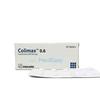
Cryscol 6 mg
Colchicine
Category: Tablet
Manufacturer: Popular Pharmaceuticals Ltd.


Medicine Selling service is not available yet.
Related Medicines
Uses of Cryscol:
- Gout
Acute gout, Familial Mediterranean Fever, Behcet's disease, Gouty arthritis
Hypersensitivity; blood dyscrasias, severe renal impairment, pregnancy, debilitated patients; SC/IM admin.
Drugs used in Gout
An acute attack of gout apparently occurs as a result of an inflammatory reaction to crystals of monosodium urate that are deposited in the joint tissue from hyperuric body fluids; the reaction is aggravated as more urate crystals accumulate. Leukocytes migrate to the sites where urate crystals have been deposited and try to engulf the crystals by phagocytosis. As a result lactic acid and proinflammatory enzymes are released which cause inflammation with severe pain, redness, and swelling of the affected joint. Lactic acid favors a local decrease in pH that enhances uric acid deposition. Colchicine inhibits the phagocytosis of uric acid by leukocytes & also diminishes the lactic acid production directly. Thus interrupts the cycle of urate crystal deposition and inflammatory response that sustains the acute attack of gout. Colchicine is absorbed when given orally, reaching a mean Cmax of 2.5 ng/mL (range 1.1 to 4.4 ng/mL) in 1 to 2 hours after a single dose administered under fasting conditions. The mean apparent volume of distribution is approximately 5 to 8 L/kg. Colchicine binding to serum protein is low (39 ± 5%), primarily to albumin regardless of concentration. CYP3A4 is involved in the metabolism of Colchicine to 2-O-demethylcolchicine and 3-O-demethylcolchicine. Plasma levels of these metabolites are minimal (less than 5% of parent drug). Following multiple oral doses (0.6 mg twice daily), the mean elimination half-life is 26.6 to 31.2 hours.
How to use
Colchicine:
Take this medicine in the dose and duration as advised by your doctor. Swallow it as a whole. Do not chew, crush or break it.
Colchicine may be taken with or without food, but it is better to take it at a fixed time.
Administration:
Should be taken with food.
Adult Dose:
Gout
Treatment of acute gout flares (Colcrys): 1.2 mg PO at first sign of flare, then 0.6 mg 1 hr later; not to exceed 1.8 mg in 1-hr period
Prophylaxis (Colcrys, Mitigare): 0.6 mg PO once daily or q12hr; not to exceed 1.2 mg/day; after gout flare, wait 12 hr to continue prophylaxis
Familial Mediterranean Fever
Colcrys: 1.2-2.4 mg/day PO in single daily dose or divided q12hr; increased in 0.3 mg/day increments as necessary to control disease; decreased in 0.3 mg/day increments if intolerable side effects develop; not to exceed 2.4 mg/day
Hepatic impairment (gout)
Mild to moderate: Dosage adjustment not necessary; monitor patients for adverse effects
Severe: Dosage adjustment not necessary; do not repeat more frequently than every 2 weeks; consider alternative therapy if repeated courses are required
Hepatic impairment (familial Mediterranean fever)
Mild to moderate: Monitor patients for adverse effects
Severe: Consider dosage reduction; do not repeat more frequently than every 2 weeks
Child Dose:
Gout
<16 years
Not recommended
>16 years
Treatment of acute gout flares: 1.2 mg PO at first sign of flare, then 0.6 mg 1 hr later; not to exceed 1.8 mg in 1-hr period
Prophylaxis: 0.6 mg PO once daily or q12hr; not to exceed 1.2 mg/day; after gout flare, wait 12 hr to continue prophylaxis
Familial Mediterranean Fever
<4 years: Safety and efficacy not established
4-6 years: 0.3-1.8 mg/day PO in single daily dose or divided q12hr
6-12 years: 0.9-1.8 mg/day PO in single daily dose or divided q12hr
>12 years: 1.2-2.4 mg/day PO in single daily dose or divided q12hr
Renal Dose:
Renal impairment (gout)
Mild (CrCl 50-80 mL/min) and moderate (CrCl 30-50 mL/min): Dosage adjustment not necessary; monitor patients for adverse effects
Severe (CrCl <30 mL/min): Dosage adjustment not necessary; do not repeat more frequently than every 2 weeks
Hemodialysis: 0.6 mg once; do not repeat more frequently than every 2 weeks
Renal impairment (familial Mediterranean fever)
Mild (CrCl 50-80 mL/min) and moderate (CrCl 30-50 mL/min): Monitor patients for adverse effects; dosage adjustment may be required
Severe (CrCl <30 mL/min): 0.3 mg/day initially; dosage increases should be done with adequate monitoring for adverse effects
Hemodialysis: 0.3 mg PO once; dosage increases should be done with adequate monitoring for adverse effects
Reversible malabsorption of vitamin B12 may occur because of ileal mucosal function alteration. Response to CNS depressants and sympathomimetics may increase when used concurrently with colchicine. Increased risk of myopathy when used concurrently with simvastatin.
Potentially Fatal: With ciclosporin, increased risk of nephrotoxicity and myotoxicity. Risk of colchicine toxicity when used with macrolides.
Hypersensitivity; blood dyscrasias, severe renal impairment, pregnancy, debilitated patients; SC/IM admin.
Common
- Nausea
- Vomiting
- Abdominal pain
>10%
Gastrointestinal (GI) effects (eg, diarrhea, nausea, cramping, abdominal pain, vomiting) (26-77%)
1-10%
Fatigue (1-4%),Gout (0-4%),Pharyngolaryngeal pain (2-3%),Headache (1-2%)
Pregnancy Category C. There are no adequate and well-controlled studies with Colchicine in pregnant women. Colchicine is excreted into human milk. Caution should be exercised when administered to a nursing woman.
Precaution:
Elderly; GI disease. Cardiac, renal and hepatic impairment; prolonged therapy not recommended; lactation.
Lactation: Drug enters breast milk; use with caution (American Academy of Pediatrics Committee states that drug is "compatible" with nursing)
The exact dose of colchicine that produces significant toxicity is unknown. Fatalities have occurred after ingestion of a dose as low as 7 mg over a 4-day period, while other patients have survived after ingesting more than 60 mg. A review of 150 patients who overdosed on colchicine found that those who ingested less than 0.5 mg/kg survived and tended to have milder toxicities, such as gastrointestinal symptoms, whereas those who took 0.5 to 0.8 mg/kg had more severe reactions, such as myelosuppression.
Store below 30°C temperature. Protect from light and moisture. Keep the medicine out of reach of children.
Drugs used in Gout
Colchicine, a phenanthrene derivative, exerts its effect by reducing the inflammatory response to the deposited urate crystals and also by diminishing phagocytosis in joints. It inhibits lactic acid production by leucocytes, thereby interrupting urate deposition and inflammatory response that sustains the acute gout attack.
Pregnancy
Available human data from published literature on colchicine use in pregnancy over several decades have not identified any drug-associated risks for major birth defects, miscarriage, or adverse maternal or fetal outcomes
Lactation
Colchicine is present in human milk
No adverse events in breastfed infants in the published literature after administration of colchicine to lactating women
No data available on the effects of colchicine on milk production
Consider developmental and health benefits of breastfeeding along with the mother’s clinical need for the drug, and any potential adverse effects on the breastfed infant from the drug or from the underlying maternal condition
Infertility
Case reports and epidemiology studies in males on colchicine therapy indicate that infertility from colchicine is rare and may be reversible

Samm Care